
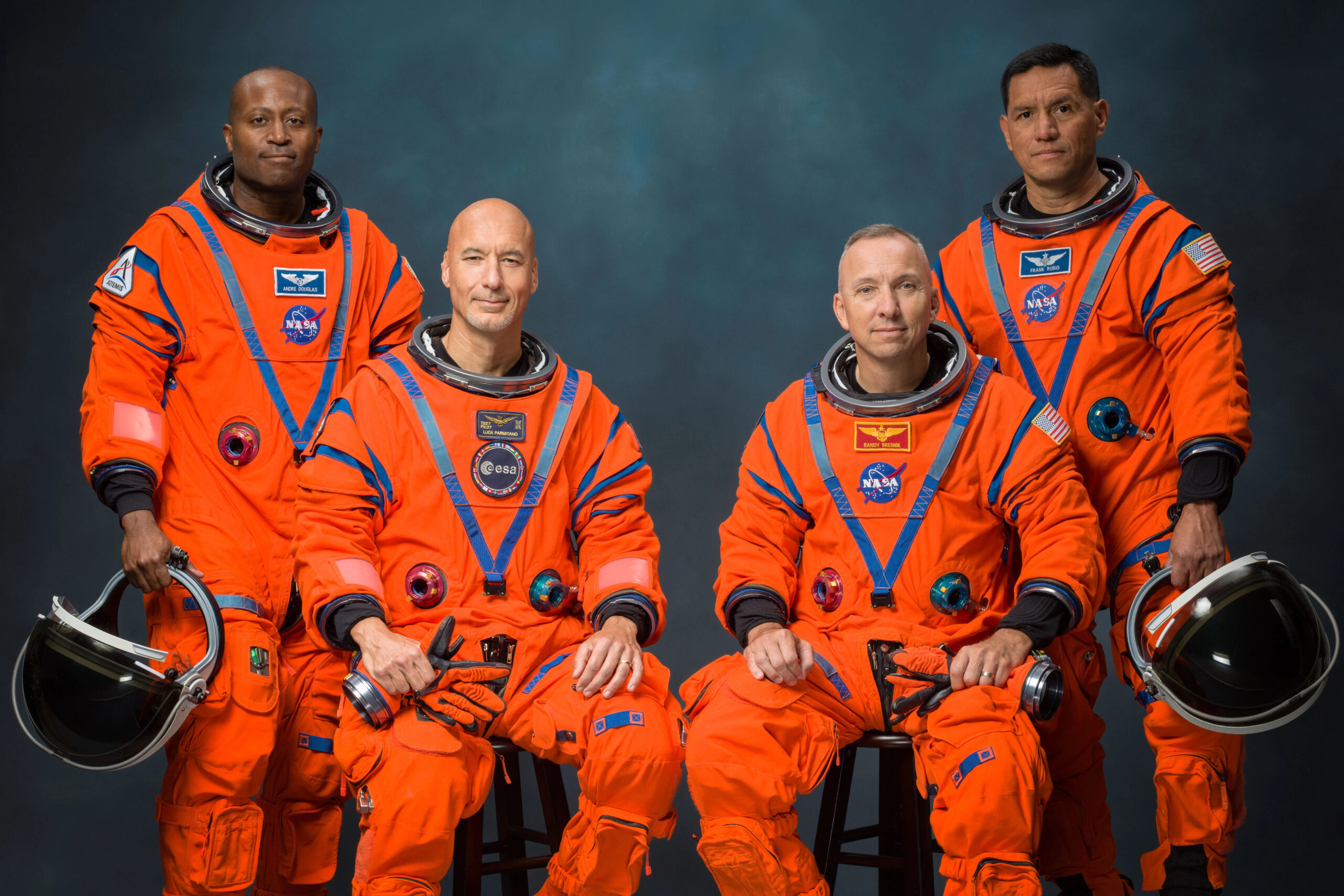
The crew will be made up of mission specialists Andre Douglas, an engineer, and Frank Rubio, an aviation doctor of Salvadoran origin.
Italian Luca Parmitano, from the Italian Space Agency, will serve as pilot, while Randy Bresnik, former commander of the International Space Station, will lead the mission as commander.
The announcement took place during an event at the Johnson Space Center in Houston, in which the directors of NASA were present, along with representatives of the companies Blue Origin, owned by tycoon Jeff Bezos, and SpaceX, owned by billionaire Elon Musk, who are developing different systems for the mission.
Artemis III will involve a test flight in Earth orbit with the objective of testing and validating the technologies, tools and procedures that will be used in future manned missions to the Moon.
“We are returning to the Moon, a great adventure to build a lunar base and develop its full scientific and economic potential, in addition to mastering the skills necessary for the next destination to which we will inevitably go,” said NASA Administrator Jared Isaacman during the team’s presentation event.
The mission will test for the first time the Orion spacecraft’s ability to dock in space with test versions of the landers being developed by Blue Origin and SpaceX.
The plan includes several launches in a short period of time, including NASA’s SLS rocket and vehicles from both private companies.
Artemis III will last approximately two weeks, about four days longer than the Artemis II mission, which flew over the Moon this year, and is intended to be the last major test mission of the Artemis program.
If it meets its objectives, NASA expects Artemis IV – scheduled for 2028 – to mark the return of astronauts to the lunar surface, according to Jeremy Parsons, deputy head of the agency’s Moon-Mars program.
“We want to test everything we can about how we operate with our commercial partners, between systems, equipment, software and hardware, in the difficult environment of space. We want to do it in Earth orbit before returning to the Moon and establishing a permanent presence there,” Parsons said.
During the mission, Orion will dock first with a Blue Origin test module for about two days and then with a test version of SpaceX’s Starship for about a day. Astronauts will conduct technology demonstrations and evaluate critical systems, including life support systems.
The official also added that Artemis III will serve to “reduce the risks” of future manned lunar missions, “with the goal of returning the US to the Moon before China.”
Problems with BlueOrigin
Today’s announcement comes two weeks after one of Blue Origin’s rockets exploded during an engine test flight at the Space Force Station in Florida, causing serious damage to the ship and launch pad.
Parson acknowledged in his speech that there are still “questions” about how these “anomalies” from Bezos’ company “are going to impact (NASA’s) plans.”
However, the official indicated that the agency has “full confidence” that the New Glenn rocket will be ready on time. “Setbacks are a learning opportunity,” he added.
An idea that was reinforced by John Couluris, one of the directors of Blue Origin, who pointed out that the company’s factories are working “24-hour shifts” to fulfill the mission.
Artemis IV, scheduled for 2028, seeks to return astronauts to the lunar surface for the first time since Apollo 17 in 1972, and is part of the US strategy to establish a sustained human presence on the Moon and advance towards future missions to Mars.