
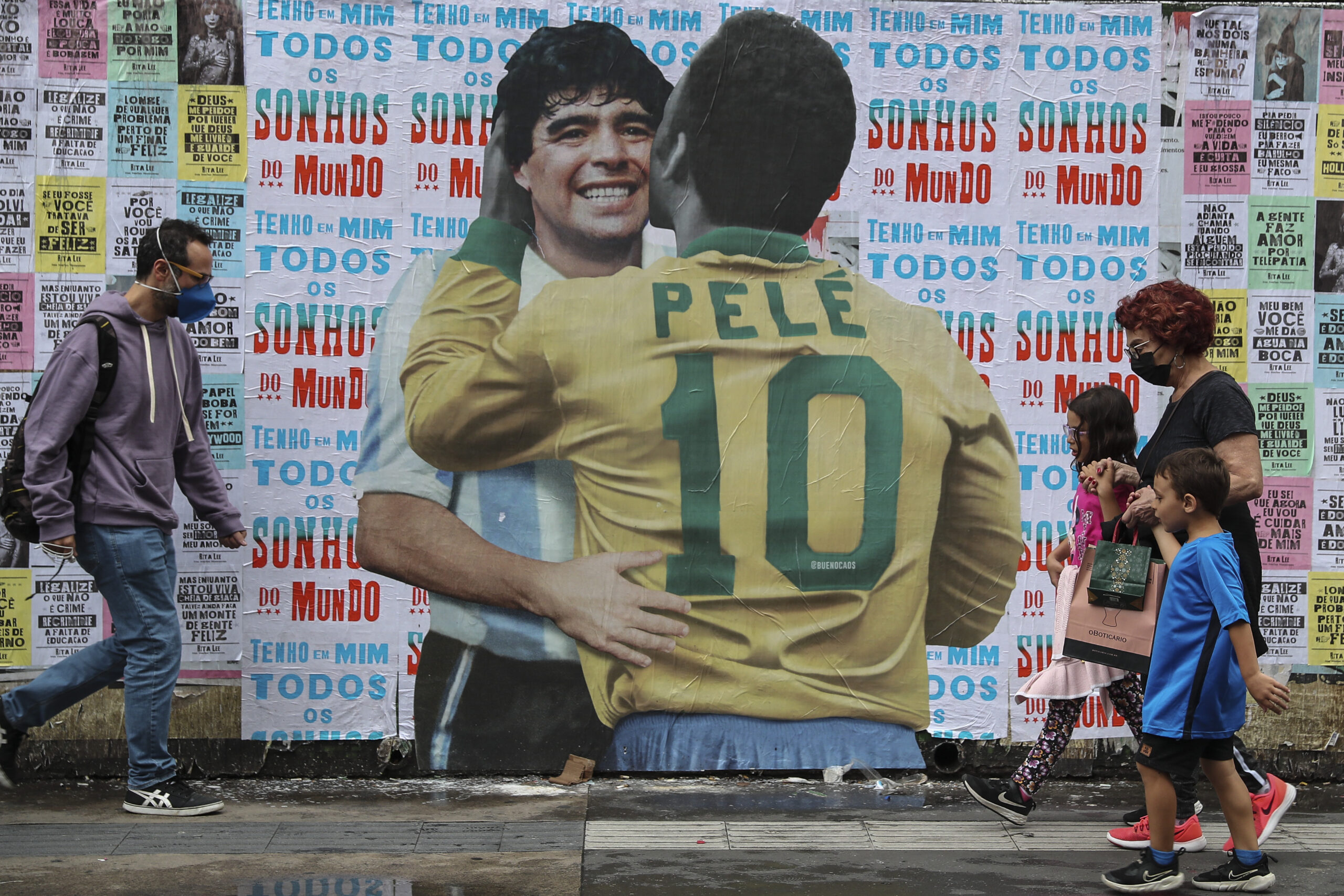
This June 11, when the Mexico City Stadium, formerly the Azteca Stadium, opens a World Cup for the third time in history, FIFA will pay tribute to Diego Armando Maradona and Pelé, whose full name was Edson Arantes do Nascimento.
The same stage where Maradona lifted the World Cup on June 29, 1986 will once again evoke his figure, this time as part of the historical memories of world football.
Pelé, for his part, had already turned the Azteca Stadium into one of the most emblematic venues in the history of the World Cup in 1970, when he won his third and last world title. In the final on June 21 of that year, Brazil defeated Italy 4-1 at the Coloso de Santa Úrsula with one of the most outstanding teams in the history of football.
Years later, Pelé would reflect on the enormous pressure he was under: “We had a fantastic team and everyone expected us to win, which made me shake. I was very nervous and under a lot of pressure… We felt that we simply had to win the title.”
That afternoon, Pelé won his third world title on the same stage where, 16 years later, Diego Armando Maradona would lift the World Cup with Argentina.
This June 11, both will be honored by FIFA in the only stadium that has hosted three World Cup openings.
In his autobiography I am the Diego of the peopleMaradona dedicates the chapter “La Gloria” to narrating the path that led him to that afternoon in the then Azteca Stadium. It is not just a story of games. It is the story of a commitment forged years before.
“For me, the World Cup in Mexico ’86, the greatest sporting joy of my entire career, had actually started three years earlier,” he writes.
He tells how coach Carlos Bilardo personally sought him out in Lloret de Mar, Spain, in January 1983, while he was recovering from hepatitis. Bilardo ran with him along the beach and proposed to him to be captain of the National Team.
Diego, at 24 years old, cried and told Claudia Villafañe, his wife at the time, and his mother. “It was what I had always dreamed of being,” he says. And he took it on with everything: “Everything, everything for the National Team, for the light blue and white.”
The book details the previous journey: extensive tours, trips of thousands of kilometers by car and plane, games every three or four days and precarious hotels.
“Madness. Madness? Justified madness,” he reflects.
That dedication forged the team that arrived in Mexico with few favoritism, but with a union born “from the anger.” On June 29, 1986, after the final whistle against Germany, Maradona describes the climactic moment:
“June 29, 1986, Azteca stadium, Mexico; that date and that place are marked on my skin. The Cup in my hands, I shook it, lifted it, kissed it… I wanted to make sure it was real.”
In the final pages of the chapter, the reflection becomes more intimate. Maradona talks about the crowd in Buenos Aires, the balcony of Doña Tota’s house, his mother, the dreams fulfilled and, at the same time, the feeling that “all that was too much.”
He was the kid from Fiorito who conquered the world and felt the weight of being, forever, “the Diego of the people.”
This June 11, just over 40 years after that final, the Mexico City Stadium – the first venue to host three World Cup openings, in 1970, 1986 and 2026 – will once again occupy a central place in the history of the World Cup. FIFA confirmed that the opening match of the 2026 World Cup will be Mexico against South Africa, in that stadium.
The organization has also highlighted the historical value of the venue, where Pelé and Maradona lived some of their most important moments in the World Cup.
Beyond the goals—the Hand of God and the Goal of the Century—the legacy that resonates is that of the captain who turned adversity into momentum. The one who prioritized the National Team above all else. The one who, in his own words, felt that “our strength and our union had been born precisely from there, from the anger.”
When the starting whistle of the 2026 World Cup blows, the Mexico City Stadium will not only inaugurate a new tournament. He will also remember the Argentine number 10 who became an immortal football figure there.