
The actors involved in the implementation of the anti-money laundering law in Guatemala are awaiting the ongoing administrative process. for its entry into force within the national legal framework.
Susan Paola Rojas, advisor to the Banking School of Guatemala, attached to the Banking Association of Guatemala (ABG), explained that the expectation is that the country faces one of the most strategic and important challenges: turning the law into a reality through an implementation that demonstrates the national commitment and the existence of the necessary elements to adequately combat money laundering and the financing of terrorism (ML/FT).
He anticipated that, although the Congress of the Republic approved the new law on June 2, “there is still, obviously, a lot to do to be able to completely get out of this gray shadow that gives us a bad rating from the FATF.”
After the approval of the law, the regulatory process corresponds so that, when the auditors of the Gafilat (Financial Action Group of Latin America) visit Guatemala in February 2027, the country has an implemented law and can avoid adverse consequences.
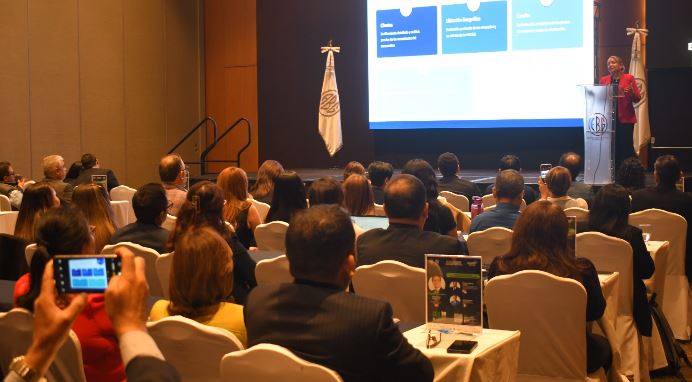
Rojas participated this Tuesday, June 16, as a speaker at the event “Comprehensive Law for the Prevention and Repression of Money Laundering or other Assets and the Financing of Terrorism: Impact and Perspectives for the Financial Ecosystem of Guatemala – Decree 15-2026”, organized by the ABG.
IVE prepares regulations for new law
Regarding the regulatory process, Rojas emphasized that it largely depends on the effort made, first, for the official publication of the law and for the three months (90 days) to pass before its entry into force.
Subsequently, the work of the Special Verification Intendancy (IVE) will also be decisive to send the Executive a previously agreed upon regulation, so that it can be implemented in the best way and in the shortest possible time.
He stressed that “we still have important challenges ahead so that we can fulfill the purpose of being able to be out of the risk of being on a gray list.”
Law maintains obligations for notaries
Rojas also addressed the institutional position adopted last week by the College of Lawyers and Notaries of Guatemala regarding the law.
He recalled that “something that is very important to take into consideration is that Notaries are not new regarding the regulation established to take measures against LDFT.”
“They—notaries—were already included in the regulations of the anti-money laundering law since 2005 and their obligations were already posed from the perspective of being able to know their clients and give notices in the event of detecting unusual operations,” he stressed.
For now, he explained that does not know what the procedure could be of the College of Lawyers and Notaries. In any case, “I would hope that there is a very accurate and careful analysis in relation to what the arguments would be to present legal measures and that this could not lead to having to lose all the work that has been done for the rest of the law, but most likely for specific articles.”
In any case, it will be important to know the specific arguments presented by the College of Lawyers and Notaries.
He insisted that, in any case, in current law they already had established obligations to know their clients and give notices if they detected operations that were unusual to them.