
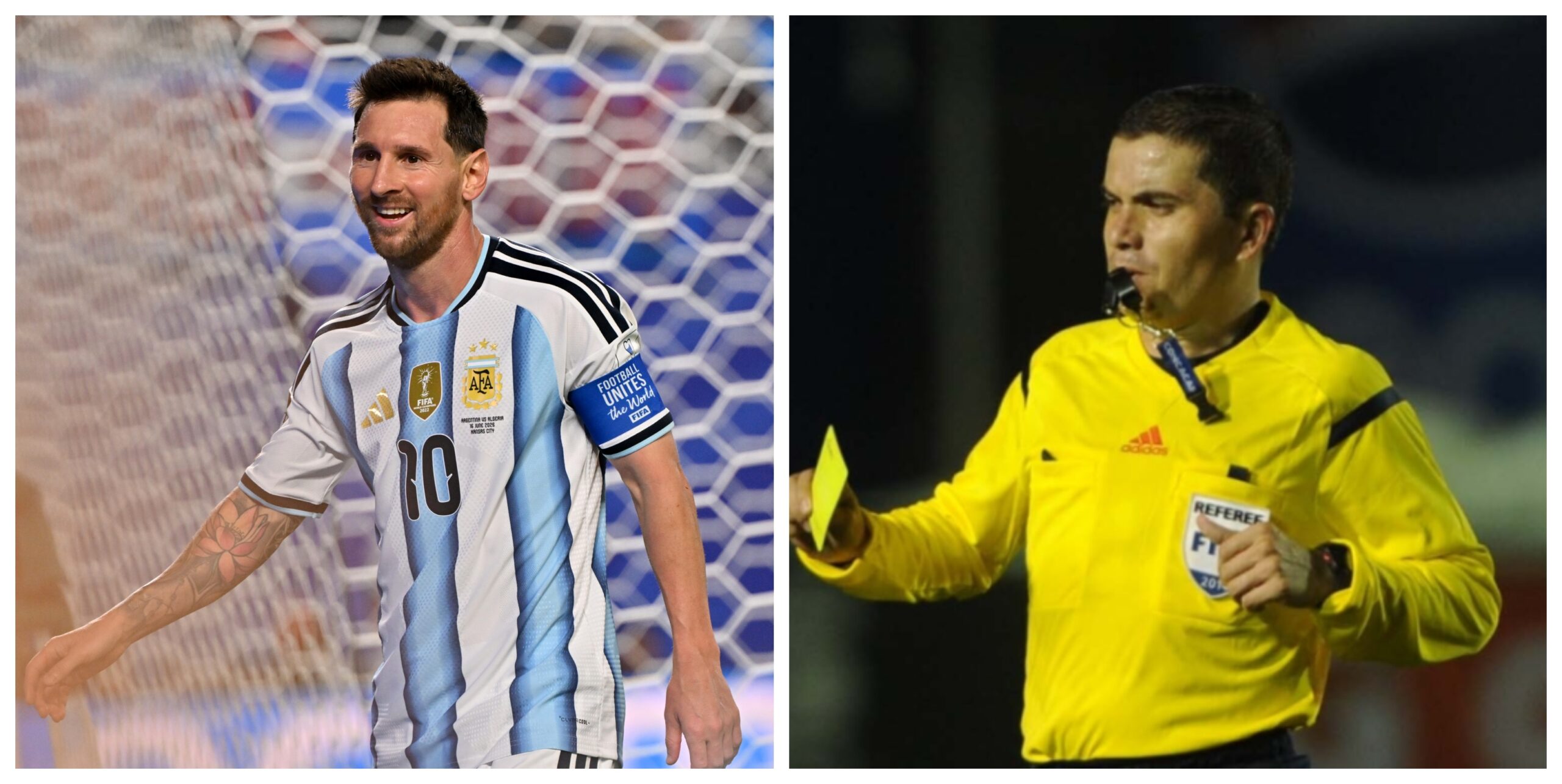
The selection of Argentina began the defense of its world title with a firm step by beating Algeria 3-0, in a match in which Lionel Andrés Messi He was the figure when he signed a hat trick and extended his scoring record in the World Cups.
The Albiceleste captain appeared in the key moments of the match and scored against the minutes 17, 60 and 76 to guide his team to an easy victory. Beyond the result, a play starring Messi generated the main controversy of the night.
After his first goal, the Argentine star was involved in a split action with Algerian defender Aïssa Mandi. In the dispute for the ball, Messi made a tackle with the sole of his foot that impacted a sensitive area of the rival, which caused his immediate fall and complaints from the African bench.
Polish referee Szymon Marciniak, rKnown for directing the final of the 2022 World Cup in Qatar, he only sanctioned the foul, without showing a card. Despite the harshness of the action, the VAR did not intervene or suggest a reviewwhich sparked questions about the application of the regulation.
Prensa Libre consulted former Guatemalan referee Jonathan Polanco, who spent 15 years as a federated referee. His performance during that period allowed him to project himself internationally and obtain the FIFA badge for four years. Polanco analyzed the play from a technical and disciplinary point of view.
Was the arbitration decision correct?
Polanco explained that the referee’s first step was correct when sanctioning the infraction:
“Yes, in that case, the referee is correct in sanctioning the infraction. Let us remember that the referee’s decision-making takes place in different steps and phases. The first thing is to establish whether an action by a player entails being sanctioned as an infraction, whether it is something that contravenes the rules of the game. The referee establishes it that way,” he expressed.
However, the analysis points to an error in the second phase: the disciplinary sanction.
Was it a red card play?
The former referee was clear in pointing out that the action should have been punished with expulsion, based on the nature of the foul: “The next step is where one of the first critical errors of this action occurs, which is when the referee has to take the disciplinary sanction. In this case, since it is an isolated foul, we focus on the nature of the infraction, and the critical thing is that the referee demonstrates a failure in classifying the violent nature of this foul,” he noted.
Polanco explained that the play meets all the criteria for serious rough play: “All the elements fit perfectly for the action to be classified as serious rough play, and rule 12 immediately translates it into a red card.. Because? Because we have to look at the contact zone, which is direct to a soft area of the body, with a high risk of causing injury to the opponent, specifically in the Achilles heel,” he expressed.
Furthermore, he emphasized the key element that determines severity: “Is the opponent’s physical integrity at risk? If the answer is yes, the action automatically has to be classified as a red card,” he pointed out.
Did you see the game? Messi’s foul ignited the #Debate in networks. Many ask #RedCard reminding other players of punishments. What do you think? pic.twitter.com/AeJoktIfnh
— Info Primicias (@infoprimiciasec) June 17, 2026
The role of VAR in the controversy
Another critical point was the inaction of the video refereeing, despite the fact that there were clear repetitions of the play.
“There is also complicity on the part of the video referee, because there are compelling elements. There is a conclusive image that the referee could have analyzed to prevent the error from being consummated. It is an action that can be classified as expulsion,” he said.
For Polanco, the technological tool did not fulfill its function in this case.
Did the context or Messi’s name influence it?
The analysis also opens the door to interpretations about whether the Argentine player’s prominence influenced the decision:
“It is a very subjective situation. In the end, everyone is going to draw their own conclusions. “The angle of vision of the referee or possible visual interference can be analyzed, but if Messi’s name weighed, it is already a subjective issue.”he pointed out.
The use of new technologies, such as RefCam, could provide more elements to evaluate what happened from the perspective of the central referee.
Why didn’t the VAR intervene?
Finally, the former referee explained how the VAR works and made it clear that the final decision always falls to the central judge:
“Video refereeing has been inconsistent. It is a tool that is within the reach of the referee to make value judgments, but the one who makes the final decision is the main referee of the game,” express.
Argentina began its World Cup journey with a solid victory and an outstanding performance by Messi, but the play with Mandi keeps the debate open as to whether it was expulsion or not.