
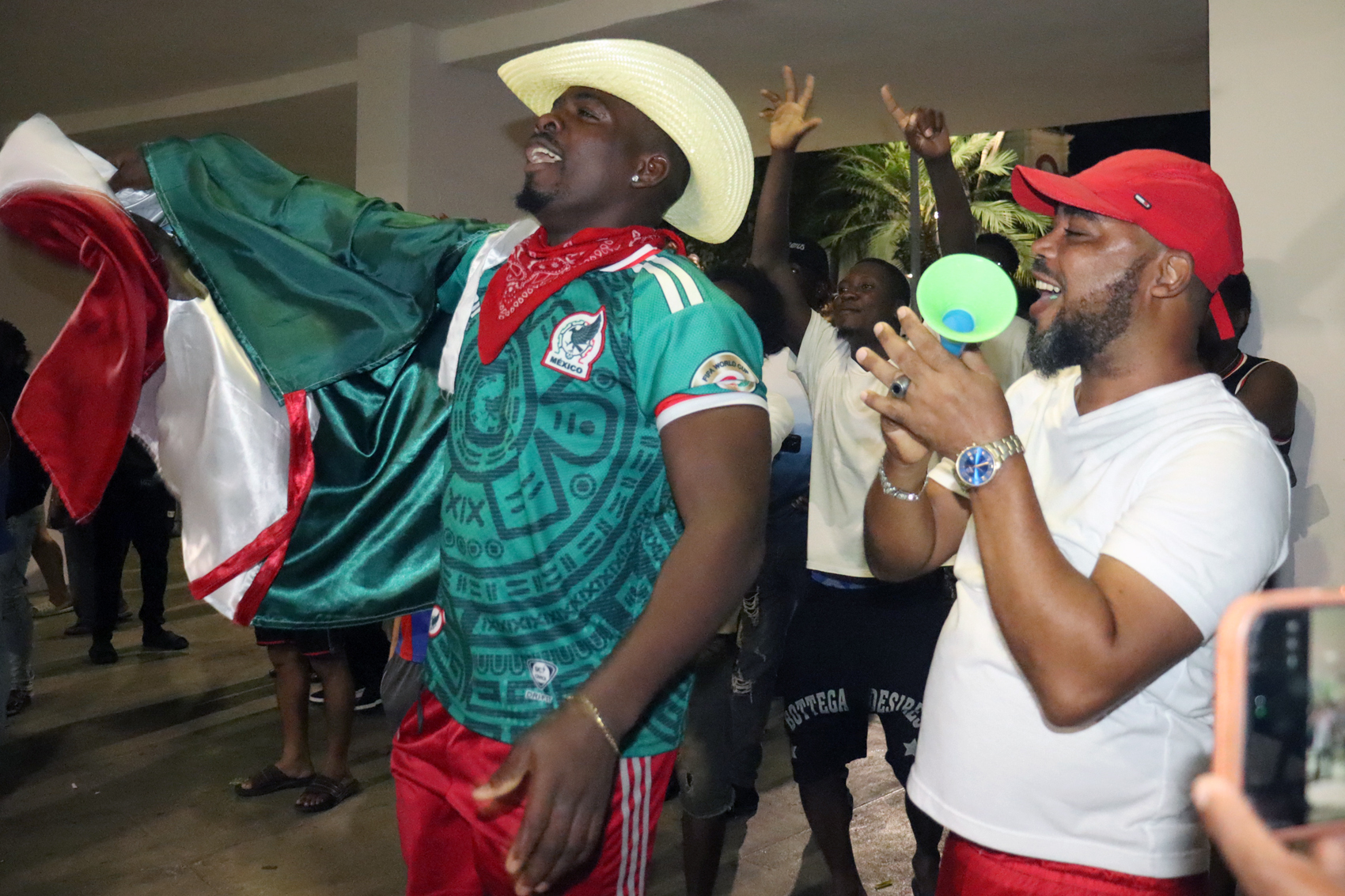
Football has the ability to unite people even thousands of miles away. With a mixture of joy and nostalgia, the Haitian community—the largest migrant group on Mexico’s southern border—gathers this Friday in Tapachula to follow the match between Haiti and Brazil at the 2026 FIFA World Cup.
For this migrant population, the meeting represents much more than a game. After more than half a century without playing in a World Cup, watching his team against Brazil has become a source of pride and a respite in a reality marked by uncertainty.
From the early hours of the day, the roof of the Miguel Hidalgo Central Park, in Tapachula, became a meeting point for dozens of Haitians.
The Mexican city, located near the border with Guatemala and the Tecún Umán and El Carmen border crossings in the department of San Marcos, is home to thousands of migrants waiting to resolve their immigration situation while trying to continue their journey north.
Although migrant caravans have decreased in size and frequency compared to previous years, the flow of people continues. This Friday, between dances and songs in Creole, dozens of Haitians gathered to support their team and share a moment of coexistence around the World Cup.
Despite the distance and difficulties of the migratory journey, support for the national team remains intact.
“For me it is a good experience, because I always had faith to participate in a World Cup like this. Now, thank God, we are close; we are not there, but one of these days we will be present,” said Bordes Clarvens, one of the migrants present at the activity.
A pause in the middle of the journey
According to municipal estimates, more than 20 thousand Haitian citizens remain in Tapachula while they carry out procedures before the Mexican Commission for Aid to Refugees (Comar).
Many of these people left Haiti due to violence and economic hardship. In this context, the World Cup represents an opportunity to share collective joy and maintain the link with their country of origin.
That feeling is summed up by Marlene Pierre Paul, who works selling water and soft drinks around the park. “I want Haiti to win two to zero against Brazil. They haven’t participated in 52 years, so we are very happy,” he expressed.
The celebration occurs in a context of changes in the migratory dynamics of the region. The tightening of immigration policies in the United States has caused Mexico to stop being only a transit country for many migrants and become a place where they seek to establish themselves, obtain legal status and rebuild their lives without losing the link with their roots.