
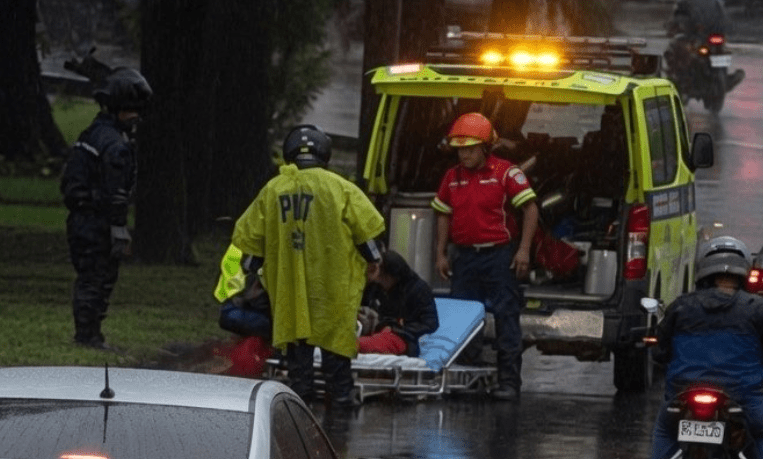
The Metropolitan Transport and Transit Regulatory Entity (Emetra), together with extra-urban transport associations and the private sector, launched this Wednesday, June 24, the national campaign “Batteries on the Road”, a road safety education initiative that aims to reduce cases of people being run over in the capital.
The project arises due to the increase in people run over in the last two years, which went from an average of 12 cases per month in 2024 to 16 currently. 73% of these incidents occur on main routes and boulevards.
As explained by the director of Emetra, Héctor Flores, the strategy seeks to provide passengers with information on the correct use of walkways, zebra crossings, pedestrian buttons and other road safety elements.
It will also have information given by bus drivers and assistants before starting each trip to the capital. To do this, they will use printed graphic materials with illustrations to facilitate passengers’ understanding.
The campaign began with transporters from Quiché, Huehuetenango, Quetzaltenango, Izabal and the south coast, and is planned as a permanent program.
The authorities indicated that the objective is for these recommendations to be transmitted among families and help reduce pedestrian accidents, especially among people who arrive in the capital to carry out procedures or receive medical attention.
Emetra reported that currently the assisted pedestrian buttons are installed mainly in areas near healthcare centers and in some sectors of zones 9 and 10.
He explained that this system allows a person to request the change of light at the traffic light using a button and obtain the green light to cross in a period of between 35 and 40 seconds.
The authorities plan to gradually expand these devices and adapt educational materials to different languages.
The implementation of the campaign did not represent a direct investment for Emetra, beyond the design of the materials, since the financing comes from companies linked to transportation and the owners of the extra-urban units.
To read more: Do you know how to cross a street when you are on foot?
In a first stage, the authorities will appeal to the commitment of the transporters so that the talks are given voluntarily before each trip.
Flores reiterated that they intend to train passengers to prevent road mishaps.
He said that it is essential to inform pedestrians about how to cross the street and the correct use of walkways and sidewalks.
He added that the information strategy will be implemented in all departments where buses leave for the capital, since the primary purpose is to protect the lives of passengers.
Stay up to date with the Now newsletter. Key information at the moment it happens. Subscribe here.