
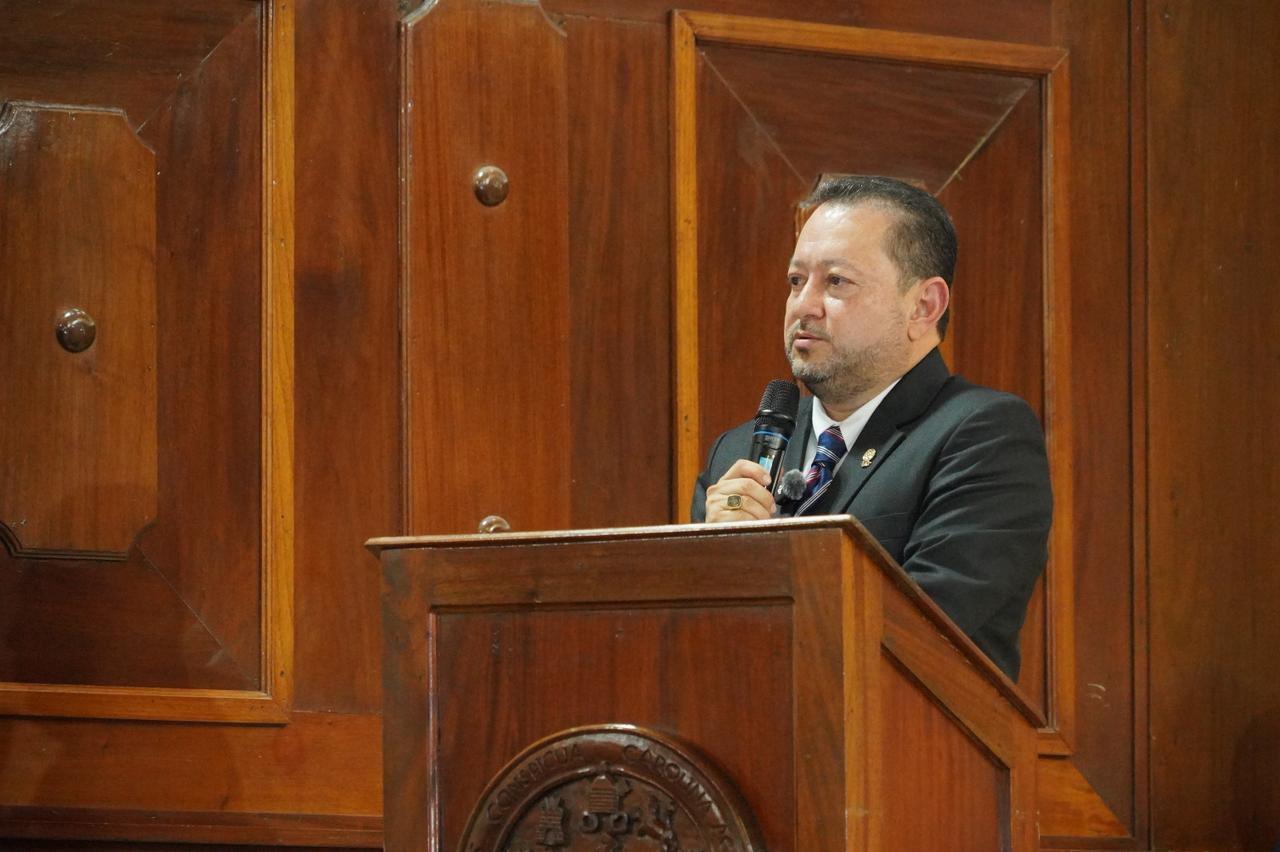
The University of San Carlos (Usac) is approaching a crucial date, since the nextWalter Mazariegos is scheduled to take office on July 1 for a second term in the rectory. However, the countdown advances in the midst of an intense judicial and political battle that questions the legality of the electoral process held last April.
The controversy centers on Mazariegos does not have the settlement of the Comptroller General of Accounts (CGC). This lack, motivated by current criminal complaints against youkeeps various sectors on alert that see his swearing-in as unfeasible and illegal under the current constitutional framework.
The Attorney General’s Office (PGN) filed a a direct protection against he Higher University Council (CSU)with which he seeks to annul Mazariegos’ re-election by arguing that he does not comply with the settlement requirement established in the Constitution.
Faced with this panorama, the university community and legal analysts project a series of critical routes. These range from the consummation of what they consider an alleged illegality on the part of the CSU, until the use of regulatory reforms for extend the current mandate, which leaves a scenario of uncertainty for the only public university in the country with influence and representation in the most powerful bodies of the State.
1. The judicial front
To understand the legal situation, it is necessary to differentiate the complaints from the appeals such as protections that were raised by the internal opposition:
- The 17 criminal complaints
This block of actions corresponds to the current complaints ratified before the Public Ministry (MP), linked to administrative and personnel anomalies. Among these complaints are three derived from findings by the Comptroller General of Accounts (CGC), which block the issuance of Mazariegos’ settlement. - Breakdown
A legislative subpoena issued on June 23 exposed the findings of the PGN after gaining access to the digital file of the Public Ministry (MP) only on June 22, after multiple rejected requests.The details and deficiencies of the process were exposed by the attorney Pilar Samayoa, head of the PGN State Attorney’s Office, who showed after reviewing the 294 copies of folios that the investigations are practically paralyzed in the Anti-Corruption Prosecutor’s Officelimiting itself almost exclusively to the accumulation of complaints filed since April 13.
To date, the bulk of the current accusations are summarized in three fronts, Samayoa described:
- Inspection: three criminal complaints from the Comptroller’s Office (CGC) that block the settlement of Mazariegos, fragmented into two files.
- From Congress: four actions by deputy José Chic, including a complaint against the rector and complaints against the CSU, the legal area and the dean of Humanities, Santos de Jesús Dávila. Added to these is a complaint from deputy Sonia Gutiérrez and another from David Illescas.
- Opposition and fraud: civil complaints by Leonel Toriello, others for allegations of fraud due to the appointment of the magistrate Julia Marisol Rivera, and one from lawyer Alejandro Xiloj against the CSU for practicing with expired terms.
Attorney Samayoa warned that “there is no evidence of investigations carried out.” In months of processing, the MP only records two basic actions: a February letter requesting administrative data from the rectory and a testimonial statement.
Given the fiscal inaction, the PGN initiated its own requirements on May 14.
- The battle of Usac-DIRE: Separately, the group Usac, Dignidad y Resistencia (Usac-DIRE) is leading a legal offensive with dozens of appeals for protection and challenges aimed at pointing out alleged irregularities in the election process.
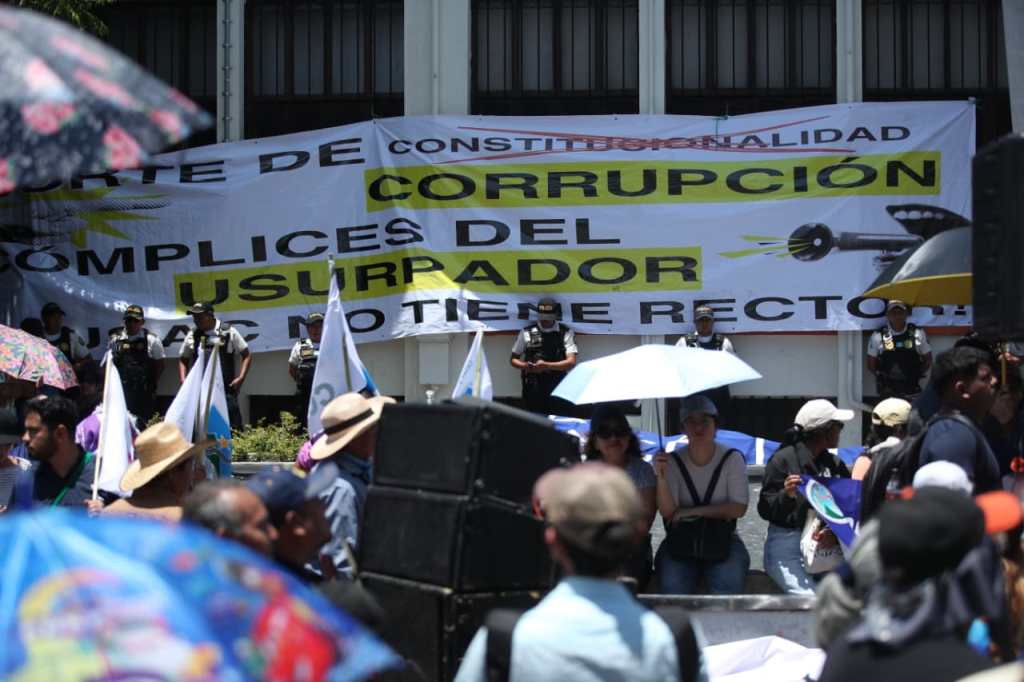
Although the Constitutional Court (CC) has suspended and rejected several of these actions—as happened on Tuesday, June 23, when the Eleventh Court confirmed the suspension of an amparo that was stopping reelection—, the leaders of DIRE trust that the still pending appeals will be resolved in their favor before the July 1 deadline expires.
The Scenarios: Does he stay, does he leave or are elections called?
Based on current conditions, jurists, legislators and analysts outline three ways out of the rectory crisis:
Legal impediment to assume
Under this perspective, Mazariegos could not take office due to the strict legal prohibition.
- Aníbal García, lawyer and leader of Usac-DIRE, maintains that the rector has an insurmountable impediment in accordance with the Law on Probity and Responsibilities of Public Officials and Employees.
- Along the same lines, Pablo Solórzano, representative of the Alliance for Reforms organization, emphasizes that Mazariegos lacks basic legal support, since the termination of the Comptroller’s Office “is an essential requirement to be in and assume office” in a proven manner.
- Deputy José Chic, from the Will, Opportunity and Solidarity (VOS) bloc, is more drastic in warning of the consequences for the management levels: “it would be a flagrant crime for the CSU to want to give it possession” under these conditions.
Hold on to office
Various sources estimate that Mazariegos could retain the rectorship using internal regulations with the support of the CSU.
- Deputy Chic explains why the CSU could hide behind a regulatory reform of the USAC approved in 2025, which prohibits the rector from handing over the position if a legal substitute has not been consolidated. Not being able to assume the new period due to lack of settlement, Mazariegos would choose to extend his current mandate for an extended period.
- Pablo Solórzano, from the Alliance for Reforms, sees this shielding of the Council as very viable: “We have seen completely illegal decisions by him and the CSU; this shows that there is no certainty or the rule of law.”
- Lawyer Aníbal García warns that this solution would deepen the crisis, since an internal norm is not superior to national law: “They can never contradict article 16 of the Probity Law or Constitutional 113, which require suitability, honesty and capacity to hold a position.”
Call for new elections
Posed as the furthest path, Congressman Chic points out that the third path would depend on the university authorities deciding to clean up the image of USAC and respect the legislation.
This would imply officially ignoring the process of last April and calling for a new transparent electoral event, resuming the spirit of the first rulings of judicial instances that ordered the re-election to be stopped before being reversed by the CC.