

The phrase “hate keeps man alive. He gives strength” maybe he could be one of the most iconic cinema. Quintus Arrius is attributed to the character of Quintus in The movie Ben-Hur.
Directed by William Wyler, this adaptation of Lew Wallace’s novel not only razed the Óscarbut became a reference of the Easter week Thanks to your unforgettable performances.
The first time the world heard about Ben-Hur It was not in 1959, when MGM premiered its cinematographic version, but in 1880, when the general and writer Lew Wallace published Ben-Hur: A History of Christ. Wallace, a man of multiple talents – from inventor to a diplomat – was inspired by a train trip, where, after debating on religion, he felt the need to deepen his faith.
The result was a novel that combined history, adventure and spirituality, and that became the best -selling book of the United States at the beginning of the 20th century.
His success was such that, even before cinema, Ben-Hur Broadway conquered in a spectacular theatrical adaptation that, between 1899 and 1920, attracted more than 20 million viewers. Wallace, initially reluctant to take his work to the stage, accepted with one condition: Jesus would not be interpreted by an actor, but symbolized by a ray of light. A decision that would later move to the cinema, where the face of Christ is never shown.
After two adaptations – including a silent version of 1925 in which a young William Wyler worked as an assistant – MGM opted everything in 1959 to revive the novel with a record budget and a cast aimed at making history.
Who were part of Ben-Hur’s cast?
The film intertwines the life of Jesus with that of a fictional protagonist, the young Jewish prince Judah Ben-Hur, who suffers betrayal, injustice and brutality, and longs for a Jewish king to defeat Rome. The cast made the spectators capture the essence that from the beginning was wanted to capture:
Charlton Heston: Judah Ben-Hur’s face
Imagine Ben-Hur Without Charlton Heston it is like thinking about Rome without the coliseum. However, the actor was not the first option to embody Judah Ben-Hur. According to the Infobae media, great stars such as Burt Lancaster, Paul Newman and even Marlon Brando rejected the role.
But it was Heston who ended up defining the Jewish prince betrayed by Rome. His dedication was legendary: for months he trained for the iconic quadrigas career, learning to handle horses as a professional dawn.
Ben-Hur It was not the first film in which Heston embodied a biblical character, since he also acted in The ten commandmentslike Moses.
His participation in Ben-Hur He gave Heston one of the 11 Oscar awards that won the film, as best actor.
Stephen Boyd: the perfect rival
The role of the antagonist, Messala Severus, fell to the charismatic Stephen Boyd, who contributed a mixture of arrogance and vulnerability to the character. Interestingly, Boyd – blue eyes – had to wear coffee contact lenses to visually differentiate himself from Heston. The chemistry between both actors raised the central conflict of history, making its enmity one of the most memorable dramatic duels of cinema.
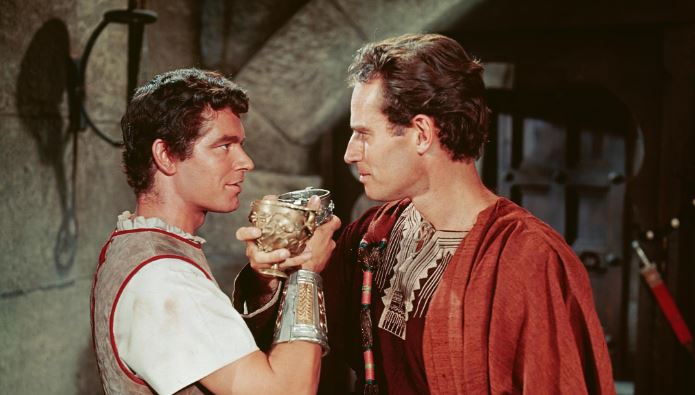
A cast that made history
Next to Heston and Boyd, other actors shone in key roles:
- Jack Hawkins as Quintus Arrius, the Roman tribune whose phrase “hate keeps man alive” was recorded in collective memory.
- Hay Harareet as Esther, the woman who personifies compassion and redeeming love.
- Hugh Griffith, Oscar winner as Sheik Ilderim, the eccentric owner of the White Horses, whose performance added humor and warmth.
- Martha Scott and Cathy O’Donnell such as Miriam and Tirzah, Ben-Hur’s sister, whose suffering scenes moved the public.
- Sam Jaffe as Simonides, the faithful servant whose loyalty transcends the tragedy.
- Finlay Currie as Balthasar, one of the Magi who connects the plot with the birth of Christ.
For some time, the actor who gave life to the Messiah in the film remained under a subtle anonymity, until it was revealed that the opera singer Claude Heater was the one who embodied this character. However, its name does not appear in the final credits.
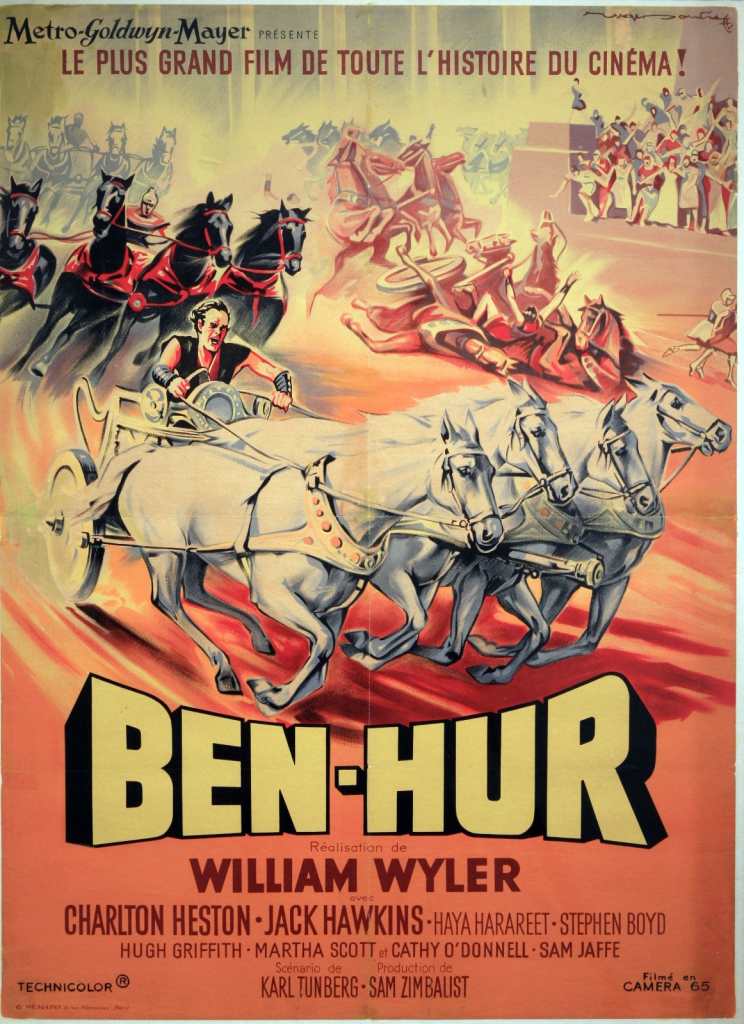
The legacy of a classic
For the filming of the film, the MGM studio organized a casting in Rome in mid -1957, with the aim of selecting more than 50 thousand people for secondary papers and as extras.
Throughout the tape, 365 actors have dialogue lines, although only 45 were considered protagonists.
According to the book The Story of the Making of Ben-Hur: A Tale of the Christ, From Metro-Goldwyn-Mayerby Ray Freiman, director William Wyler prioritized the characterization of the characters above the physicist of the actors or their trajectory in the cinema. To make a clear difference between the groups, he chose British actors for the roles of Romans and Americans to interpret the Jews.
The film cost MGM 15 million dollars, one of the largest budgets of the time. It premiered on November 24, 1959 and for the study it became a resounding success.
He won a total of 11 Oscar awards and has been the only Hollywood film included in the official list of religious films approved by the Vatican and, as a clock, it is broadcast on television chains every Holy Week.