

According to several historians, the image was commissioned by the religious of the Congregation of the Oratory of San Felipe Neri, the sculptor Alonzo de La Paz and Toledo in 1697.
The order was one of the last to be authorized by the authorities of the Kingdom of Guatemala in the seventeenth century, founded on July 2, 1664, according to the historian Juan Alberto Sandoval.
In a lot where the hermitage of the Holy Veracruz was the temple and convent of the Neredians, as they are also known.
The temple is known to this day as the “School of Christ” and in its early years it acquired popularity since the site was veiled the Brother Pedro de San José Betancur. The most important images and that are still today are those of the Nazarene and that of the San Felipe Neri pattern, both venerated in the parish of the Santa Cruz del Milagro, zone 6.
The transfer and the new capital of Guatemala
After the earthquakes of 1773, it was decided, after a dispute, to move the city to the Hermitage Valley. The authorities forced the different religious orders to vacate the old churches and transfer their assets to the new capital.
The oratory congregation was assigned a space in the apple located in what is currently located in the 4th. Avenue and 7a. Calle Zone 1. In that place the order continued to carry out its work until the reforms of the liberal revolution of 1871 were implemented, commanded by Justo Rufino Barrios.
The religious of San Felipe Neri were expelled and their convent was expropriated by the State. The values of the School of Christ were in the hands of Francisco Lainfiesta, one of the neighborhood ministers. The religious took part of their assets to the Church of Santa Catalina, which worked meters from its former headquarters. There remained the images of the Nazarene, the Painful and San Felipe Neri for several years.
The old parish
On August 14, 1723, the parish of the Santa Cruz del Milagro, which kept a cross to which numerous prodigies had been attributed inside, among which the having trembled by itself had been attributed to it, among which the having trembled by itself, was established in the ancient parish of the town of La Ermita. The Cross had a hermitage in the old settlement of Santiago de Guatemala. Between 1859 and 1860 the architect Julián Rivera restored the frontispiece of the temple.
On September 28, 1884, the triumphal transfer of the images of Jesus Nazareno of the School of Christ, the Painful and San Felipe Neri who headed the courtship and carried the keys to the temple of the Holy Cross of the Milagro.
“The neighbors received them with great jubilation and celebrated for three days the arrival of the Blessed Sacrament, the Patron, the Nazarene and the Cross of the Miracle in the last and definitive house of veneration,” tell the chronicles of the time on the transfer.
More than a century of Holy Monday
The image of Jesus Nazareno is an image of Baroque style, on his face denotes some paleness that accentuates his attitude overwhelmed by fatigue, tiredness and the pain that Christ suffered in his passion is also of the few images of Christ who has tears on his face.
At first he was known as “Jesus of the nobles” since it is said that the aristocracy of the time was the one who carried the image in procession before its transfer to the parish.
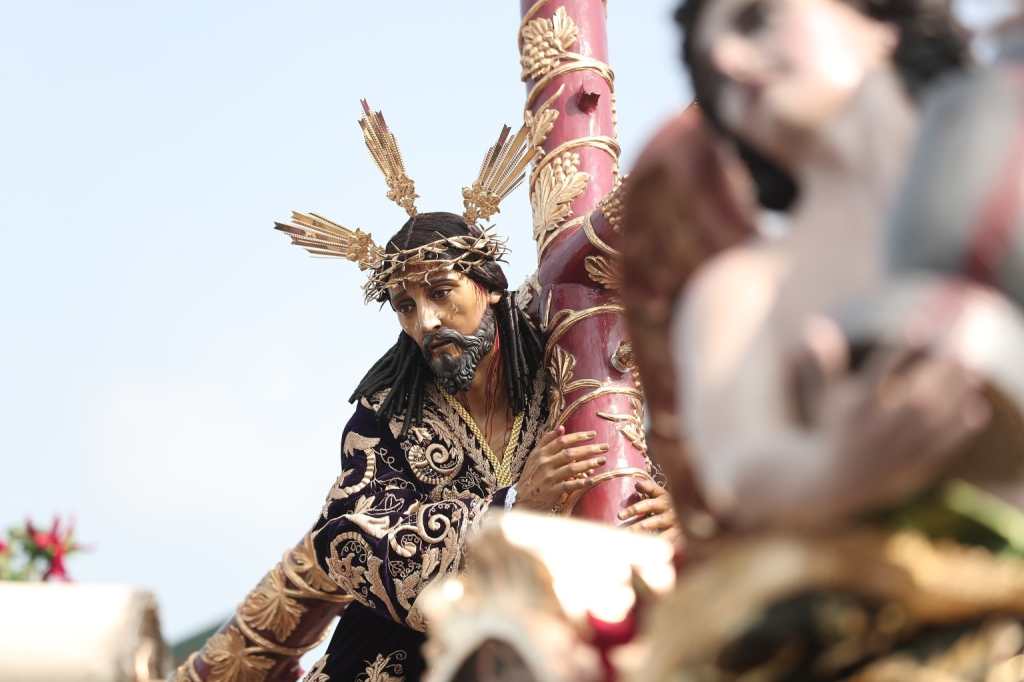
Subsequently he was known as “Jesus of the School of Christ”, as can be seen in the embroidery banner that heads its procession. The appellation is due to its old origin, the Church of the School of Christ today disappeared in the capital.
After the influence of the first tapes referring to the passion of Christ and the Spanish imagery, the image was incorporated in the first half of the twentieth century a burst in the head composed of three groups of rays, which are a representation of the Holy Trinity (Father, Son and Holy Spirit). Since then, the Nazarene image is known as “Jesus of the three powers.”
Since 1896 the image has processed Holy Monday since its current temple, The Holy Cross of the Miracle. In the weekly “The Catholic Week” of April 11, 1896, it describes how that first procession was:
“At about four thirty minutes in the afternoon, it came out for the first time, in procession, from the Church of the Old Parish, the image with the cross in tow that, once, venerated in the school of Christ, an image no less beautiful than the others to whom they are taxed. from the night to the temple where it left. ”
In its early years the procession was simple and presented decorations loaded with symbolism and tenderness, For example, it showed the Nazarene between stones, thorns and sheep, a classic stamp, in addition to dressing a simple robe without embroidery. It is after the 1950s that the procession evolves and has varied decorations, in addition to the suppression of the three powers on the head of the image, which were replaced by a Nimbo, very traditional of the Guatemalan Nazarenes.
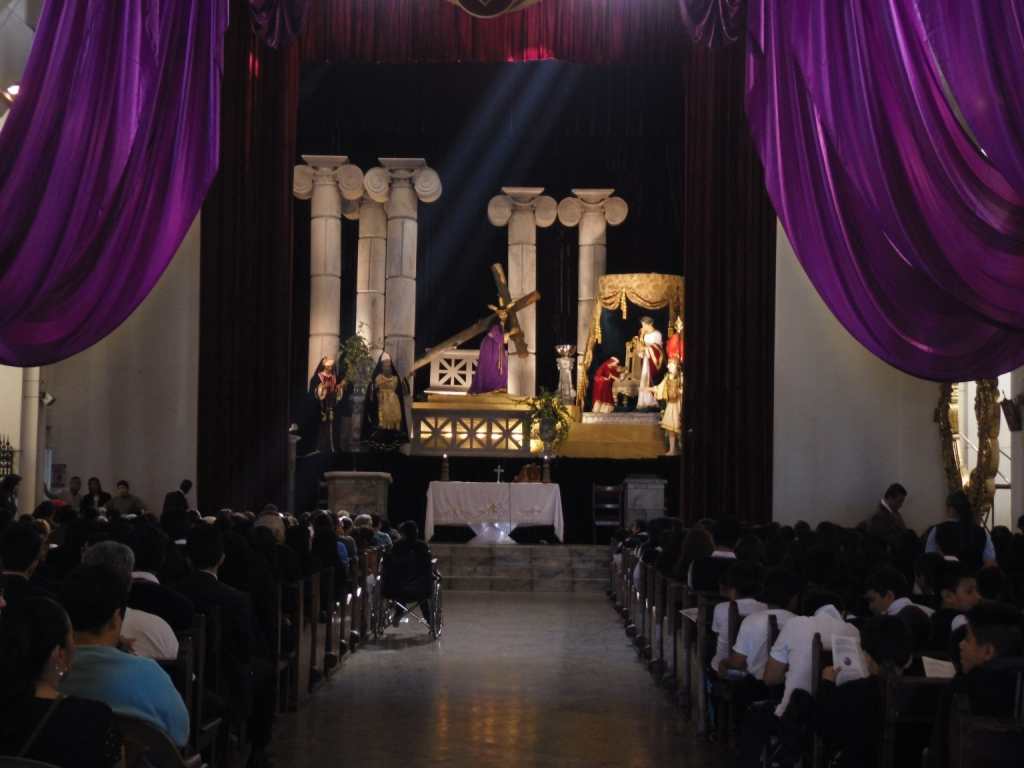
In the early 1990s, the procession was in a difficult stage, which was surpassed in 1996 when a new directive was integrated into the association which revised the procession with new glitters on the eve of the centenary of its Holy Monday procession, which was commemorated with a lot of pomp.
In the same period, the extinct historian Haroldo Rodas Estrada presented the thesis on the authorship of the Nazarene, which was based on the analysis of the sizes of Jesús Nazareno and San Felipe Neri, the latter carved by Alonzo de la Paz. Formerly the stature of Jesus was attributed to Quirio Cataño in a strange hypothesis that gave him more senior.
In 1997 the tricentennial of Jesus of the three powers was held And at present it is one of the most roots processions among the devotees that covered with purple robe and capirote, pallet, belt and bands accompany it in its more than 12 hours of procession. After the image of the Nazarene procession the Blessed Virgin of Dolores, who has accompanied him in the last 120 years and is a very expressive and beautiful image.
Jesús Nazareno has several funeral marches, among which he stands out Infinite tenderness. The Blessed Virgin of Dolores also has an official march which is called Crying waterfallboth marches were composed of the Pbro. Julio González Celis, pastor for many years of the Cross of the Miracle. The Nazarene underwent a restoration process that lasted almost a year and was carried out at the Institute of Anthropology and History, Idaeh where details of the sculpture resurfaced. He was enshrined on March 7, 2017 together with the painful in solemn ceremony officiated by the then Metropolitan Archbishop, Óscar Julio Vian.