

“It is a continuous struggle,” said Sevillian historian Manuel Jesús Roldán to BBC Mundo in 2024. “You have to do pedagogy every year to explain to what is coming that this is a huge wealth of centuries.”
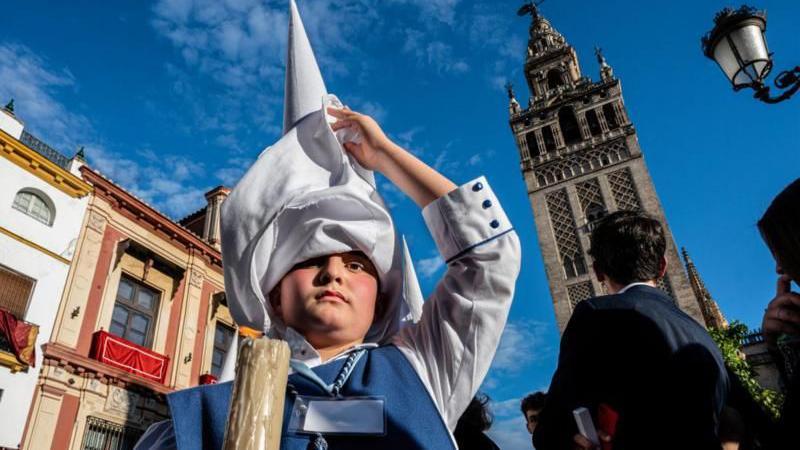
Roldán referred to the capirote, that cone that the Nazarenes or penitents carry in the processions in Holy Week in Spain – and in some Latin American countries, such as Colombia -, and that is possibly one of its most recognizable icons.
But also to the celebration of Easter itself, a “living party” that has evolved over the centuries, “and that, especially in southern Spain, has a festive sense, is a curious combination of living passion and mixing it with the resurrection.”
From Palm Sunday to Resurrection Sunday, the streets of Spain are filled with faithful and curious that come to see Holy Week processions, in which the different brotherhoods or penitential brotherhoods walk for hours with images of the passion of Jesus.
These huge sizes, that the “Costaleros” load on their shoulders, are accompanied by religious, musicians and dozens of penitents, men and women who wear long robes and, in most cases, carry a hood that ends at peak.
The capirote, that kind of cucurucho made of cardboard and more recently also plastic, has its origin in one of the most sinister institutions in the country’s history: the Spanish Inquisition.
The Holy Office
Those condemned by this institution, which was founded by the Catholic Monarchs in the fifteenth century to maintain Catholic orthodoxy in their territories, were forced to wear a cap and a small tunic of fabric is enough called “Sambenito” to identify and embarrass them during faith cars.
“The self of faith was the great theater made by the courts of the Inquisition that had as its objective, in theory, reincorporate the heretics to the Church, but which, in the back Spanish ”.
For three centuries, thousands of people were convicted in Spain by the religious courts of the Inquisition, accused of different crimes, which could range from blasphemy to heresy. Many of these convicted, especially in the first years, ended up at the bonfire.
But before, the Inquisition gave them the opportunity to abjure their sins and proclaim their adhesion to the Catholic faith. Those who did so, the “penitents”, obtained the grace of being strangled before they were burned. Those convicted of death who did not regret their sins were alive incinerated.
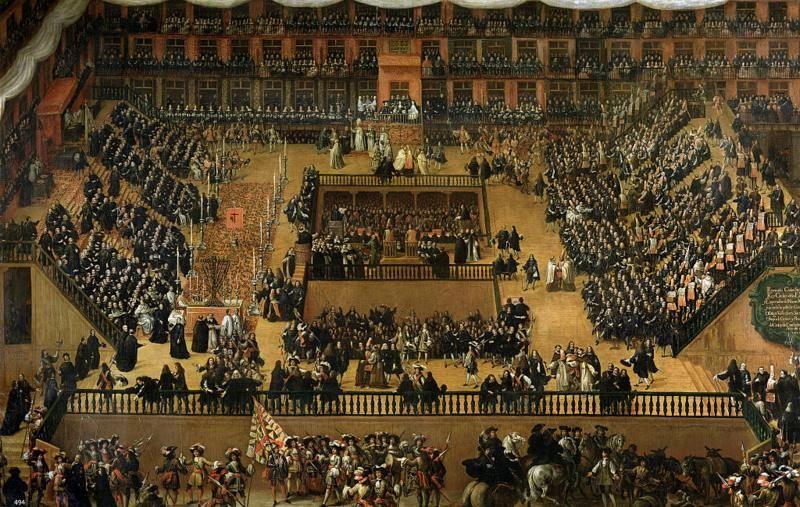
The cars of faith were held in the public square, usually in spring or in autumn, when a sufficient number of convicted had joined. A kind of scenario was installed, where ecclesiastical, secular authorities and prisoners sat, and even rehearsed on the eve.
Weeks before, painters were already contracted to prepare the sambenitos and the hoods that the convicted would carry. The drawings and colors that painted them varied depending on the heresy.
“Some simply wore the bag, others were much more painted, even simulating flames. Those, obviously, went to the fire,” Martínez Millán said, who is a professor of modern history at the Autonomous University of Madrid (AUM).
Thus dresses, the convicted had to go in procession as public humiliation to the place where the faith car was held.
Once the sentence read, those convicted of death were taken to the burner, who used to be on the outskirts of the city so that the “temporary arm”, as the civil authorities were called, executed the penalty. The others were forced to dress the sambenito during all the time that his sentence would last.
Without forgetting
But the conviction did not end there.
The sambenitos and the capirotes were then taken to the parish church to be hung with the names of convicted.
“From then on, at Mass they always had to sit under their sambenito, as well as their children or grandchildren. La Mancha endured for generations, which is one of the great cruelty of the Inquisition,” Martínez Millán said.
The expression “hang the sambenito to someone” or “carry a sambenito”, used mainly in Spain, comes precisely from there.
When a person wanted, for example, to enter the university or ask for a title of a military order, he had to request a blood cleaning file in which it was demonstrated that, throughout three generations, no one had been convicted of the Inquisition.
The sambenitos hanging in the churches served as testimony and the only way to clean the name was oblivion but, as explained by the professor of the AUM, “forgotten did not exist.”
The large cars of faith ceased to be held in the second half of the 18th century, when they went on to organize within the institutions of the Inquisition, in what came to be called “autillos.”
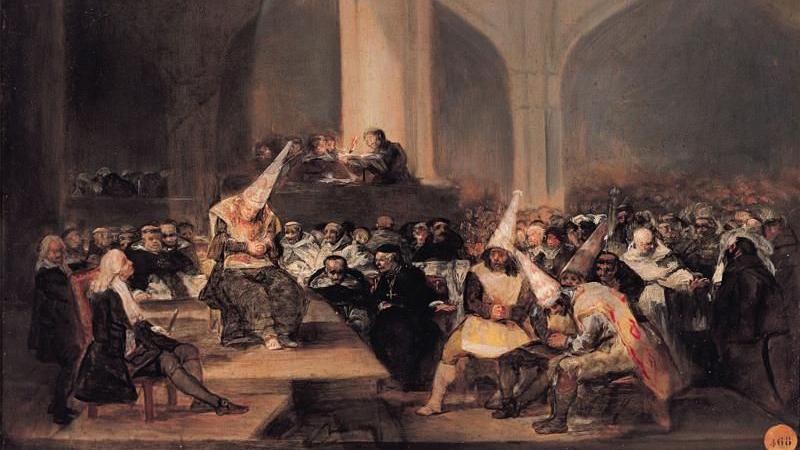
One of them inspired what is possibly the painting about the most famous Inquisition that exists, the painting Inquisition Faith Auto from Francisco de Goya.
In its center, dressed in a capirote and a sambenito adorned with flames, a convicted person listens to his sentence with the low gaze and the resigned attitude, while a crowd of clergy, authorities and figures without identifying generate an suffocating atmosphere. Next to the podium, three other convicted dresses still wait for their turn.
Penitential Brotherhoods
How this cardboard cucurucho jumped from the Inquisition to Holy Week celebrations is not clear.
However, historians believe that the penitential brotherhoods adopted this capirote – which because of its form also symbolized the attempt to approach God – of having seen it in those penitent condemned.
The first brotherhoods that were formed in the fifteenth century, after San Vicente Ferrer preached penance, and that came out in procession, were very different from those known today.
The penance led to flagellation, so these men undressed their backs and whipped with strings and chains in a bloody show.
At this time “the cult of the Vera Cruz is beginning to claim the blood of Christ, so a series of images that are usually a crucified one,” explained Manuel Jesús Roldán.
This image of Jesus crucified extends throughout Spain and Latin America.
The penitents were anonymous, covered their face with an mask and wore a enough and cheap fabric robe, which usually used to be white.
Historians agree that the first of these brotherhoods adopted by the capirote at the end of the 16th century is the Sevillian Brotherhood of the Hiniesta, which has a medieval origin and that continues to exist today.
“The Brotherhood of the Hiniesta adapts that cardboard cone to the mask that carried their penitents, and begins to differentiate two types of brothers: the ‘Blood brother’, which was flagellated and that carried the mask fallen back, and the ‘brother of light’, who was in charge of carrying a candle and that carried the capirote,” said Roldán, author of the book “Stories of the Holy Week they counted. ”
For the seventeenth century, most of the brotherhoods of Spain already used this cucurucho, giving another presence to the penitents, which by then began to call Nazarenes.
Each brotherhood adopted a color. Many chose the purple, which was the penitential; But some red, for its sacramental symbolism; others green, for the cult of Vera Cruz; and others kept the target or adopted black, which became fashionable at the end of the 18th century.
Since then, the brotherhoods and processions were about to disappear with the arrival at the throne of Carlos III. “Penance was something that collided with the ideas of the Enlightenment, so it prohibited them from being publicly struck in the street, that the face would be covered with an mask and that they went out at night,” explained the Sevillian historian.
After the War of Independence and the return to absolutism, the Brotherhoods returned to their activity. But the penance, which was already considered past centuries, never recovered.
Today, Holy Week processions in Spain go far beyond the religious and are part of a popular culture that has “a sense, festive, identity, which connects with the return every year to a date, to a known people, to a feeling of the city and a way of understanding the life that makes this party remain alive,” said Roldán.
The historian explained that some interpretations even connect them with the important substrate of classic Roman culture that exists in Spain, where at the end of March parties around spring were held.
“Although the processions are very serious and rigorous, they also have that traditional festive sense,” Roldán argued.
“That is why it is difficult to make those of outside that those who dress as Nazarene are not only gentlemen anchored in the past, but they can be young, older, women, men, left -wing people, right -wing … even there are atheists!”
*This article was originally published in 2023 and updated in 2025 on the occasion of Holy Week.

Click here To read more BBC News World Stories.
Subscribe here To our new newsletter to receive every Friday a selection of our best content of the week.
You can also follow us in YouTube, Instagram, Tiktok, X, Facebook and in our WhatsApp channel.
And remember that you can receive notifications in our app. Download the latest version and act.