
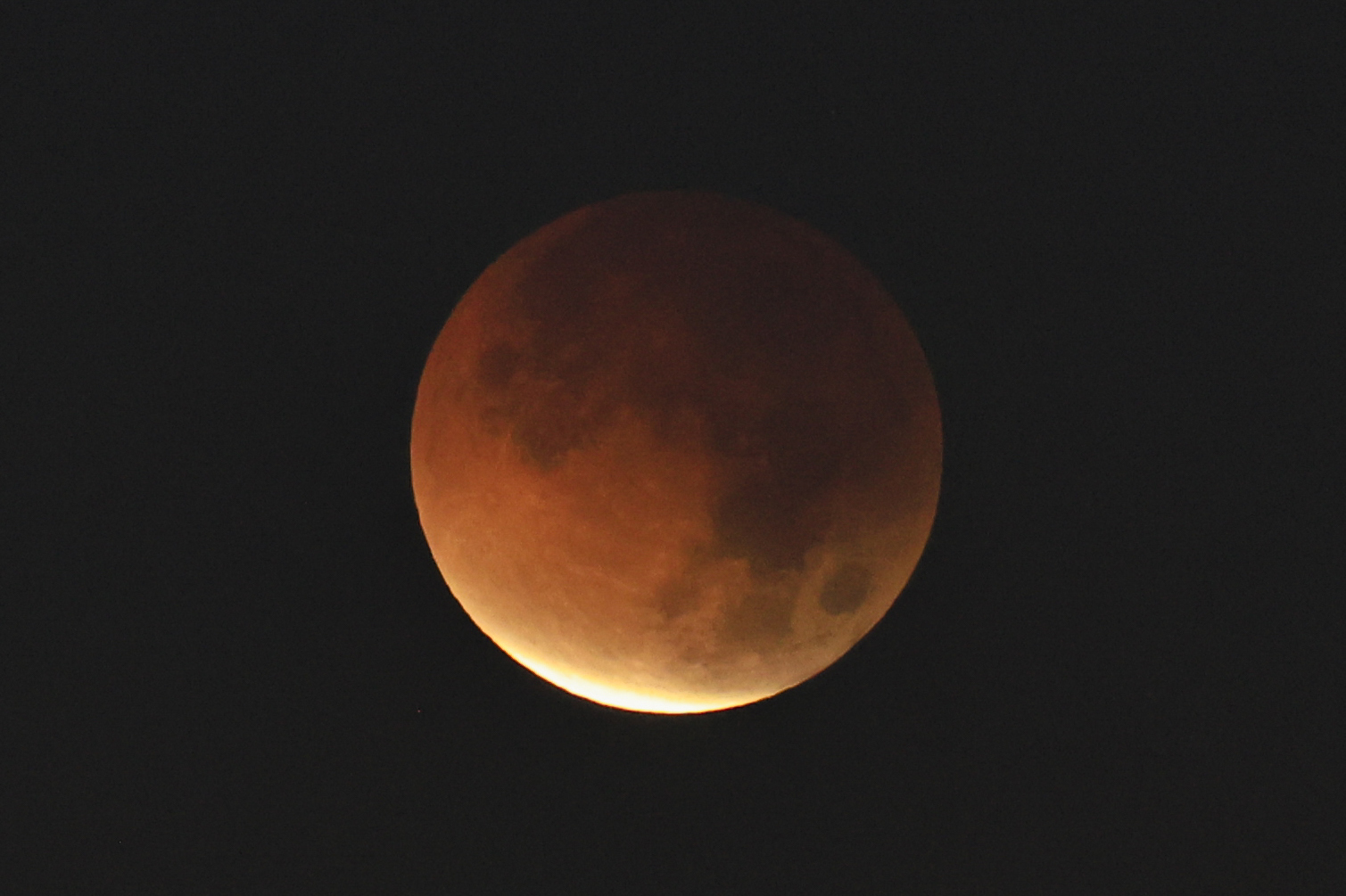
Astronomers and lovers of celestial phenomena will be able to enjoy a partial lunar eclipse that will close the 2026 eclipse calendar, during which the Earth’s natural satellite will acquire an orange tone.
It will be on August 27, 2026 when the Moon, the Earth and the Sun give the world one of humanity’s favorite astronomical phenomena: a lunar eclipse. Although it will not be a total eclipse, a percentage of the Moon will change color during the process.
The National Aeronautics and Space Administration (NASA) explains that, as it is a partial lunar eclipse, only a portion of the satellite will enter the darkest area of the Earth’s shadow, so only that part will change color.
This phenomenon will not completely change the appearance of the Moon, since, according to NASA, the alignment between the Sun, Earth and Moon will not be completely centered. Even so, the phenomenon will be worth appreciating.
Although in some regions this spectacle will be seen between the night of August 27 and the early morning of August 28, the director of the Institute of Earth Sciences and Astronomy of the Galileo University, Edgar Castro, explained that in Guatemala it will be visible during the night of August 27.
Castro highlighted that this eclipse will be visible in Guatemala and in countries throughout America during the night of August 27. In this event, the natural satellite can be observed in the full moon phase at first, but, as the minutes pass, it will begin to lose its perfect shape and change color.
Key times for the eclipse
The eclipse, which will peak after 10 p.m., will be a unique event to enjoy. Edgar Castro shared the key times to observe this phenomenon.
- 8:33 p.m. (Guatemala): will give start the threshold phase. From this moment on, the Moon It will start to lose its perfect shape.
- 9:20 p.m.: the umbra will have covered 50% of the lunar disk.
- 10:12 p.m.: The partial lunar eclipse will reach its peak, when 92% of the disk mole will be covered.
- 11:08 p.m.: the Moon It will begin to emerge from the Earth’s shadow and will remain covered by 50% of its disk.
- 11:52 p.m.: the Moon It will be completely uncovered, which will mark the end of the eclipse.
Countries where the eclipse will be visible
In various parts of the world you can enjoy this partial lunar eclipse, while in small regions it will not be visible. These are the regions where it can be observed, according to NASA:
- America
- Europe
- Africa
- Western Asia
Warnings for viewing
Although this astronomical phenomenon can be seen in Guatemala, Castro warned that August, being a month of the rainy season, could present cloudy skies and even rain.
He stressed that one must be attentive to the weather conditions during those days, since, if the sky is cloudy, the phenomenon will not be able to be appreciated.