
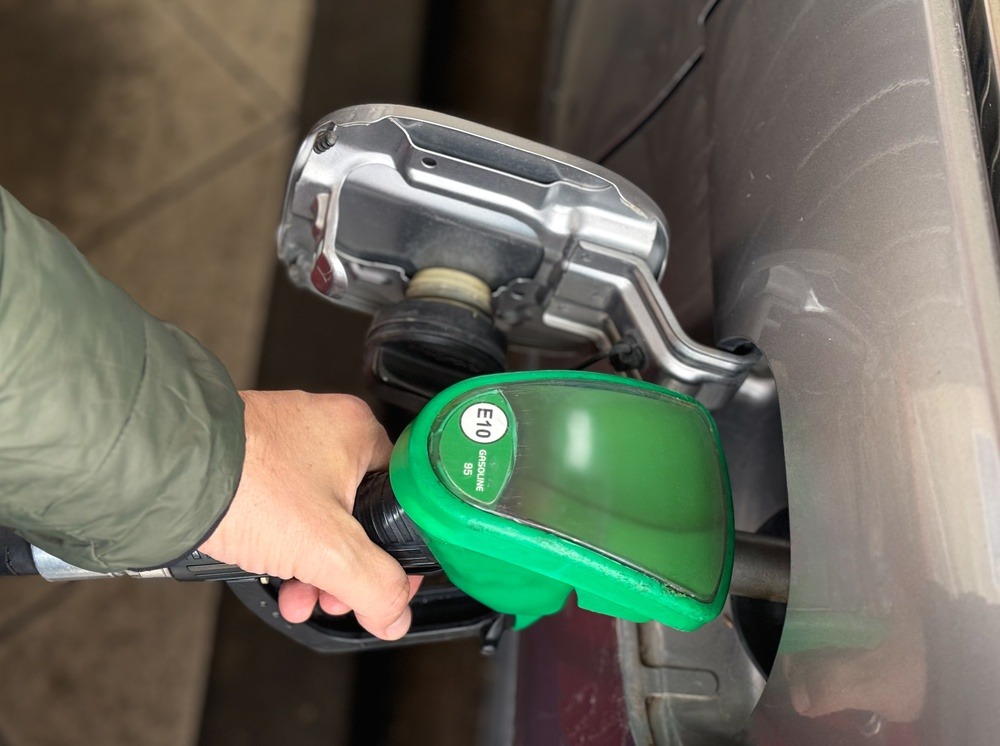
During a seminar organized by the Latin American Office of the US Grains & Bioproducts Councilthe minister of Energy and Mines, Edwin Barriosexplained the progress of the implementation and assured that the incorporation of ethanol does not respond to an obligation imposed by an international treaty, but rather to compliance with the climate and energy commitments assumed by the country.
The official recalled that Guatemala is part of international agreements such as the United Nations Framework Convention on Climate Change (UNFCCC)he Kyoto Protocol and the Paris Agreement (COP21)whose objectives were later incorporated into national legislation.
The head of the portfolio also clarified that the transition towards E10 gasoline will start with the regular gasoline. As explained, the implementation will be gradual, with the objective of facilitating market adaptation and generating confidence among consumers about the performance of the new fuel.
Barrios also recognized that one of the main challenges will be to generate trust among consumers: “The challenge now is to establish a ramp of trust among gasoline consumers and break the doubt they have about their vehicles being damaged,” said Barrios.
He added that the mandatory nature of the measure should not be interpreted as a limitation for the consumer, but as a guarantee that the entire population will have access to fuel with uniform quality standards: “The issue of mandatory nature is often confused with the issue of stability of fuel quality,” said the official.
An important fact is that although the implementation of the E10 gasoline raises doubts among some drivers, a large part of the vehicle fleet in Guatemala You have already used this type of fuel. This is because a large number of the vehicles that circulate in the country are imported from USAwhere gasoline with 10% ethanol (E10) It has been the standard for several years. That country has even temporarily expanded the marketing of E15 gasoline (15% ethanol) until the end of this year, a measure aimed at guaranteeing supply.
America leads the world production of biofuels
During the seminar, the international biofuels specialist of the Inter-American Institute for Cooperation on Agriculture (IICA), Agustín Torrobapresented an overview of the development of biofuels on the continent.
The expert indicated that the Americas concentrate near the 85% of world ethanol productiondriven mainly by USA and Brazil.
Torroba, furthermore, explained that the ethanol continues to be the main substitute for gasoline, while biodiesel partially replaces fossil diesel. In addition, he highlighted the growth of new sustainable fuels for aviation (SAF) and for maritime transport.
Guatemala joins the countries that use mixtures with ethanol
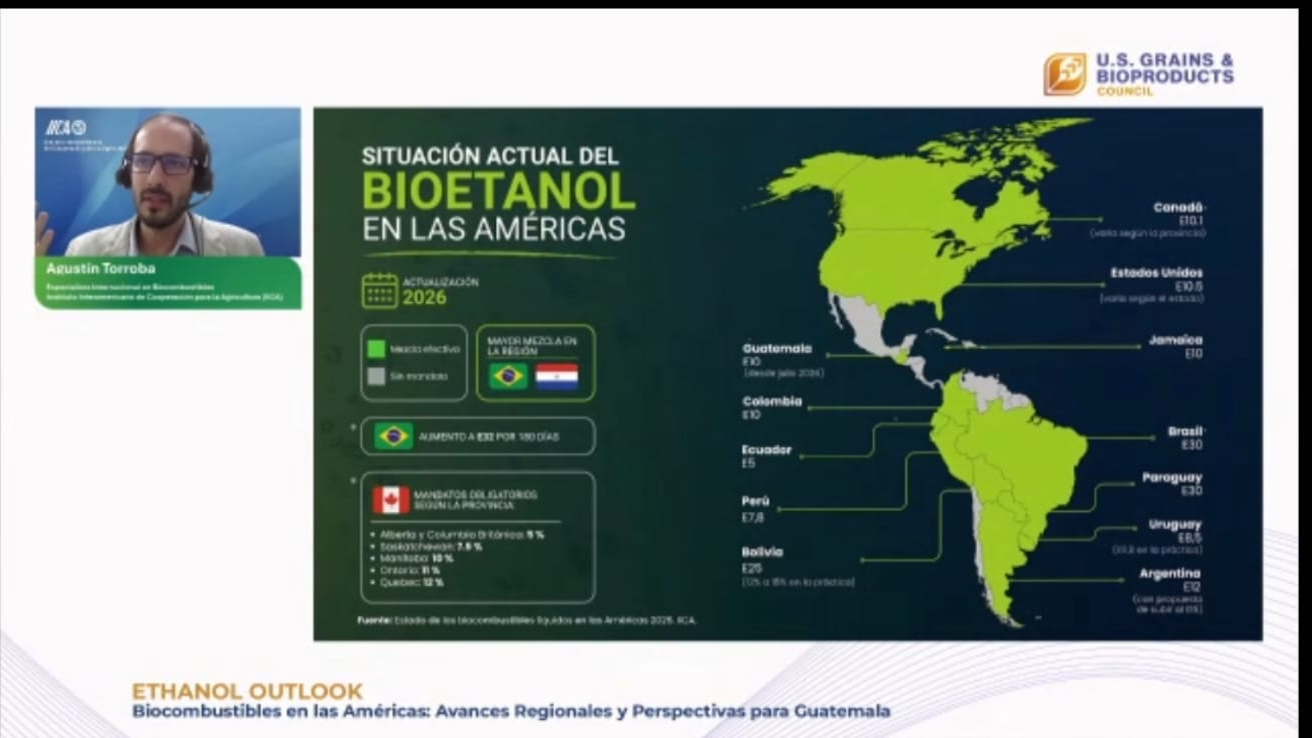
Torroba explained that the countries of the region mainly apply two mechanisms to promote biofuels: mandatory mixing mandates and the carbon reduction standards.
As an example he mentioned that:
- Brazil use mixtures of up to 30% ethanol (E30).
- USA until recently it maintained an average close to 10.5%which expanded the percentage of ethanol recently.
- Colombia commercializes E10.
- Guatemala will join this group with the entry into force of the E10 gasoline.
International conflicts drive the use of biofuels
Specialist Torroba also took advantage of the space to comment that due to the volatility of international oil prices and geopolitical conflicts, they have led numerous governments to strengthen their oil policies. biofuels to reduce dependence on imported fossil fuels.
Some of the changes that countries recently incorporated were:
- Argentina promotes increasing ethanol E12 to E15 and biodiesel B7.5 to B10.
- Paraguay raised biodiesel B5 to B8.
- USA authorized the mixture for the rest of 2026 E15replacing the E10.
- Canada strengthened its federal renewable fuel standards.
- The European Union analyzes the adoption of mixtures E20.
- Indonesia increased biodiesel up to B50.
- India has already surpassed E20 and incorporated vehicles Flex Fuel within your energy strategy.
According to Torroba, these decisions reflect that biofuels have regained a strategic role, not only for their contribution to reducing emissions, but also for their contribution to energy securitycompetitiveness and agricultural development.
What is a biofuel and how do countries use it?
The biofuels They are fuels made from raw materials of biological or renewable originsuch as agricultural crops, vegetable oils, animal fats and organic waste. Unlike fossil fuels, they can partially replace gasoline and diesel, reducing greenhouse gas emissions and dependence on imported oil.
According to Torroba, biodiesel not only contributes to reducing polluting emissions, but also strengthens the energy securitysince it allows countries to take advantage of their own agricultural production to reduce dependence on imported fuels. For example, he cited the case of Brazil which mainly uses sugarcane to manufacture ethanol, while USA employs cornexplained the specialist.
On the other hand, he commented that, in the case of biodiesel, raw materials such as soybean oil, palm oil, canolain addition to used cooking oils and animal fats.
The specialist highlighted that the experience in the Americas shows that biofuels are no longer just a tool to combat climate change and have become a strategy to promote agricultural developmentimprove the competitiveness and reinforce the energy securitytaking advantage of the productive strengths of each country.
Guatemala is the first Central American country to adopt biofuel
With the implementation of the E10 gasoline the next August 22, Guatemala will become the first Central American country in adopting a mixture of ethanol as part of its energy transition and emissions reduction strategy.
According to specialists, this measure not only seeks to reduce transport emissions, but also to strengthen energy security through the use of agricultural raw materials, a trend that has gained greater momentum in recent years due to the volatility of oil prices and geopolitical conflicts.