

Novelist, essayist and political, Mario Vargas Llosa He died last Sunday, April 13, at the age of 89. Vargas Llosa was Nobel Prize for Literature in 2010.
On his tour he received the title of Doctor in Philosophy and Letters from the Complutense University of Madrid and wrote numerous fiction, theater and essays novels.
With his work translated into 30 languages, Vargas Llosa received multiple awards: Cervantes Award, Prince of Asturias de las Letras, Brief Library, that of Spanish criticism, the National Novel Prize of Peru and the Romulo Gallegos.
On different occasions he visited Guatemala, but the following dates were made public:
He received a doctorate in Guatemala
In May 1993 Mario Vargas Llosa He received a doctor Honoris Causa For Francisco Marroquín University. He was 57 years old.
On that occasion he spent almost an hour signing books. In this regard he made a joke where he acknowledged that, “if literature is saved, women will save it, because I have the impression that for each reader there are ten literature readers,” he said on that occasion.
He also explained some doubts about how a writer is inspired. TOHe sure that as a child he learned to be a reader through adventure stories. “They led me to live their own experiences and adventures from others,” he said.
He assured that his work method has been through personal experiences and stories he met, ensuring that not everything is a biography.
The return to Francisco Marroquín University
In November 2018 Mario Vargas Llosa participated in an activity in the Francisco Marroquín University.
Vargas Llosa visited that institution of higher education to present his book: The call of the tribe, which He addresses the issue of freedom and derives from thinkers who influenced him, including Adam Smith, José Ortega y Gasset, Friedrich Hayek, Karl Popper, Raymond Aron, Isaiah Berlin and Jean-Fr.fois Revel, who were of enormous help during those years of unease, showing him another tradition of thought that privileged the individual in front of the tribe, the nation, the nation, the nation, the nation class or party, and that defended freedom of expression as a fundamental value for the exercise of democracy.
In his exhibition Vargas Llosa stressed that all of them thought differently but there was a common and extremely important thought: freedom is escontial for the development of a society.
https://www.youtube.com/watch?v=i2vim_hihpu
In 2018 he also made a discreet visitlittle publicized and that was announced by a tweet, where the author’s photograph is disseminated in the departmental head of Zacapa.
Mario Vargas Llosa, the Nobel Prize for Literature, visiting the Association of Tales and Anecdotes Accountants of Zacapa. pic.twitter.com/zp7fswirsm
– Evelyn Morataya (@evelynMorarataya) May 24, 2018
Specifically at the headquarters of the Zacapaneca Association of Tales and Anecdotes Accountants (AZCCA), which was founded in 1987 and promotes the oral tradition of the east department of the country.
Vargas Llosa was amazed with the situation. His experience was narrated in a column in the newspaper The countryfrom Spain. The writer highlighted the imagination and word of those who are dedicated to living and telling the stories.
He was also seen in Sofos drinking coffee and buying some books.
One day in Sofos is to find the Nobel Prize for Literature, Mario Vargas Llosa buying books and drinking coffee. Of those tremendous meetings that happen only in a bookstore. pic.twitter.com/36g42odiuf
– Sofos Librería (@Sophasenlinea) May 27, 2018
RECIOUS TIMES
In December 2019, the Miguel Ángel Asturias Cultural Center was the stage for the presentation of the book RECIOUS TIMES.
The book tells a history of political conspiracies with the military coup of Carlos Castillo Armas and sponsored by the United States through the CIA to overthrow the government of Jacobo Affenz, but which encloses other characters and fictions.
Francisco Pérez de Antón then described that meeting a writer like Vargas Llosa was to share with one of the most lucid intellectuals of our time and represents a memorable experience. “A seducer with the word and admirable in the use of language,” he said.
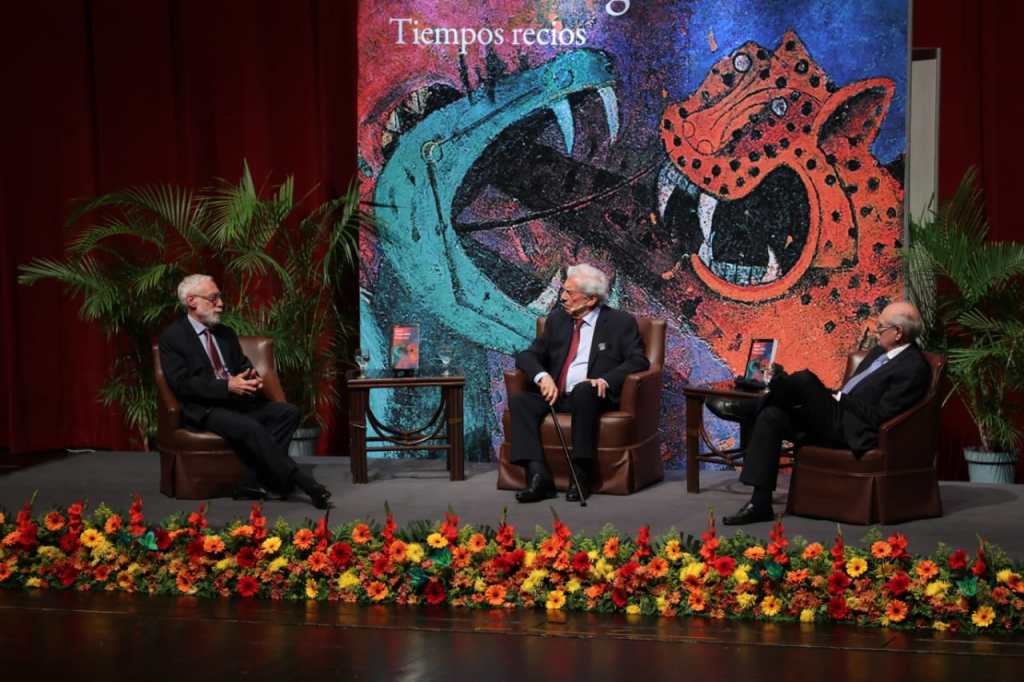
Vargas Llosa also stressed that in his creative process regularly one of the first things he writes is the title where a perspective of it is concentrated, but in this novel he did not succeed and it was until it ended that it was in the search for it.
While reading a letter from Santa Teresa de Ávila, whom he calls a great poet and magnificent writer, he found the phrase “RECIOUS TIMES”which gave the name to the novel. “It was a lighting and perfectly describes the time that Guatemala went from from the October revolution to the murder of Castillo Armas,” he added.
Before the book he traveled to Guatemala twice, as a tourist to Petén and visit the rest of the country. To write RECIOUS TIMES He traveled three times, made the trajectory of Castillo Armas and went to the towns where it is said that there were fighting. It was documented reading newspapers and magazines because although it had fiction, the book was based on historical events.