
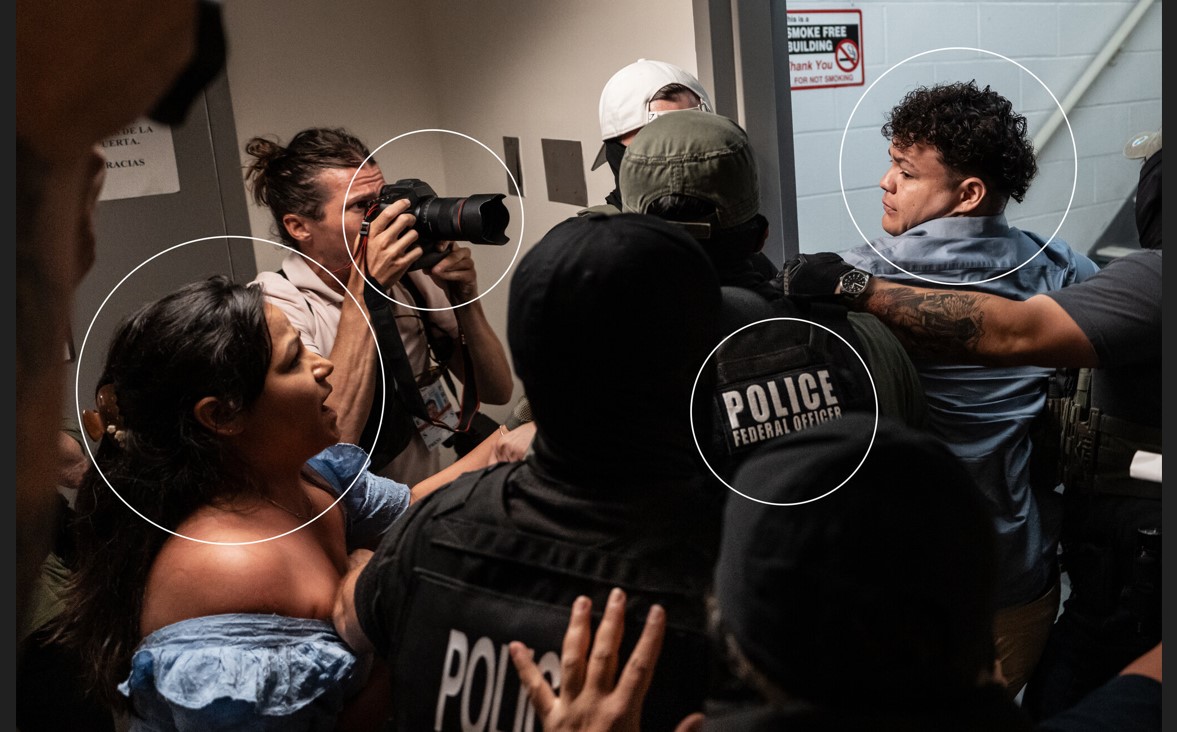
In New York, especially, arrests made in court have caused an increase in the arrests of undocumented migrants without criminal record.
Migration authorities used to stay out of court and courts. They knew that their presence could intimidate migrants and deter them from resorting to the legal system.
That changed in May, when Donald Trump’s government began to stop some migrants who presented themselves to mandatory appointments in court to accelerate their expulsions. The arrests have made the courts become places where Trump’s immigration repression campaign is seen live.
Masked agents monitor the courts. Migrants come to their audiences without knowing if they are falling into a trap. The arrests sometimes become intense struggles in corridors also crowded with photographers, activists and politicians.
Often, relatives are stunned.
“His arrest was like the show of the day, ”said Porfiria Lopez, one of Lopez Benitez’s sisters.“ The question we continue to ask ourselves is: how do they decide who they take? Is it random or is it theater?
Lopez Benitez, who is from Paraguay, crossed the southern border in May 2023. He was briefly arrested by border patrol agents in Arizona, subject to a deportation process and released in the United States while his case advanced in the courts. He traveled to New York, where he met with his two sisters, who are American citizens. He lived in Queens, worked in construction and had no criminal record, according to his family and lawyers.
As many people accused of illegally entering the United States, Lopez Benitez presented regularly to judicial appointments related to their deportation process, a legal process in which a migratory judge decides whether a person who entered illegally must be expelled from the country. As part of that process, Lopez Benitez had requested asylum, a type of legal protection for migrants who fear returning to their countries of origin.
Lopez Benitez’s sisters encouraged him to appear at his next hearing, on July 16, in the court located in the 26th of Federal Plaza, despite the arrests that were being carried out there. He arrived with his sisters and the hearing seemed to go well, and the judge scheduled his next hearing by 2029, to listen to the arguments of his asylum application.
Such a distant audience date is not unusual. It is the result of the enormous delay in the migratory courts, where millions of cases have accumulated for years, a situation that has generated frustration to Trump officials and has left many migrants in limbo while their asylum requests are reviewed.
But when he left the court, he was surrounded by federal agents. They stopped him and took him. They sent it to a detention cell crowded at number 26 of Federal Plaza for three days, before the customs immigration and control service transferred it to a detention center to more than 2500 kilometers, in Houston.
Lopez Benitez’s lawyers, who presented a legal motion requesting their release, did not understand why they had stopped it in the midst of their ongoing deportation process. They alleged that his detention violated his procedural rights, that he was not a danger or a risk of escape and that he had to be released while his immigration case was resolved.
In legal documents, government lawyers affirmed that Lopez Benitez was subject to mandatory detention for having illegally entered the country and had no right to an audience to request bail. They added that their lawyers had not demonstrated any “extraordinary circumstance” that justified their liberation.
Last week, Lopez Benitez received an pardon: a federal judge, Dale Ho, ordered that he was released from the Custody of the ICE and returned to New York as he continued his deportation case, so that his abrupt detention was nothing.
On Thursday, two weeks after the arrest of Lopez Benitez, ICE communicated to the family that it would be transferred back to the 26th of Federal Plaza to 6 pm the agency did not tell them much more.
The building was closed when the sisters showed up, so they surrounded their perimeter under a drizzle until they found a side exit by which their brother expected to come out.
They waited, nervous, for an hour, holding a sign with Spiderman scribbles, the favorite superhero of Lopez Benitez, and some greetings: welcome. I miss you.
They confused a few workers who left the building with Lopez Benitez, until they saw an imposing and familiar figure that walked to the glass doors of the exit. The man approached. He wore a white sweatshirt and sports pants, and two agents escort him.
He approached even more, and his unmistakable curly hair became more evident. It was him.
The sisters rushed, moaning, jumping to hug him.
Lopez Benitez Sollozaba.
Subscriber content
One of the two ICE agents turned away to contemplate the reunion. He visibly excited himself and wanted Lopez Benitez, in Spanish.
“This is the good part of the work,” said the agent, before leaving.