
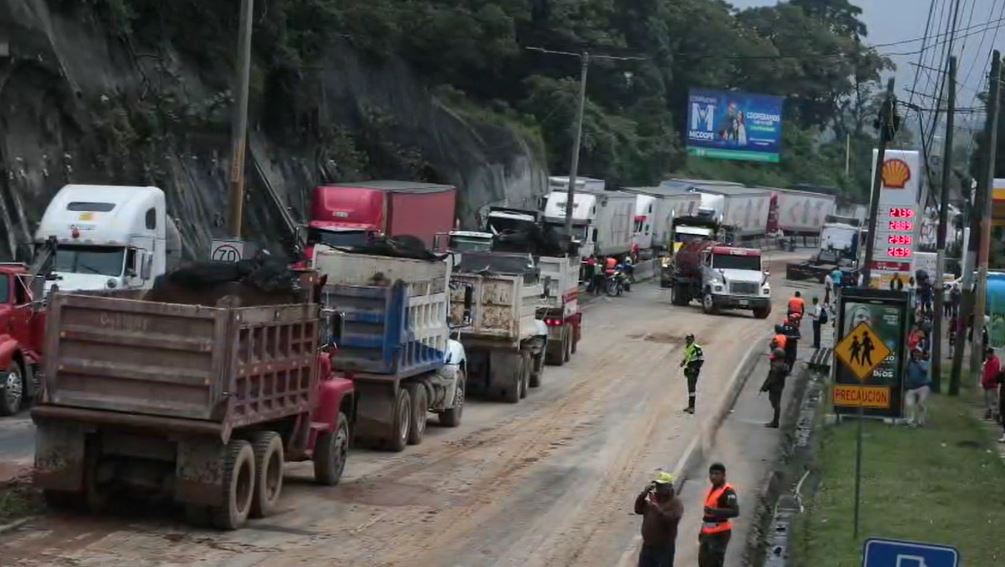
Higher costs and travel time, as well as loss of productive work hours and effects on logistics, are some of the impacts derived from the collapse at kilometer 24.5 of the highway to El Salvador.
The first landslide occurred on Monday, October 6, and blocked all lanes at that point. Until this Thursday the 9th, the landslides continue in the area, and one missing person and two injuries have already been reported.
Apart from being an access route for thousands of people, this section, which is part of the CA-1, is one of the strategic routes for the transfer of export and import cargo, as well as for the local distribution of products, commerce and industrial materials.
Costs and effects
As traffic through the area is suspended, alternative routes must be sought. For example, moving along the CA-2 Oriente can increase the distance between 20 and 30 kilometers, depending on the starting point of the load. This could prolong the transfer time by up to two hours, compared to the now closed road, explained Carlos Steiger, logistics analyst at the Guatemalan Association of Exporters (Agexport).
As for the cost, an increase of up to Q800 for freight is estimated, although the amount varies if it is fresh or dry product, he added.
Among the most affected products are manufactured goods such as food and beverages, cosmetics, plastic items and furniture, which are transferred to the regional market, mainly to El Salvador and Costa Rica, as well as fresh products sent to El Salvador, especially fruits and vegetables.
Steiger indicated that around 306 thousand units of transport for exports and imports circulate annually to and from the border posts with El Salvador, such as Pedro de Alvarado, Valle Nuevo and San Cristóbal.
This figure is equivalent to about 775 units per day. He clarified that not all of them travel through the CA-1 Oriente, where the collapse occurred, but the need for alternative routes congests the CA-2 Oriente, which is now the only road enabled to connect with El Salvador.
CONTENT FOR SUBSCRIBERS
Commercial corridor and affected areas
The CA-1 Oriente highway is a trunk road that connects the capital with the east of the country and the border with El Salvador, it is part of the Central American logistics corridor, key for regional trade, explained Herlindo Herrera, member of the Board of Directors and director of Communication of the Logistics Guild attached to the Chamber of Industry of Guatemala (CIG).
Among the affected areas, he mentioned Fraijanes, Santa Catarina Pinula, Villa Canales and San José Pinula, both residential and commercial and industrial areas that depend on this route for supply, while in Santa Rosa, municipalities such as Barberena and Cuilapa – with agro-industrial and commercial activity – also use this route for distribution, the executive commented.
Free zones, industrial parks in the east and the transit of goods destined for El Salvador and Honduras are also affected in their connectivity.
Immediate and future impact
Herrera explained that the immediate operational impacts include the urgent redesign of itineraries and schedules, with forced detours towards longer alternative routes, some in poor condition and not suitable for heavy transport, and details this:
- This implies an increase in logistics costs, such as fuel consumption for longer journeys and an increase in man hours for longer trips, with delays ranging from several hours to days in deliveries and fleet rotation cycles.
- Also if the closure is prolonged, companies will have to reconfigure their logistics networks, but the use of substitute routes not designed for cargo generates greater risks, more time and costs, which reduces the efficiency of the supply chain.
- Travel times are expected to remain, on average, 30% above usual, even if flow partially improves.
- By increasing cycle times per trip, trucks complete fewer trips than planned, reducing the volume shipped and increasing the need for fleet to meet commercial commitments.
The immediate consequence It is a structural increase in the unit logistics cost. Perishable or time-sensitive products—such as food, drugs or chemicals—face higher refrigeration costs.
If the closure lasts more than two or three weekscosts are no longer “eventual” and become part of the structural cost of the business. Since the highway to El Salvador is part of the strategic international trade corridor (CA-1), a prolonged closure affects national productivity, the flow of imported or exported goods, and labor mobility.
Four factors
Luis Mazariegos, member of the Board of Directors of the Guatemalan Chamber of Food and Beverages (CGAB), explained that the blocking of roads due to various events impacts several aspects which coincide with what Herrera explained.

First, the fleet operating cost, which includes fuel, vehicle rotation time, and salaries, without the sales or distribution force advancing.
Second, market losssince the products and services do not reach grocery stores, stores or markets. That day of sales is lost because the next day they must continue with their route.
Third, the loss of product, especially perishables that require refrigeration, such as dairy products, meats, hams or chicken. These have an operating limit depending on the fuel, and taking longer on the road increases the risk of losses. Freight for raw materials may also be lost.
Fourth, the displacement of workers. Some do not arrive or arrive late, which represents a loss of half a day or full days of work, with effects on productivity for both employees and companies.
“The landslide at kilometer 24.5 paralyzed commercial cargo transportation, both that coming from Central America to Guatemala and that for export. In food and beverages, the number one trading partner for Guatemala is Central America, especially El Salvador and Honduras,” Mazariegos said.
Heavy transport units, exceeding three tons, spent more than a day and a half stranded while looking for alternative routes, also considering the traffic restrictions in several municipalities during peak hours.
In the case of local distribution – such as to stores and grocery stores – which uses units smaller than three tons, there was also an impact, although these can circulate on alternate routes without time restrictions.
Affectation is reported for vans and trailers destined for Jutiapa and other eastern areas.