
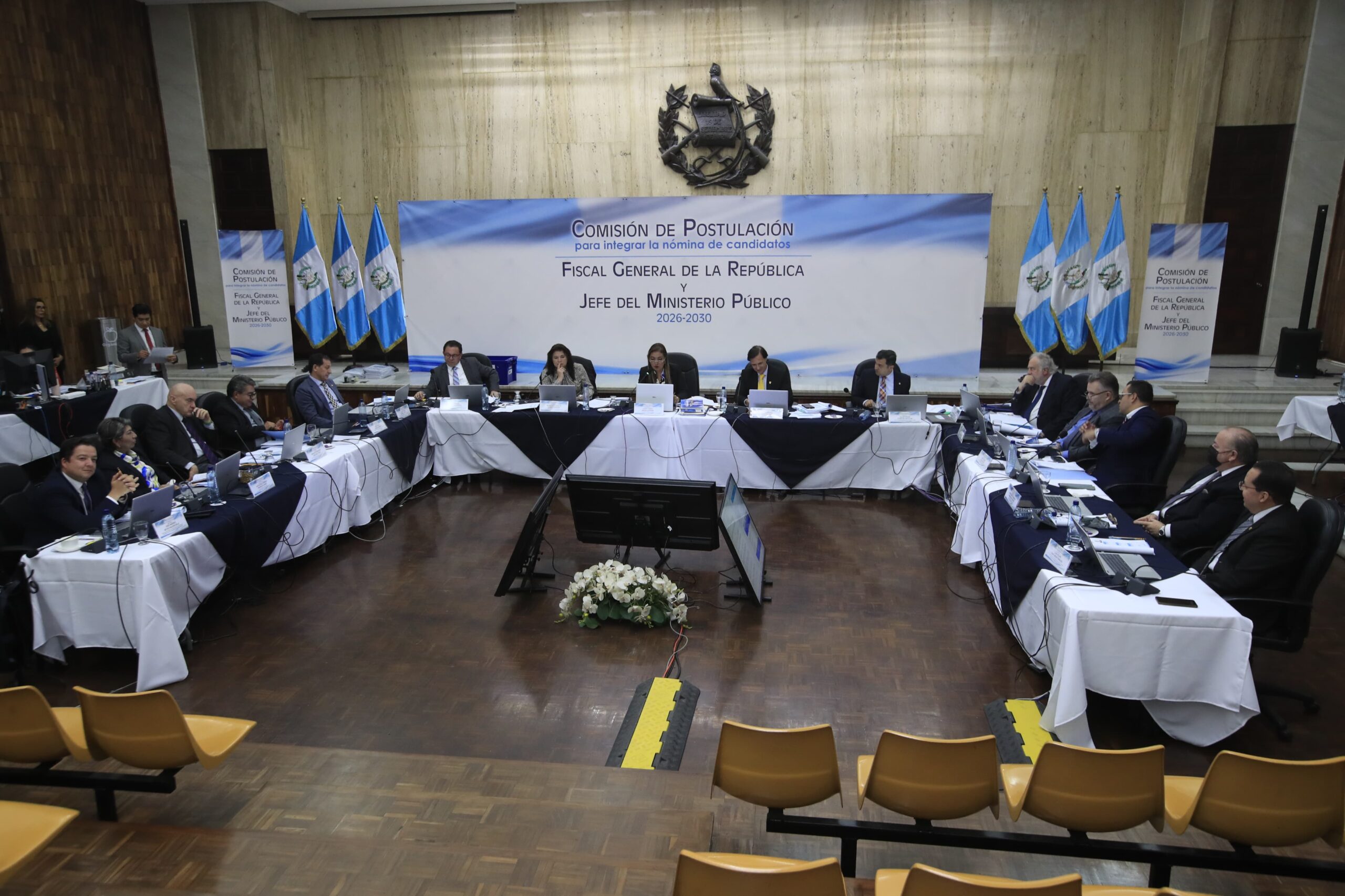
The work of the Nomination Commission for Attorney General is in the final stretch, but recent legal actions seek to influence the processas a mechanism of intimidation towards the commissioners before defining the list of candidates.
At the beginning of the session on Tuesday the 14th, the secretary of the commission Patricia Gámez considered that the complaints filed by Ricardo Méndez Ruiz against several commissioners are a form of intimidation. “I take it as an act of coercion, not only against me but against the commission. I want to point out that our law, those who are not legitimately accredited, is an intimidating process”
“I have acted in this commission with principles, with full independence. Filing complaints, instrumentalizing criminal law is an act of coercion that should not be allowed by any of us.”
For his part, the president of the Foundation Against Terrorism considers that his actions are necessary for a transcendental process, seeking to respect the laws and to avoid a possible conflict of interest.
The complaint is related to the postulator’s session on Monday, April 13, when the commission debated for several minutes whether the experience of a judge is comparable to the experience of a lawyer.
Among the requirements to be an applicant for attorney general, one must complete at least one period as a judge of the Court of Appeals or a court of equal category, or have at least 10 years of practice as a lawyer.
The exercise of a judge is not mentioned verbatim to aspire to said public office, which has caused some commissioners to doubt the qualification that must be given to judges when evaluating their professional experience.
The actions
Méndez Ruiz filed a complaint against Patricia Gámez, president of the Board of Directors of the College of Lawyers and Notaries of Guatemala (Cang) and head secretary of the commission, as well as against some commissioners.
The complaint was announced on his social network
The action occurs because Gámez and some commissioners are allegedly omitting the legal requirements in favor of some candidates for attorney general, considering Méndez Ruiz, which would be affecting the process.
#URGENT
🧵The Foundation Against Terrorism filed an injunction against Bernardo Arévalo, due to his lack of suitability to appoint Attorney General. pic.twitter.com/jBuIwhJKuc— Ricardo Mendez Ruiz (@RMendezRuiz) April 14, 2026
He also presented an amparo action against President Bernardo Arévalo, indicating that the president is not suitable to appoint the next head of the Public Ministry (MP).
“We have a president with criminal charges against him, in confrontation with the MP and with the power to appoint attorney general (…) our protection aims to put a stop to a flawed appointment, a stop to a conflict of interest,” said Méndez Ruiz in a video on the social network X.
President Arévalo has been mentioned by the current MP in the Semilla Corruption Case, which attributes illegalities in the process of establishing the political party that brought him to the presidency.
They seek to intimidate
Alejandro Solórzano, an independent observer, believes that the legal actions seek to generate fear among the commissioners, to influence the meaning of their votes in the key decisions that the candidate has this week: qualifying candidates and preparing the list of the six candidates.
The qualification is the filter for whether an aspiring candidate for attorney general continues or not in the process, since they need a minimum qualification of 75 points to be taken into account in the formation of the list of six candidates.
But the complaint and protection, in the middle of the qualification and prior to the final vote, has a clear underlying message, according to the analyst who has followed up on the candidate.
“They are clear intimidations with attempts to influence the votes. A criminal process causes fear in anyone, as lawyers they know how the law is applied in Guatemala, so some could feel intimidated,” he said.
The CC must pronounce
The debate that put some commissioners in the crosshairs of the Foundation Against Terrorism, to the point that they were denounced, was facilitated by Luis Aragón Solé, alternate secretary of the commission and dean of law at Universidad San Pablo.
The commissioner said that he was not seeking to alter the grading table, but suggested, on more than one occasion, holding a voting event to define the case, which generated resistance from some commissioners.
Among the arguments of that debate, mention was made of a protection that the Constitutional Court (CC) has on this issue, which days after the integration of the payroll has not been resolved.
Now, the new CC has that responsibility on its shoulders. Even three of the five titular magistrates delivered a note to Judge Anabella Morfín, president of the CC, to schedule this protection.
For Solórzano, it is best for the CC to rule and resolve this protection before the payroll integration stage is reached, to prevent the work carried out from being annulled in the event of a possible provisional protection.
“It is a crucial moment for the CC to issue its resolution and it will serve to project it. There is talk of two or three progressive votes, but that will be evaluated with decision-making,” he said.
The analyst was clear that the case should be heard, but he would hope that the CC does not affect the right to equality of judges. “It would be prudent to maintain the right of judges and maintain that right of equality with career prosecutors and career lawyers.”