
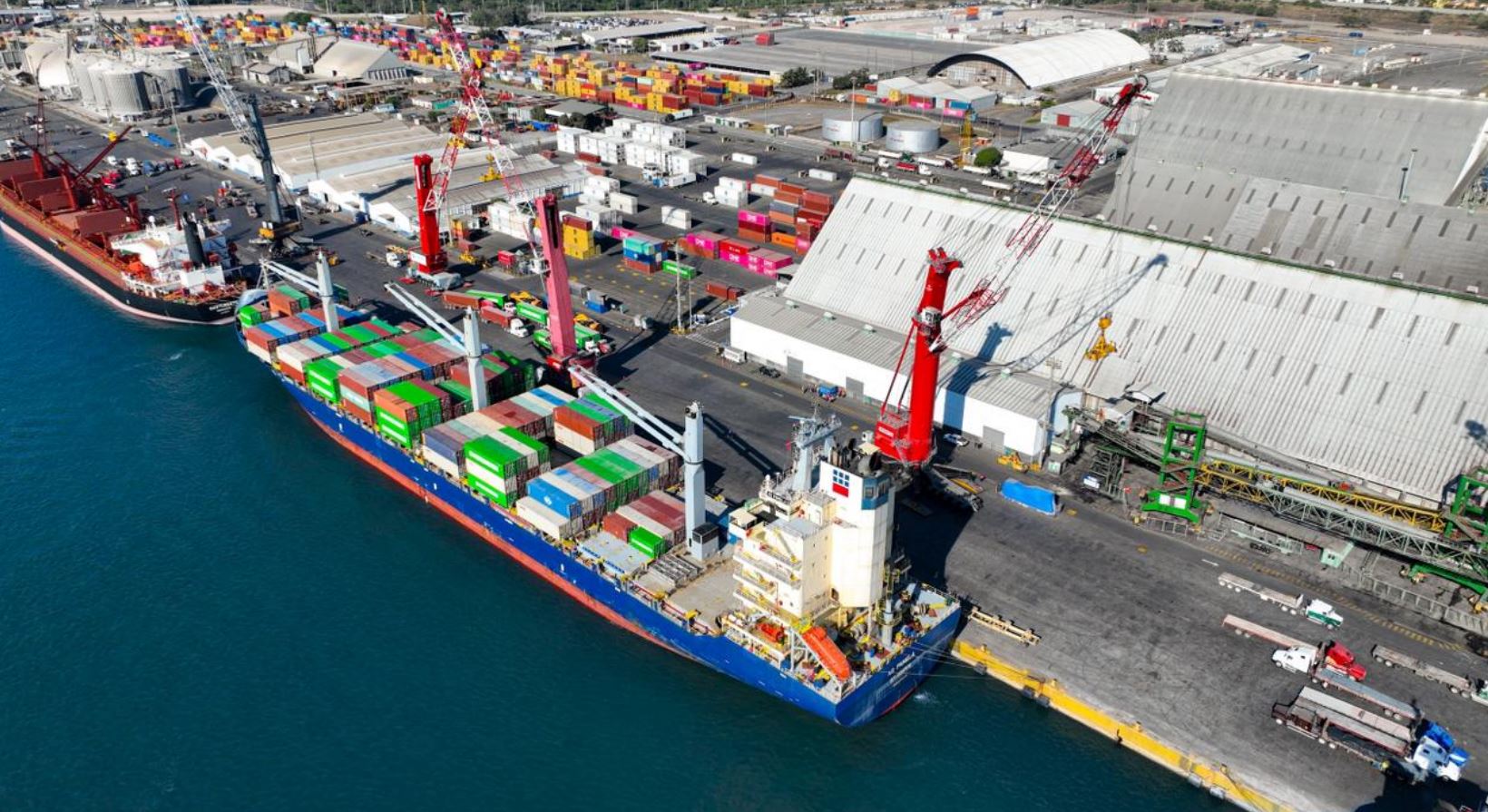
The movement of maritime cargo in Guatemala reached 35 million 254 thousand metric tons (MT) in 2025, which represented an increase of 13.3%, that is, four million more compared to 2024, when 31 million 107 thousand tons were moved, according to figures released this week by the National Port Commission (CPN), at an event held in Antigua Guatemala.
The balance was positive, despite the implementation of the United States tariff policy, which generated trade tensions, a country that continues to be the main route for embarking and disembarking goods for foreign trade.
The bulletin highlights that The ports maintain their trend as the main logistics platform for Guatemala’s foreign trade and represented 75% of the total volume of merchandise and goods transported last year. Land transportation represented 24.9% and air transportation, 0.10%.
This means that the port system continues to be the main axis for foreign trade.
In 2025, the national economy grew 4.3%, driven by the consumption of goods and services generated by the extraordinary income of family remittances, which exceeded US$25,530 million, with double-digit growth.
For 2026, the expectation of maritime cargo movement remains in line with the estimate of the economy’s growth rate, which stands at 4.1% as a central value.
Ports concentrate 75% of foreign trade
Statistics presented during the annual meeting of the United Nations Conference on Trade and Development (UNCTAD), organized by the TrainforTrade programme, indicate that the Quetzal Port Company (EPQ), in Escuintla, transported 17 million 332 thousand tons, which is equivalent to 49.1% of the total moved in the national port system last year. The figures include records from the APM Terminals Quetzal container terminal.
In second place, with 8 million 767 thousand tons, is the Santo Tomás de Castilla National Port Company (Empornac), in Izabal (25% of the total); Puerto Barrios, with 5 million 658 thousand tons (16%), and the San José buoys, in Escuintla, a terminal specialized in the handling of liquid bulk (fuels), with 3 million 496 thousand tons (9.9%).
With the official results, the EPQ continues to be the main port that serves the largest amount of maritime cargo in the port system.
In addition to cargo movement, the CPN statistical bulletin updated port operations figures, such as the number of containers moved, vessels docked, collection, main connection ports, efficiency indicators and national logistics.
It was explained that the objective of this data is to have official information for economic agents and the national logistics and port system, in order to facilitate decision-making, the formulation of initiatives and proposals, as well as the development of projects.
Maritime cargo grows with a sustained trend
This growth averages between 10% and 15%; That is, each year a positive trend has been maintained, since in 2023 28.8 million were registered; in 2024, 31.1 million, and in 2025, 35.2 million. That is, the system continues to grow organically, explained Leonel Molina, general director of the designated authority of the National Port System, CPN.
He exemplified that, if it is considered that 100% of those 35 million metric tons that are moved in the three ports, 89% corresponds to national consumption, that is, to import operations.
“In other words, our ports are not transshipment ports nor do they move cargo for third parties, as is the case in Panama, Manzanillo or Long Beach, which are transshipment ports; we are ports that serve our imports,” he stressed.
The director added that, under the premise that ports serve the national economy for imports and exports by 90%, as the national economy increases there is a direct correlation between the growth of imports and exports, which is proportional to the increase in the mobilization of metric tons.