
The election of the next attorney general was reconfigured again after the intervention of the Constitutional Court (CC)which forced part of the process to be repeated and left the previous payroll void. The resolution directly impacted the evaluation criteria used by the Nomination Commission.
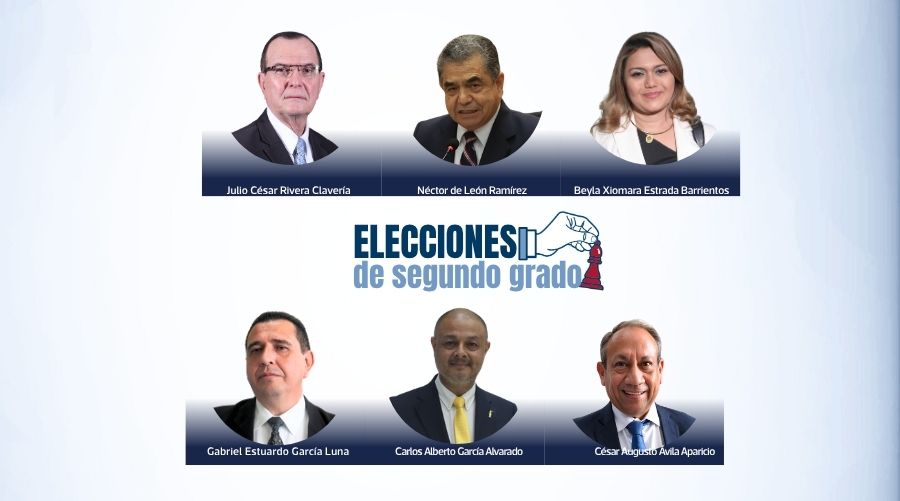
With this adjustment, the postulator joined a new list of six candidates, which will be sent to President Bernardo Arévalo, in charge of making the final designation.
The CC ruling introduced a decisive change: it ordered to modify the way in which professional experience was valued, which altered the qualifications and the previous result of the process.
In this new scenario, the profiles included in the list return to the center of the debate, both because of their trajectories within the justice system and because of past decisions that have generated public questions.
Gabriel Estuardo García Luna (15 votes in favor and none against)
In 2022 he was a candidate for attorney general. He is currently a substitute member of the Judicial Disciplinary Board. During her presidency of that board, Judge Rocío Murillo was suspended for 20 days without pay, due to administrative misconduct, for failing to comply with a personal exhibition in the case of the death of 41 girls from the Hogar Seguro Virgen de la Asunción, in 2018.
A complaint was registered against him in the Human Rights Ombudsman’s Office, from 2015 to 2018.
He presented a preliminary lawsuit together with Mildred Azucena Mejía Ábrego, against Víctor Leonel López del Valle, Justice of the Peace in Santa Catalina La Tinta, Alta Verapaz, which was admitted for processing by the CSJ.
He was a vocal magistrate of the Mixed Regional Chamber of the Court of Appeals of Cobán, Alta Verapaz. He entered the Judicial Branch in 1997, where he held positions of officer, secretary, justice of the peace, judge of First Instance and courtroom magistrate in the criminal area.
He has been a university professor in the bachelor’s and master’s degrees, at the Rafael Landívar University and at the School of Judicial Studies (EEJ). He has a master’s degree in Criminal Law from USAC.
Beyla Adaly Estrada Barrientos (12 votes in favor and three against)
She is a judge of the Third Chamber of Criminal Appeals. She is the wife of Alfredo Brito, former Secretary of Social Communication during the government of former President Jimmy Morales, which has generated attention about possible crossovers between her personal environment and high-profile political cases.
In his career he has learned about files related to relevant figures, including Jimmy Morales himself, whose government faced multiple investigations. Among its most cited resolutions is the benefit of house arrest granted to the brother of the former president, Samuel Morales, and his son José Manuel Morales, who were prosecuted in the Botín Propiedad case, an investigation for alleged irregularities in the use of public resources from which they were acquitted.
In his career, he learned about files from other relevant figures in the political and judicial system. Among them, Gustavo Alejos, named by the Special Prosecutor’s Office against Impunity (Feci) within the State Cooptation case for his alleged role as an intermediary between companies and officials for the awarding of public contracts and obtaining irregular political financing during the government of Otto Pérez Molina.
In this context, the Third Chamber of Criminal Appeals—of which Estrada was a member—heard appeals within its process and confirmed alternative measures in its favor, despite the fact that the Feci had challenged that benefit, which raised questions because it was an actor in a relevant corruption investigation.
In 2018, the Third Chamber of Criminal Appeals – made up of Estrada Barrientos – granted protection in favor of the Russian citizen Igor Bitkov, with which it annulled the resolution of Judge Éricka Aifán that had sent him to trial for the use of allegedly falsified documents. The Chamber considered that the judge had not complied with previous guidelines and ordered her to issue a new resolution.
The ruling had direct implications for Aifán, since it not only reversed his decision, but also led to legal actions against him by the magistrates, who questioned his actions due to an alleged breach of protection. This episode highlighted tensions between higher-risk courts and appeals chambers in high-impact cases.
Julio César Rivera Clavería (10 votes in favor and five against)
He began his career in 1976 as a detective in the Judicial Section of the State Attorney’s Office, giving way to a career linked to public security and state administration.
During the government of Vinicio Cerezo he held key positions as director of Prisons, and later he was vice minister of the Interior and director of the Treasury Guard.
His name was mentioned in reports from the International Commission against Impunity in Guatemala (CICIG), taken up by journalistic investigations, for alleged indirect links with the Moreno Network, a structure dedicated to smuggling and customs fraud in the 80s and 90s.
The accusation is based on the testimony of an effective collaborator who placed him in environments related to operators of that network, without a role being attributed to him within the structure nor criminal charges arising against him.
Clavería has rejected these versions and maintains that he was never formally investigated for these events.
In the political sphere, he was a presidential candidate in 2023 for the Mi Familia party and, since 2010, he has sought on several occasions to be appointed as attorney general, without achieving his appointment.
Néctor Guilebaldo de León (10 votes in favor and five against)
He is a career judge with experience in the criminal field. Between 2014 and 2023 he served as presiding judge of the Fourth Court of Appeals of the Criminal Branch, and since 2016 he joined the plenary session of the Supreme Court of Justice (CSJ) as a substitute judge.
In 2020, he endorsed processing a request for a pretrial against the judges of the Constitutional Court, Francisco de Mata Vela and Gloria Porras, promoted by the defense of the Bitkov family in the Migration case, which generated debate in the legal field.
He also acted as investigative judge in the pretrial against Parlacén deputy Gilmar Othmar Sánchez Herrera, linked to the case. Loot Property Registry. In that role, he recommended that the request continue its processing, allowing the process to advance so that the CSJ could rule on the withdrawal of immunity.
He has faced specific questions. Lawyer Alfonso Carrillo has pointed this out for resolutions linked to the Blanca Stalling case, especially for decisions adopted in the Appeals Chamber that – according to the jurist – affected key stages of the process and were favorable for the former judge. These accusations have been public, although they have not led to sanctions against them.
In 2022 he joined the list of candidates for attorney general of the Public Ministry.
Carlos Alberto García Alvarado (11 votes in favor and four against)
He ran for judge of the Supreme Electoral Tribunal in the process that concluded this year.
He has been the district attorney of Petén since 2021 and has also participated in the application processes for a judgeship of the Supreme Court of Justice, in the 2024 process, but was excluded for failing to comply with the formal requirements.
He was also in the municipal prosecutor’s office of Livingston, Izabal, as deputy district attorney between 2017 and 2021, in the organized crime section prosecutor’s office between 2015 and 2016 and assistant prosecutor in the Crimes against Cultural Heritage prosecutor’s office.
César Augusto Ávila Aparicio (11 votes in favor and four against)
Current magistrate of the Mixed Regional Chamber of the Court of Appeals of Zacapa. He had previously held that position in the Chiquimula room.
He is the husband of Heidy Hichos Posadas, niece of former deputy Baudilio Hichos, who declared to this newspaper in 2014 that he had been an operator of judges and magistrates for the defunct Líder and Patriota parties.
In the Mixed Court of Chiquimula, Ávila Aparicio tried to recuse himself from hearing the pretrial against the then mayor of Ipala Esduin Javier Javier, accused of the murder of three people.
He worked in the First Economic Court of Guatemala as a service assistant, notifier and official.
He was legal advisor in the Ministry of Environment and in the Municipality of Chiquimula.
He has also been part of the board of directors of the Institute of Judges of the Court of Appeals, and in 2023 he was part of the list of 26 candidates for judges of the Supreme Court of Justice, a process in which he was included in the list of 40 candidates who obtained master’s degrees and postgraduate degrees in a short time.