
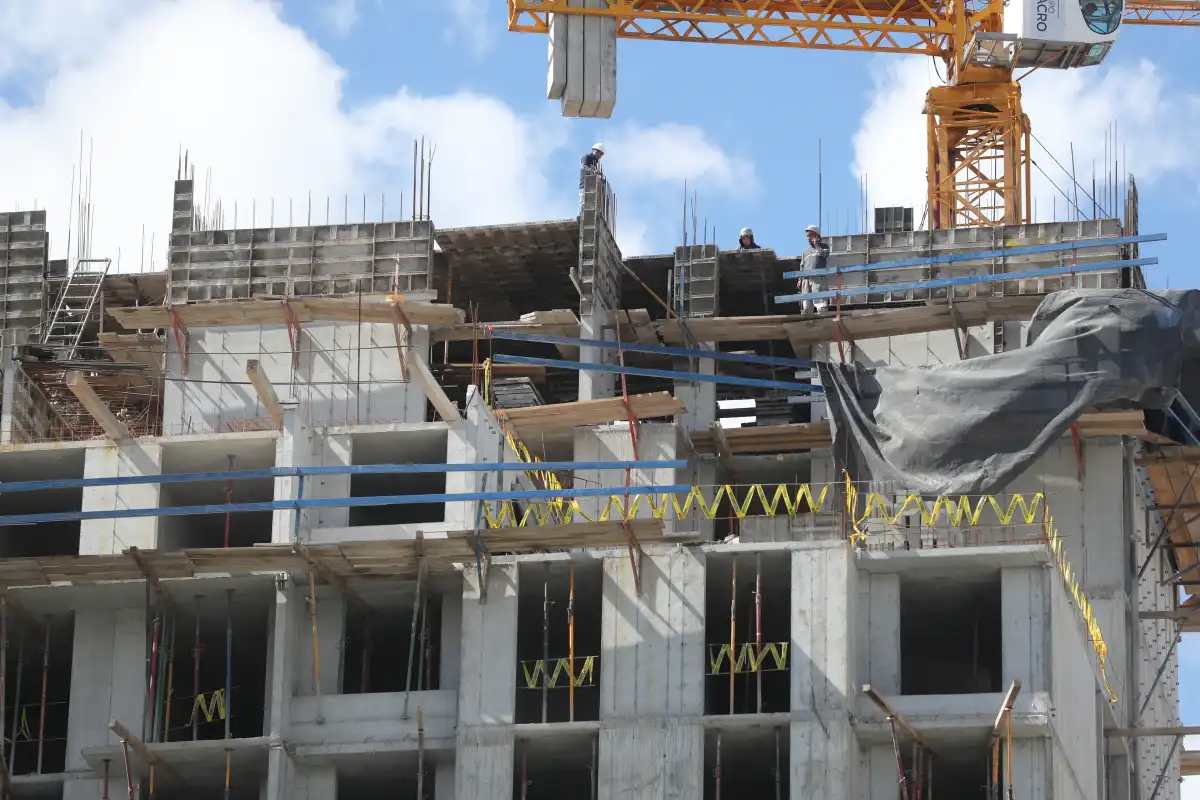
On August 12, the government agreement that gave life to the Agile Construction Window (VAG) expires in 2021. This platform was promoted during the pandemic as part of an economic reactivation strategy and integrated nine institutions, with the aim of digitizing and coordinating the procedures prior to obtaining municipal construction licenses.
Government Agreement 105-2021 created the “Interinstitutional Commission to contribute to the economic reactivation of the construction sector”, whose function was to promote coordination between entities and streamline processes related to licenses.
The vice minister of the Ministry of Environment and Natural Resources, José Rodrigo Rodas, explained to Free press that the mechanism arose in a context in which it was necessary to avoid crowds and reactivate the economy due to the covid-19 pandemic. “The objective of the agreement is to contribute to the use and coordination of the agile construction window as an alternative and voluntary means for users, in order to streamline and digitize the documents prior to obtaining the construction license,” he indicated.
In that sense, he indicated that the role of the Ministry of the Environment is to streamline and digitalize environmental licenses and resolve them within the times stipulated by law. In addition, he added that between 2024 and 2025, 166 files were registered, mainly in categories B1 and B2.
According to Rodas, these correspond to real estate projects, warehouses and supermarkets. “We noticed an increase in the request for records compared to the previous government,” he mentioned.
The institutions that make up the VAG are:
- Ministry of Economy (Mineco)
- Ministry of Environment and Natural Resources (MARN)
- Ministry of Culture and Sports (MCD)
- Ministry of Energy and Mines (MEM)
- Ministry of Public Health and Social Assistance (MSPAS)
- National Council of Protected Areas (Conap)
- General Directorate of Civil Aeronautics (DGAC)
- General Property Registry
- National Forest Institute (Inab)
- National Coordinator for Disaster Reduction (Conred)
Time reduction
According to Vice Minister José Rodrigo Rodas, one of the main achievements of the Agile Construction Window has been the reduction of license resolution times. He pointed out that previously the efforts could extend up to 500 or 700 days, while currently the deadlines are between 42 and 94 days, depending on the category of the project.
“We are solving an A instrument in 94 days, a B1 in 69 days and a B2 in 42 days,” he indicated. He added that, in comparison, during the previous government the times were 126 days for category A, 137 for B1 and 119 for B2.
The official added that, although reductions in time have been recorded, there are still pending goals. He indicated that in 2024 a reform was made to the regulations that reduced the period for resolving category A instruments from 95 to 75 days. However, the current average is still above that objective. “We know there is still a lot to do,” he said.
Benefits and challenges
Vice Minister José Rodrigo Rodas indicated that the reduction in time is one of the main benefits; However, he specified that these have not implied a decrease in the quality of environmental instruments. “We are not compromising the quality of environmental instruments,” he stated.
He explained that these function as nature protection mechanisms, by including mitigation measures aimed at reducing the impacts of projects on the environment. In that sense, he pointed out that the streamlining of processes seeks to boost the economy, generate employment and promote development, but with environmental balance.
The official also highlighted the increase in the efforts of the Ministry of Environment and Natural Resources (MARN), which went from dealing with around 19 thousand files in 2023 to 21 thousand in 2024 and more than 24 thousand in 2025. He indicated that the institution not only manages projects linked to construction, but also mining, electrification and agro-industrial initiatives.
Among the main challenges, he mentioned the limitation of personnel to deal with the volume of files. “A technician had to see a large number of files that he really didn’t have enough time to resolve,” he said.
To address this situation, he indicated that new personnel were hired and trained, which allowed response times to be improved. Likewise, he added that another challenge has been the digitalization of services, a process in which adjustments are still being made.
They seek renewal
According to José Ardón, executive director of the Guatemalan Chamber of Construction, the sector has maintained communication with public institutions to advance the process of renewing the mechanism. “We are making arrangements with the authorities. We have found good will and open ears to evaluate the results we have had in these five years of existence of the window,” he stated.
He added that the Chamber is working on a report on the economic impact of the tool on the country’s competitiveness, with the aim of providing input for the discussion on its continuity.
From the Ministry of Environment and Natural Resources, Vice Minister José Rodrigo Rodas explained that the agreement establishes the Ministry of Economy (Mineco) as the governing body, in charge of convening the institutions to make a decision on the continuity of the mechanism. “This decision would have to be made in a collegial manner to determine what analysis and what continuity could be given to the agile construction window,” he indicated.
He pointed out that the current context must be evaluated, since the instrument emerged during the pandemic and now responds to a different economic dynamic.
Rodas added that the decision does not depend solely on his portfolio, but on the set of institutions that make up the commission. “We have made efforts to comply with the objective of the agreement and the objective of the law, which is to streamline the procedures for environmental management,” he said.
He indicated that the changes implemented have allowed reductions in resolution times, although he stressed that the continuity of the mechanism requires a joint analysis.