
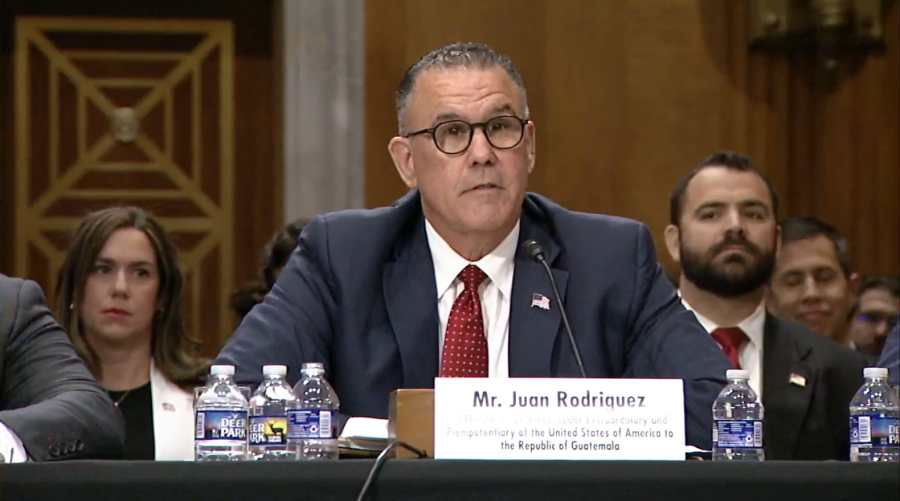
The audience of Juan Rodrigueznominated as ambassador of USA in Guatemalabefore the United States Senate on Tuesday, April 28, included among its definitions that Washington should not intervene in Guatemalan electoral processes or support candidatesalthough it does support the rule of law and transparency.
Although his initial presentation addressed topics such as migration, security and geopolitics, it was the senators’ questions that defined the most relevant moments, especially around the democratic process in Guatemala and the influence of external actors.
Next, the expanded exchange and the closest to the interventions.
Elections and non-intervention
In the first round, the Democratic Senator Tim Kaine He consulted him about the role of the United States in the elections in Guatemala.
Rodríguez responded that the Embassy must interact with candidates, but without endorsing any, considering that this would constitute interference.
He also stated that US support should focus on ensuring transparent processes and avoiding the influence of “malign actors.”
Tim Kaine: In December 2023, several members of this committee traveled to Guatemala in response to what we considered a possible attempt to interrupt the democratic transition and prevent the then president-elect from taking office. There was a bipartisan effort to support that transition.
Now, Guatemala faces key processes: judicial elections, appointments to the Constitutional Court, the Attorney General’s Office and, later, general elections. How can the United States support free and fair elections without interfering in the country’s domestic politics?
Juan Rodríguez: I think it’s very important for the Embassy, first of all, to interact with the candidates who are running for office… I think it’s important for them to let the candidates know what the priorities of the United States are.
However, I don’t think the Embassy should be used to endorse any specific candidate, I think that crosses the line into interference in domestic politics, and I wouldn’t support that.
As for how to ensure a transparent and fair election… I believe that, above all, the United States must defend the rule of law.
I think we should continue to support the ongoing elections that are happening in Guatemala. “When I say support, I believe we must ensure that the internal process is observed, that there is no interference from malign actors, and that Guatemala is determined to determine for itself who will be its representative in these important institutions.”
Tim Kaine: When you talk about malign actors, do you include both foreign and domestic actors who try to interfere in the democratic process?
Juan Rodríguez: “I totally agree. So far, I think the Tribunal, the Electoral Tribunal, has already been elected. Right now there is an electoral process underway for the position of attorney general, and from what I see, things are moving forward in accordance with national law, and I think that is what we should support.”
Consuelo Porras: sanctions and lack of information
Later, Kaine addressed the issue of Attorney General Consuelo Porras. Rodríguez avoided commenting on the sanctions against him, arguing that he does not have access to classified information.
Tim Kaine: The current attorney general, Consuelo Porras, has been sanctioned by the United States. If confirmed, would you continue with that US policy regarding that official?
Juan Rodríguez: “I am not aware of the details of why Consuelo Porras has been sanctioned. The State Department has not shared that information with me, so I cannot comment on what the basis for the sanctions is. However, I am here to serve under the instructions of the president and the secretary, and I will carry out those instructions as the president’s representative in Guatemala.”
Tim Kaine: Do you know the attorney general or have you discussed her case with US authorities?
Juan Rodríguez: “No… they told me that the information was classified, and as an outsider I have no right to receive that information.”
Bilateral relationship and cooperation
He Republican Senator Steve Daines focused his intervention on the bilateral relationship and assured that the relationship between the US and Guatemala is going through a moment of high cooperation in migration and combating drug traffickingbut warned that Bernardo Arévalo’s government faces obstructions from corrupt networks within the judicial system and the Prosecutor’s Office, which, in his words, limits his ability to govern.
Senator Steve Daines: The bilateral relationship has advanced in immigration cooperation and against drug trafficking. At the same time, President Arévalo has faced persistent obstruction from corrupt networks embedded in Guatemala’s Judiciary and Attorney General’s Office, limiting his ability to govern effectively.
If confirmed, How do you plan to maintain the strong bilateral relationship with the Trump Administration while navigating the domestic political constraints facing the president? And what types of programs will you promote to State Department leadership when requesting resources from the America First Opportunity Fund?
Juan Rodríguez: “I think it builds on the foundation that has already been established… there is strong inter-institutional cooperation with the Guatemalan government to combat drug trafficking and illicit financing of political organizations.
I think that can certainly be strengthened. […] There is a memorandum of understanding on global health… that has allocated about $65 million in aid… and I think that financial assistance and training of the interagency task force should continue to be pursued.”
Corruption, CICIG and sovereignty
The debate continued with the topic of corruption and CICIGwhere the nominee expressed that this type of mechanism can come into tension with national sovereignty. He noted that the best way to combat corruption is to strengthen internal institutions.
Tim Kaine: “One of the challenges in Guatemala has been corruption […] In 2007, the UN established an anti-corruption organization called CICIG […] who participated in investigations, even linked to previous governments.
President Jimmy Morales refused to extend his term […] and since then what is known as the ‘Corrupt Pact’ emerged, which included Attorney General Consuelo Porras. You have suggested that you had concerns about the Commission […] for a possible violation of sovereignty.
Did you have concerns about CICIG? And I could describe them, but more generally, What do you think we should do to help Guatemalan officials who want to combat the culture of corruption in the country?
Juan Rodríguez: “First, I want you to understand that I represented a Canadian company that had the first case filed with CICIG, so I was very aware of the organization.
The problem with the organization is that it goes against our long-standing principle of allowing countries to govern themselves and the principle of self-determination.
And ultimately, that is the struggle that was faced at the time that is why President Jimmy Morales refused to renew it.”
Tim Kaine: Did you not believe that President Morales’ decision was also based on his own concern about the prosecution of people linked to his administration due to this climate of corruption?
Juan Rodríguez: “Senator, frankly, I don’t know the reason. I wasn’t there and I don’t know exactly the reasons why that happened. I’m only aware, from press reports, that that was the stated reason, the threat to sovereignty. Well, I think the way to fight corruption is simply to strengthen the rule of law and the national institutions designed to fight it.
If you want to combat corruption, strengthen the Prosecutor’s Office and the Public Ministry. And that is where the United States can be very instructive and persuasive. I believe the way to combat corruption is simply to strengthen the rule of law and the national institutions designed to fight it. If you want to combat corruption, strengthen the Prosecutor’s Office and the Public Ministry. And that is where the United States can be very instructive and persuasive.”
Migration, human trafficking and security
In the round with him Republican Senator Ted Cruz, the focus turned towards migration and security.
Rodríguez proposed expanding cooperation with Guatemalan security forces, reinforcing training and maintaining financial assistance.
Ted Cruz: Guatemala is a key point on migratory routes and in the operation of human trafficking networks. What concrete measures will you take to reduce irregular migration in the long term?
Juan Rodríguez: “I think the main focus should be on developing more inter-institutional participation with the Guatemalan Police and Law Enforcement. We already provide training, we provide financial assistance and I think that should be encouraged. As I understand it, the Arévalo Administration has been very cooperative with the United States in that regard.”
China, Taiwan and technology
Finally, at address China’s influencewarned that an eventual change in relations between Guatemala and that country would be a “blow to national security” of the United States, and proposed counteracting it with investment and technological cooperation.
Ted Cruz: China seeks to get Guatemala to break relations with Taiwan. What would it mean for US interests if Guatemala switches from Taiwan to China? And if confirmed, what is your plan to ensure that Guatemala remains aligned with Taiwan and, more broadly, with the United States rather than China?
Juan Rodríguez: “It would be a blow to national security if Guatemala switched its support from Taiwan to China. In my opinion, the way to counter China’s economic coercion, because that is what it does, is to encourage more foreign direct investment in Guatemala by the Taiwanese government and the United States.
I believe the United States can do much more to counter China’s malign influences, for example, in the area of cybersecurity. I think we can do a lot more to encourage the phone company, for example, to stop using Huawei software. “There is no reason why the telephone company, which is owned by a US holding company, cannot use a trusted US provider for its backbone.”
General posture
In his opening statement, Juan Rodríguez made his line clear on the immigration issue. “Migration must be addressed with urgency and realism. Illegal immigration from Guatemala puts pressure on our border, our resources and our communities. I will push for even stronger cooperation with the Guatemalan Government to stop illegal immigration, dismantle human trafficking networks and ensure the prompt return of those who do not have a legal basis to remain in the United States,” was one of his specific phrases.
“Our message will be clear. Illegal immigration is not a gateway. Second, economic commitment must support American workers, businesses and producers,” he continued.
“I will work to ensure that Guatemala is a key bulwark against Chinese influence in the region,” he also assured.
The hearing revealed a nominee who prioritizes security, migration and geopolitics, with an emphasis on concrete results for the United States, but who did not delve into sensitive issues such as sanctions against the attorney general and the internal dynamics of the justice system in Guatemala.