
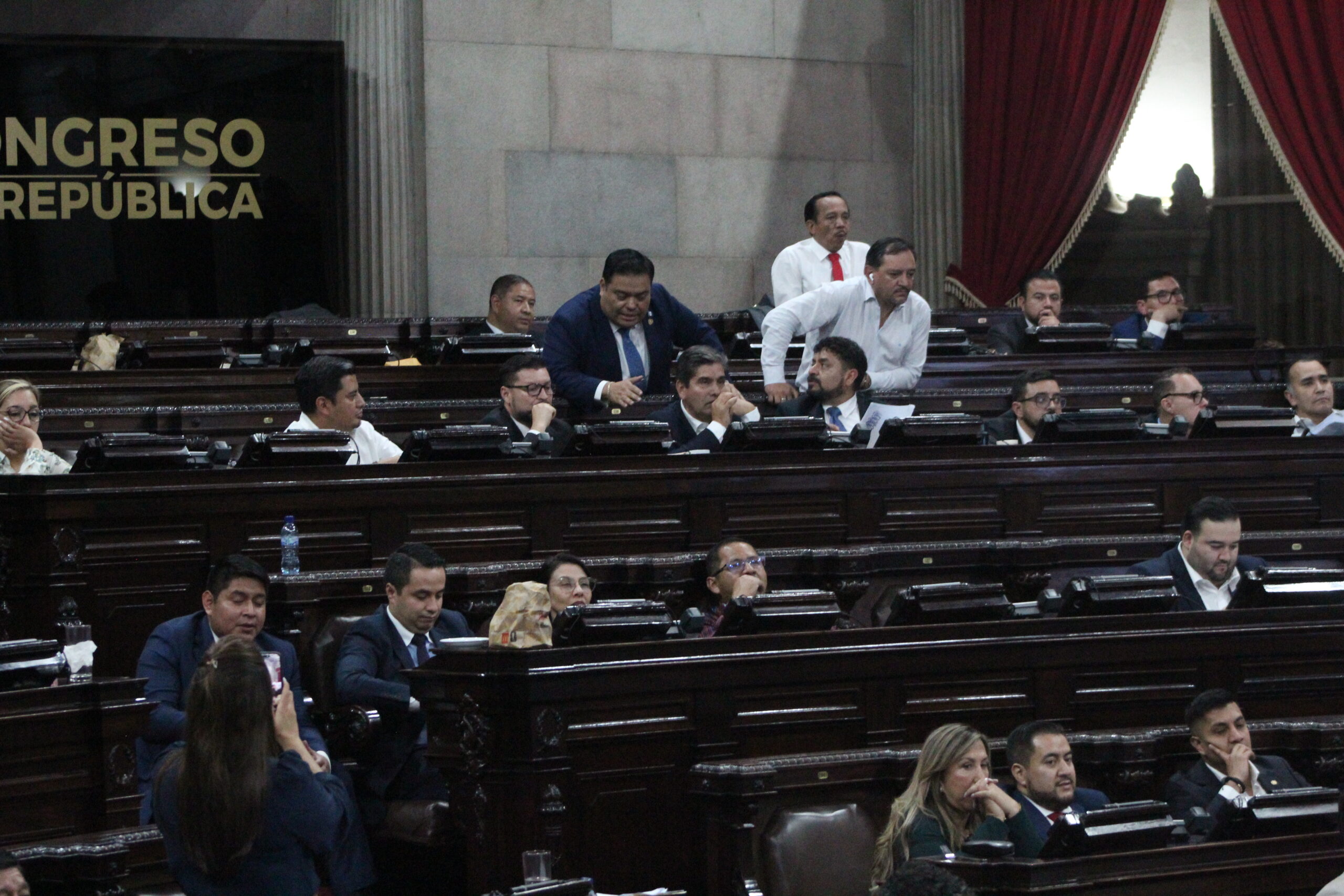
Tomorrow is the last opportunity that the deputies have to approve in the first regular period of sessions of 2026, initiative 6593, which contains the Comprehensive Law against Money Laundering or Other Assets and the Financing of Terrorism.
In the ordinary session last Tuesday, May 5, the discussion and approval by articles and their final draft was planned. However, Because the 107 votes required for its approval were not reached, the president of Congress, Luis Contreras, adjourned the sessionwhich postponed the approval of the standard for another week.
According to deputies from the official bloc, as well as from other legislative blocs, the benches Vamos, National Unity of Hope (UNE), Everyone, Valor and Cabal They hindered the approval of the anti-money laundering law, as they sought consensus to approve the modifications to the organic law of the Public Ministry (MP) and annul the agreement that gave life to the International Commission Against Impunity in Guatemala (CICIG), this in exchange for the votes to approve the anti-money laundering law.
However, negotiations and agreements continue in Congress to ensure that the anti-money laundering law can be approved before the end of the first regular session on May 15.
Negotiations continue
The second vice president of Congress, Elmer Palencia, He stated that there are agreements between the different legislative blocks to approve the amendments to the anti-money laundering law during the session that will be held tomorrow.
“We are already in the final stretch to reach the necessary agreements to approve the amendments and that will allow us to approve this important initiative next Tuesday. There are few details, there are some observations, but all the contributions of the legislative blocks are important and are being taken into account, in such a way that we can have a modern law that allows the fight against money laundering,” said the congressman.
For his part, the president of Congress, Luis Contreras, indicated that there are still certain “fears” on the part of some legislative blocks to approve the law, mainly related to the obligations that notaries must comply with to prevent money laundering.
“Notaries have several obligations. The first is to register, which they should have already done. The second is to have a record of their clients and the third is to notify if a client engages in any illicit business; they would have to notify it, but they also have a lot of problems with the fines, they want the notaries to only have a $500 fine and Gafi does not accept it, the fine has to be bigger, they—Gafi—are stuck on that,” said Contreras.
Both the requirements requested from notaries and other aspects of the proposal They are part of the recommendations of the Latin American Financial Action Group (Gafilat), with the purpose of aligning the anti-money laundering norm with international standards.
The president of Congress assured that the anti-money laundering law initiative, as well as the initiative to create the port law, will be included in the agenda of the session that will be held on Tuesday, May 12, since the objective is to approve them before the extraordinary period begins on the 16th of the current month.
Modification to the MP law and avoid new Cicig
Deputy Orlando Blanco, fourth vice president of Congress, He stated that last Tuesday There was a “systematic blockage” to the approval of the anti-money laundering law by several groups. The main reason was the negotiation of votes that would allow the modifications to be approved. the MP law to return to the president the power to remove the attorney general, This is due to the possible possibility that the next government could dismiss the prosecutor who was appointed by President Bernardo Arévalo.
“They were negotiating to approve the Public Ministry law, the one that allows the president to change the prosecutor whenever he wants. However, when President Bernardo Arévalo presented it in May 2024, nothing happened. Now they want it to pave the way in case they want to change the prosecutor,” Blanco said.
He also indicated that another issue they sought to address was the repeal of the agreement that gave life to the defunct International Commission Against Impunity in Guatemala (CICIG), which is still in force. This is due to the possibility that the commission could be reactivated again by the new head of the MP.
“There was also talk that they wanted to repeal the agreement that the State of Guatemala signed with Cicig, because that agreement could be reopened at any time and the new prosecutor could request again, through an exchange of letters, that this agreement that enabled Cicig be re-enabled. I see it as very complicated, but it is part of what they were negotiating,” said Blanco.
The congressman also indicated that there is a third scenario and that is that “There are certain people interested in regularizing their situation” before the anti-money laundering law can be approved, Therefore, it would be convenient for them to delay its approval.
Political persecution tool
According to the head of the Vamos group, Alan Rodríguez, at no time do the deputies of his bench oppose the approval of the anti-money laundering law, but only They consider that it would not be feasible to approve a law of such magnitude without due modifications for its implementation and discarded the accusations made by the pro-government deputies.
“What we are in favor of defending the rights of the people, of defending the rights and constitutional guarantees of Guatemalans and not just coming to approve a law without the necessary amendments, without the necessary knowledge and not just coming like sheep to vote, because I assure you that at least 90 deputies have not read that law, they have not read the opinion and they have not read the amendments, but they do not really know the consequences of voting for something like that without reading,” he assured.
According to Rodríguez, the pro-government deputies “have not read the law either” and assures that, If the anti-money laundering law is approved without the corresponding amendments, it will only serve as an “instrument of political persecution” by the ruling party.
They should not be afraid
For his part, deputy Raúl Barrera, from the official blocassures that there should be no opposition to the law for “those who do things correctly,” since what the law does anti-money laundering law is to standardize the country with the standards established internationally to combat this crime.
“Anyone who believes that the law is risky is because they can flirt with activities that may not be legal, which is why anyone who operates within the framework of legality should not fear that this law will become a current instrument,” he says. Barrera also assures that “with the positive change in the Public Ministry there should be no fear that the justice system will continue to be used as a tool of political persecution, we must turn the page and have confidence that the change also fundamentally implies that the laws are interpreted correctly.”
Important for investment
On Friday, May 8, the regular meeting of the Presidential Commission for the Coordination of Efforts against Money Laundering or Other Assets, the Financing of Terrorism and the Financing of the Proliferation of Weapons of Mass Destruction in Guatemala (Copreclaft) was held. Authorities from the Executive Branch, the Judicial Branch and representatives of different Government entities were present at the meeting, in which details about the national strategy to combat money laundering or other assets and the financing of terrorism were announced. through which it seeks to close all those gaps that have been identified by Gafilat since 2016, as well as the risks identified since 2024.
The acting president, Karin Herrera, He stated that the approval of the Anti-Money Laundering Law by Congress is very important, since it depends on it for the country to continue maintaining its rating, as well as its attractiveness for future investors.
“The approval of this law is very important, we are very close, one step, one small step away from it being approved, which is essential for the country’s rating. Because at this moment Guatemala is still attractive and can be even more attractive for investors. But if it loses that rating it loses investment attractiveness,” he pointed out.
The national strategy to combat money laundering contemplates several actions, such as inter-institutional collaboration between organizations and institutions, which will allow the development of plans and measures to avoid this crime. It also addresses the recovery of assets derived from this activity and their proper management.
Likewise, it includes the legal system, for which the approval of the law that is pending in Congress is of utmost importance; In addition, it contemplates prevention and strategic alliances that allow us to continue addressing this problem and, finally, the training of the personnel of the entities and institutions involved in the fight and prevention of money laundering in the country.