
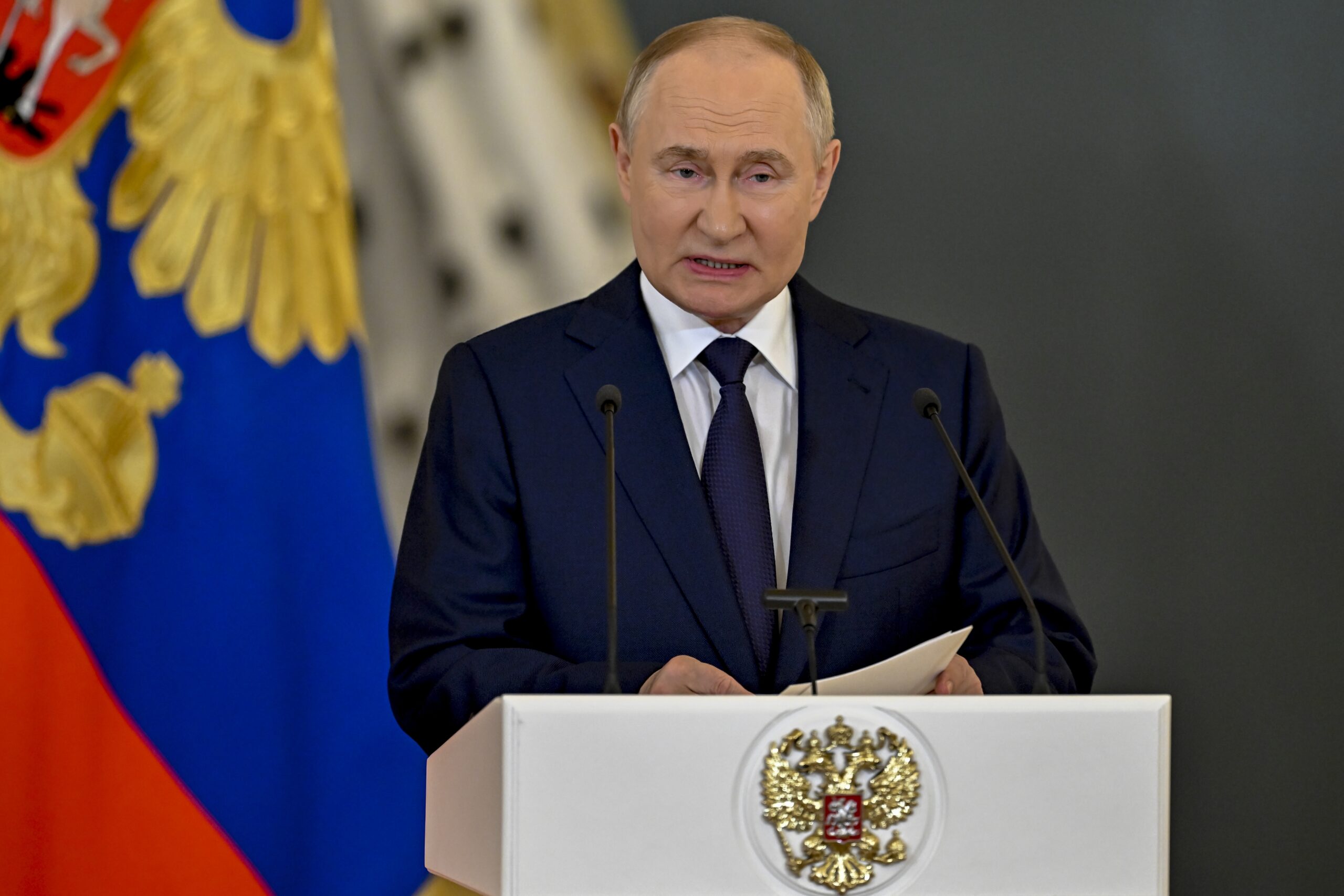
For years, many Russians cheered Vladimir Putin’s full-scale invasion of Ukraine in a burst of nationalist fervor. Others remained silent, fearful of state repression of any criticism, however mild, of the social and economic consequences of the conflict. Now that is starting to change. In the fifth year of the war, the Russians are increasingly pessimistic about their future. Ukrainian drone attacks are increasingly penetrating the national territory and stricter restrictions on the internet, justified by the Kremlin as a security measure, have caused an outbreak of public outrage.
While Vladimir Putin continues with his strategya growing number of people are directing their criticism toward the Kremlin, amid signs of waning support for the power structures the president built. “There is a growing sense in Russia that the current system of government is becoming too disruptive and increasingly counterproductive,” said Tatiana Stanovaya, founder of the consulting firm R.Politik, in a May 6 post on X. “Tolerance toward the status quo is eroding.”
The spark that unleashed the riots, unexpectedly, was a video posted on social networks, directed at Putin, by the Russian beauty blogger Victoria Bonya, resident in Monaco, who has almost 14 million followers on Instagram. “People are afraid of you,” he said in the mid-April video, which received more than 30 million views. “You don’t know what is happening in the country.
People are suffering.” The publication became a cultural phenomenon and generated more than 86 thousand comments, many of which praised the “honesty and bravery” of Bonya, who revealed adeep frustration at the worsening situationwith the closure of businesses, the emigration of professionals and increasing restrictions on daily life. A commentator from the Belgorod region, bordering Ukraine, said: “Every day there are deaths, burning cars… people leave.”
“Attitudes toward Putin are changing,” said Alexander Baunov, a senior fellow at the Carnegie Center in Berlin. “It feels like the atmosphere itself has changed.” For residents of Tuapse, a coastal city on the Black Sea, where the ukrainian drone strikes have targeted the Rosneft PJSC refinery, the change in air quality is real. Videos on social media show toxic smoke rising over the city and oil product spills contaminating local soil.
The authorities have declared a regional state of emergency. ANDn the rest of Russia, Ukraine’s almost daily attackshigh inflation and continued high interest rates are contributing to the deterioration of public morale, while the death toll continues to skyrocket with no sign of any progress in a war that was supposed to last only a few days. While Putin’s personal popularity remains high by international standards, his approval rating fell to 66% in the week ending April 19, according to a survey by state-owned company VTsIOM, down from 74% two months earlier and the lowest figure since the start of the war in February 2022.
The survey has not been updated since then. Only 55% of Russians believe thate the country is on the right track, the lowest percentage rerecorded during the war, according to a survey published April 30 by the Moscow-based polling firm Levada. This figure represents a decrease compared to the 67% recorded at the end of last year. “The fatigue derived from the constant tension of a war with no clear end, added to the fiscal pressure and the deterioration of the economic situation, is contributing to the increase in pessimism,” declared Denis Volkov, director of Levada.
VTsIOM and the Kremlin-linked Public Opinion Foundation announced last Friday that, as usual, they would not publish their political popularity ratings this week. The initial optimism that the American president, Donald Trump could help negotiate A Russian-friendly peace deal to end the war has faded since his summit with Putin in Alaska in August, which Volkov described as “the high point of expectations.”
There is certainly no sign that Putin’s position is in jeopardy after more than 26 years in power, nor that the Kremlin is reconsidering. his determination to continue the war in Ukraine. Discontent over internet restrictions is causing divisions among officials over the wisdom of the security services’ relentless crackdown. This is fueling fears of a backlash in September’s parliamentary elections, when the Kremlin sought to demonstrate public support for Putin and the war.
Communist leader Gennady Zyuganov, who heads the second-largest faction in parliament’s lower house, issued an alarming warning to lawmakers last month: Russia risks an upheaval on the scale of the 1917 revolution if it does not change course. “We have told them 10 times that the economy will inevitably fail,” Zyuganov said. “If you do not urgently take financial, economic and other measures, by the fall we will be faced with what happened in 1917. We have no right to repeat it!”
The communist’s apparent rejection of the revolution that ushered in seven decades of communist rule sparked hilarity among Russian commentators, before Zyuganov’s party clarified that he was actually referring to the coup d’état of February 1917. This is not much more reassuring for the Kremlin, since those events led to the abdication of Tsar Nicholas II and the formation of a new provisional government.
As Bonya’s criticism reverberated on Russian social media, Kremlin spokesman Dmitry Peskov took the unusual step of announcing that the issues she had raised were being addressed. When Vladimir Solovyov, a prominent state television commentator, insulted Bonya in an attempt to discredit her, it sparked a wave of protests as she accused him of misogyny. Finally, he apologized. On the other hand, Ilya Remeslo, a former pro-Kremlin activist who claimed to have spent time in a psychiatric hospital after lashing out at Putin in Telegram posts, has reappeared with more critical messages that mock the Kremlin.
These include predictions that Putin will lose power this year. “The system cannot be rescued from the abyss,” he stated in a May 3 publication addressed to his almost 120,000 followers. Nationalist bloggers and commentators, disappointed by Russia’s failure to defeat Ukraine, have also begun lashing out at the Kremlin leader. In a message posted on Telegram on May 2, Maxim Kalashnikov compared the situation in Russia to the “decline and collapse” of the Soviet Union under its aging leader Leonid Brezhnev, adding: “We are once again facing a formidable historical turning point.”
Outside of online information bubbles, symptoms of depression are increasing throughout Russian society, driven by “pessimistic economic expectations and the accumulation of fatigue stemming from the military campaign,” according to a monitoring report from the Institute of Psychology of the Russian Academy of Sciences published March 16. This manifests itself in various ways, according to informal testimonies. Pharmacies reported a 24% increase in demand for antidepressants last year, RBC reported, citing data from the DSM Group.
Online searches for how to leave Russia have more than doubled since January, the newspaper reported Vedomosti. “For television, it is a heroic war, but in reality it is pain and misery,” said Sergei, a 43-year-old former soldier who fought in Ukraine for three years before being demobilized due to an injury and who now helps his brother run a small business that is struggling due to this year’s tax hikes. “It’s not true that everyone on the front wants the war to continue; normal people want peace.”
While mass protests are unlikely, growing frustration could end up causing problems for Putin. “There is growing discontent that cannot yet manifest itself in protests due to the regime’s high level of repression,” said Andrei Kolesnikov, a Moscow-based political analyst. “It could break out, like an underground fire, caused by something unexpected, in an unexpected place and at an unexpected time.”