
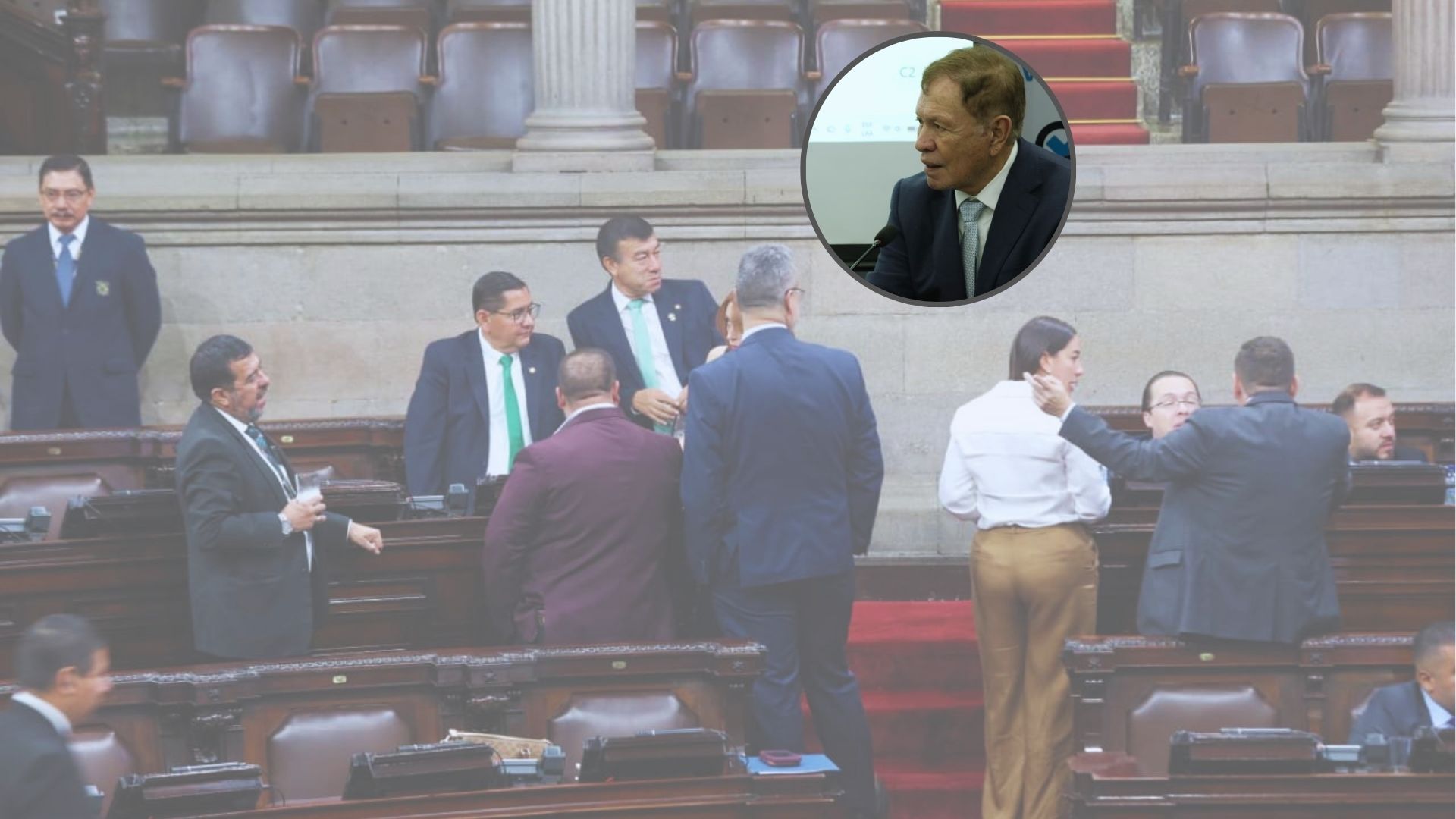
The president of Congress of the RepublicLuis Contreras, assured that he arrived at the plenary session on May 12 convinced that initiative 6593, Comprehensive Law against Money Laundering and Financing of Terrorism would be approved, due to the consensus previously reached between benches and technical sectors.
As explained in Free Press Radioafter approval on third reading, a period was opened for deputies to present observations and proposals. Then a technical table was installed with the participation of the Special Verification Intendance (IVE)the Banking Association of Guatemala (ABG)the Economy Commission and representatives of UNE, Vamos, Cabal and VOS.
From that process emerged 12 amendments and two articles agreed uponsigned by the participating groups, which were the only changes planned to be approved that day in plenary.
Agreement was not to accept seat amendments
Contreras indicated that there was a political agreement not to accept seat amendmentsin order to avoid last minute modifications without technical review.
However, while seeking to gather the necessary quorum, a group of deputies formed a “parallel table” that returned hours later with nine new amendments.
Of these proposals, four modified already agreed agreements and five introduced substantive changes to the regulations.
“The one who broke quorum was me”
The president of Congress maintained that it was he who made the decision to break the quorum to prevent these amendments from being known in plenary. “Who decided to break quorum it was me”, he stated.
He explained that approving non-consensual changes could compromise compliance with the recommendations of the Financial Action Task Force (FATF) and leaving the law incompatible with international standards for the prevention of money laundering.
He also rejected versions that attributed the suspension of the session to external pressures. “I don’t let myself be carried away by anyone,” he said, while apologizing for the measure.
“The one who decided to break the quorum was me. I did not let myself be carried away by the Semilla Movement or by anyone. I made the decision because I considered it was the best for the country and to protect the anti-money laundering law”
Luis Contreras, president of the Congress of the Republic (2026-2027)
Designated benches and legislative division
Regarding the so-called parallel table, Contreras indicated that deputies from Come on, Worth and UNEalthough he clarified that he still does not know which legislator presented each specific proposal.
He also acknowledged that Congress is currently divided.
He explained that there are around 90 firm votes in favor of the law, but they are still missing 27 supports to achieve approval.
Despite this, he stated that he perceives general political will to move forward with the regulations.
The changes that caused alarm
Among the amendments that led to the breaking of the quorum, Contreras highlighted a change related to the suspicious transactions.
RELATED READINGS


The original text obliges financial entities to report suspicious transactions, even if they do not come to fruition. One of the proposals sought to eliminate that obligation when the transaction will not be consummated.
For Contreras, this represented a fundamental change because it altered essential prevention mechanisms.
A second point discussed was the definition of Politically Exposed Persons (PEP).
Among the proposals was reduce from five years to one the period in which a person maintains that status after leaving public office, in addition to limiting the scope of family members included in that category.
RELATED READINGS

As third pointalso expressed concern about an amendment that modified the classification of the crime of money launderingwhich he described as a “completely fundamental” change.
The president of Congress recognized that some proposals contained positive aspects, as a reform to article 52 for strengthen training functions of the IVEalthough he insisted that there was a lack of technical and political consensus.
When will the money laundering law be addressed again in Congress?
Contreras reported that he summoned block leaders for the May 18with the participation of the Economy Commission, the IVE and the ABG, to once again review the proposals presented. He indicated that there it will be possible to determine which bench promoted each modification.
Finally, he announced that he will call the plenary session June 2 to discuss exclusively the anti-money laundering law and, if necessary, continue the debate June 3.
“I know that deep down all the deputies want to approve the law,” said Luis Contreras. The president of Congress recognized that the legislators are not opposed to the anti-money laundering lawbut they seek to introduce changes. He added that one of the main problems in the Legislature is that many do not read the initiatives and are unaware that Guatemala already has current regulations on the matter, approved in 2001 and 2005which he noted are stricter than the proposal currently under discussion.