
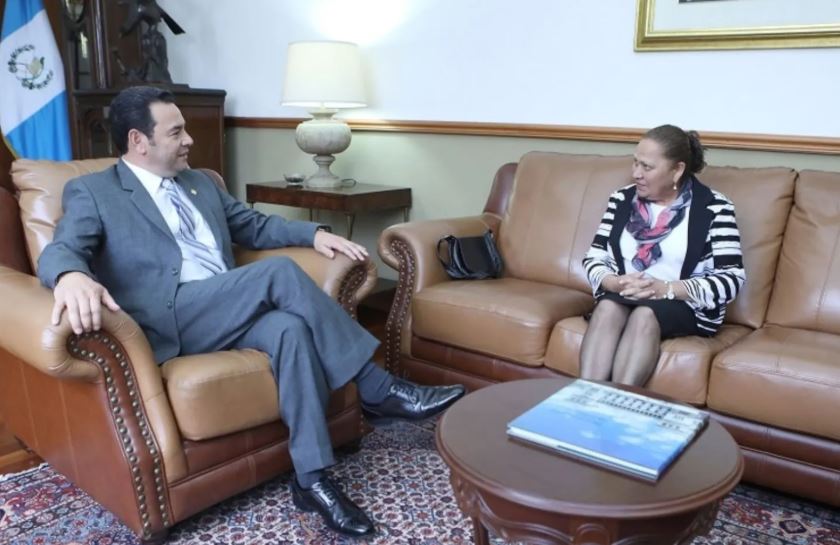
María Consuelo Porras Argueta will cease to be the attorney general next Sunday, after Gabriel García Luna assumes the leadership of the Public Ministry (MP).
Porras considers that he has left significant contributions to the work of the research entity.
To prepare this interview, questions were sent to the Department of Social Communication of the MP, which sent a series of answers attributed to Attorney General Porras herself.
How did you receive the Public Ministry in 2018?
I received a Public Ministry with important institutional needs and a structure that was not yet strengthened to respond efficiently to the demands of the population. There were more than one million 266 thousand cases without attention or resolution, thousands of victims without a response and a management model that had already become outdated in relation to the needs of the country.
Furthermore, the institution only had a presence in 64 municipalities, which limited access to justice for a large part of the Guatemalan population. We also find poorly modernized processes, a lag in investigations and a limited technological and operational capacity to confront complex criminal phenomena.
What was the main challenge during your management?
More than a challenge, it was hard and constant work of institutional transformation. Our priority was to modernize and comprehensively strengthen the Public Ministry to make it a closer, more efficient institution with greater response capacity for the population.
This involved expanding national coverage until reaching presence in all 340 municipalities in the country, reducing tax arrears, modernizing technological systems, digitizing files and creating specialized prosecutors’ offices to combat complex crimes such as corruption, drug trafficking, extortion, human trafficking and organized crime.
We also work deeply to improve care for victims through specialized models such as MAINA, MAIJU and Ix’Kem MAIMI, also strengthening institutional independence in the face of internal and external pressures.
This entire process required administrative reorganization, professionalization of staff and the implementation of new mechanisms of transparency, control and management by results.
After eight years as Attorney General, what do you consider to be your greatest achievement and legacy?
I consider that the greatest achievement was promoting a historical and structural transformation of the Public Ministry, modernizing an institution that today has greater coverage, specialization and technological capacity.
During both administrations we achieved growth of more than 300% in fiscal infrastructure, going from 174 to 693 offices and reaching national coverage in the 340 municipalities of the country.
Likewise, we created new prosecutor’s offices and specialized agencies, implemented the ASTREA computer system, the electronic file and the Comprehensive Case Management Model, allowing us to streamline investigations and reduce institutional delays inherited from previous administrations.
We also strengthened strategic criminal prosecution through specialized units against drug trafficking, corruption, extortion and transnational crime.
My legacy is to have left a more modern, accessible, technologically strengthened Public Ministry with comprehensive care mechanisms for victims, also supported by international certifications of quality, transparency and institutional security.
How do you leave the institution of the Public Ministry after eight years of management?
I leave an institution strengthened both in its structure and in its operational and technological capabilities. Today the Public Ministry has a presence throughout the country, specialized prosecutor’s offices, digital service platforms and modern criminal management and investigation systems.
We implement technological tools such as ASTREA, the electronic file, digital reporting platforms and criminal analysis and institutional intelligence systems. We also strengthened international cooperation, ongoing staff training, and transparency and internal control mechanisms.