
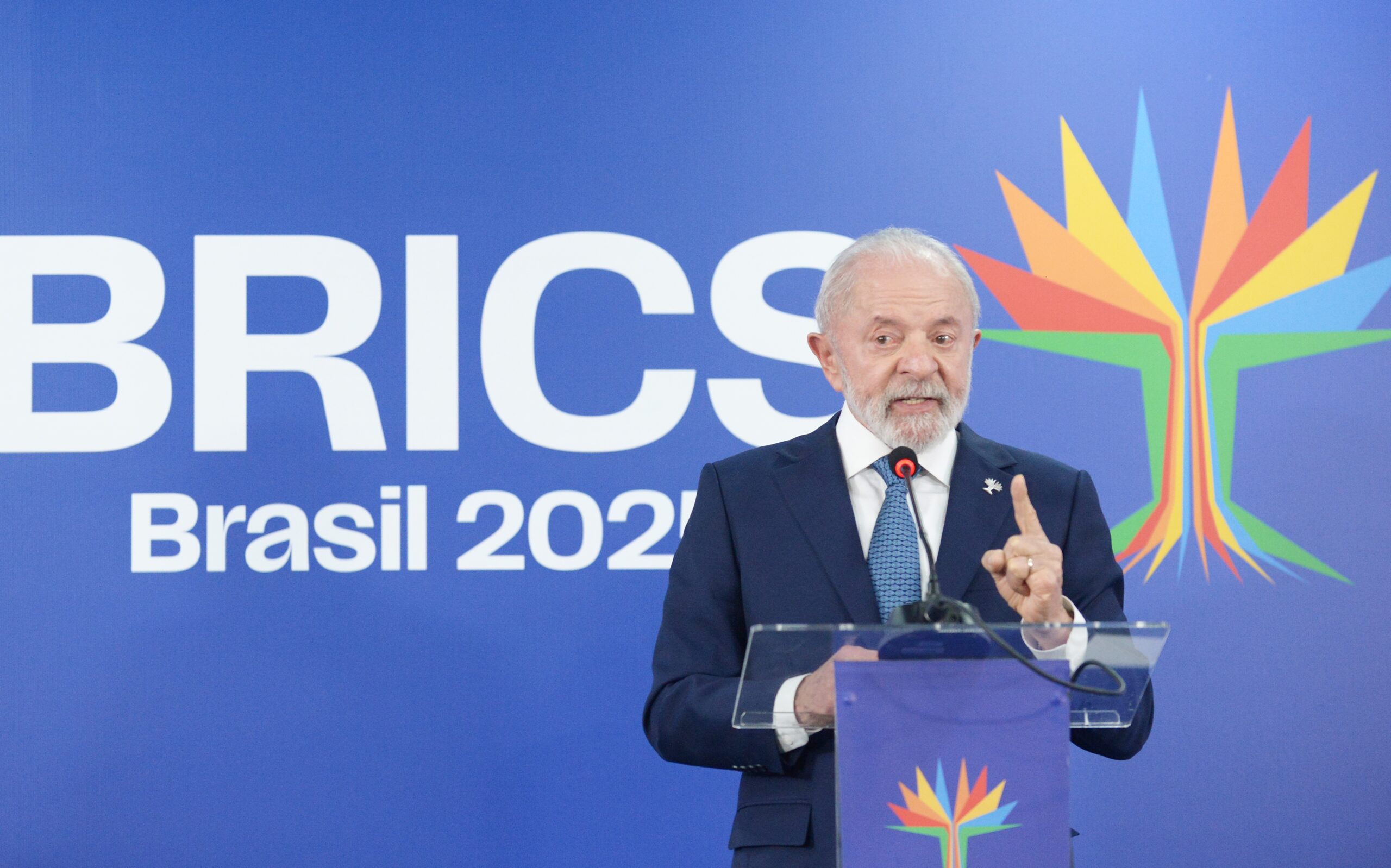
When Brazilian President Luiz Inácio Lula da Silva arrived at the White House this month, his host began by leading him down the Presidential Walk of Fame to his own portraits.
As they walked side by side, Lula joked with President Donald Trump about his serious expression in the photos. “Don’t you know how to smile?” Lula asked him, according to what he said. Trump, he added, responded that voters preferred serious-looking leaders. “Only during the elections,” Lula said. “Now that they rule, they can smile a little. Life becomes lighter when we smile.” In the official photograph released by the Brazilian government after the May 7 meeting, Trump appears smiling.
“We had a great meeting,” Trump told reporters. “We are carrying out many commercial operations and we are going to increase them. …He is a good man. He’s a smart guy.” Trump has a history of cordial personal relationships with some left-wing leaders, from Mexican President Claudia Sheinbaum and her predecessor, Andrés Manuel López Obrador, to Chinese President Xi Jinping. But cordiality between him and Lula would have seemed unlikely a year ago, when he was imposing tariffs on key Brazilian exports and sanctions on Brazilian officials in an attempt to stop the prosecution of his friend, former President Jair Bolsonaro—Bolsonaro, defeated by Lula in 2022, had been accused of trying to stay in power through a military coup in which the ruler was going to be assassinated).
Lula describes his approach toward Trump as strategic. “If I can make Trump laugh, I can do other things too,” he told Washington Post in his first media interview since the meeting. “You can’t just give up.” ANDhe Brazilian president, 80, is trying to achieve more than just a diplomatic reset. Facing what will likely be his last election in October, the veteran leader of the Latin American left seeks to present himself as a pragmatic statesman capable of collaborating with the global right without succumbing to it. Lula is seeking a fourth term in a tight race against Flávio Bolsonaro, running in place of his father, who is currently serving a 27-year sentence for attempting to overthrow Brazil’s democratic rule of law.
He hopes to reinforce an image of experience, stability and political flexibility at a time when political conservatism is on the rise from El Salvador to Argentina. Sitting at the large wooden desk in his office, with a world map behind him, Lula says his personal relationship with Trump could help attract American investment to Brazil, avoid more tariffs and sanctions, and ensure respect for Brazilian democracy. “Trump knows that I oppose the war with Iran, that I disagree with its intervention in Venezuela and that I condemn the genocide that is taking place in Palestine,” he declared. “But my political disagreements with Trump do not affect my relationship with him as head of state. What I want is for him to treat Brazil with respect, understanding that I am the democratically elected president here,” he said.
For him, the lack of respect was what caused the marked deterioration in relations last year. After the imposition of tariffs and sanctions by the Republican, Lula accused him of violating Brazil’s sovereignty. He took advantage of his public appearances to send a clear message: Brazil was willing to dialogue with Washington to resolve their differences, but only if they were treated equally. The former union leader, who rose from extreme poverty to win three presidential terms, has forged his political identity around negotiation and personal diplomacy. However, her approach to Trump has been influenced by a lesson she learned from her illiterate mother, Dona Lindu.
“Those who bow their heads may not be able to raise them again,” he said. “Brazil is very proud of what it is. We don’t have to bow down to anyone.” It has represented a radical change with respect to Jair Bolsonaro’s approach, characterized by ideological alignment with Washington and open admiration for Trump. Lula says he is not trying to create a division between Trump and Bolsonaro. However, he sees strong relationships as a way to counter the “falsehoods” about Brazil that he says fueled the pressure campaign ahead of the 2025 elections. Eduardo Bolsonaro, another son of the former president, moved to the United States last year to convince Trump that his father was being politically persecuted.
“I would never ask Trump not to like Bolsonaro. That’s your problem“said Lula. “I don’t need to make any effort to let him know that I am better than Bolsonaro. “He already knows.”
Trump and Lula met briefly for the first time at the UN General Assembly in September, days after Bolsonaro’s conviction. Since then, they have met twice more and spoken on the phone four times. Trump has effusively praised Lula, calling him “dynamic” and “smart,” and has reduced tariffs and lifted sanctions against Brazil. The domestic political benefits have become evident. Many Brazilians saw Lula’s confrontation with Trump as a defense of sovereignty.
In a poll taken after the visit to the White House, 60% of Brazilians said it had been “good for Brazil.” Even so, Lula begins the campaign facing difficulties. The price of food and fuel is rising, and the polarized electorate is almost evenly divided between him and Flávio Bolsonaro. A new package of measures to ease economic pressure on voters and accusations that the younger Bolsonaro requested millions of dollars from a banker investigated for the country’s largest financial fraud should favor him. Lula has increasingly held up his relationship with Trump as proof that leaders can be ideological adversaries and still negotiate. According to him, pro-democratic leaders must offer concrete results before anti-establishment movements grow stronger.
“Democracy failed when it stopped responding to the most basic aspirations of the people,” Lula said. “So any idiot who speaks out against the system gets applause. That’s happening all over the world.” Lula’s attempts to achieve peace in Venezuela and Ukraine have failed, and Washington has shown little interest in Brazilian mediation in Cuba. However, he still wants to position Brazil as a mediator in global conflicts. “You can only mediate when those in power want it,” Lula said. He warned Venezuelan authoritarian Nicolás Maduro that internationally supervised elections would strengthen his legitimacy if he won. “But Maduro did not do it, and instead, he only fueled suspicions. There are those who know they are wrong and still continue to act badly.”
But Cuba is different, he argues, because its government wants to dialogue. He asked Trump to lift the economic blockade on the island: Cuba, he said, “needs an opportunity.” “What I know is that if the United States opens a negotiating table, not one based on impositions, Cuba will participate.” Trump told him that he was not going to invade the island, he claimed. Among the Latin American left, Trump’s military attacks on vessels in the Caribbean and eastern Pacific, the capture of Maduro in Venezuela and the possibility of action against Cuba have revived recurring concerns about US interventionism in the region.
Democracy failed when it stopped responding to the most basic aspirations of the people.
Trump has also stepped up pressure by other means, labeling criminal groups in Mexico, Colombia and Venezuela as foreign terrorist organizations, a designation that allows for asset seizure and military action. Flávio Bolsonaro and his allies have called for similar designations to be imposedsa the main Brazilian criminal organizations. Lula argues that this pressure alone will not end drug trafficking. “The United States will not do that with Brazil,” he said. Despite his good relationship with Trump, Lula says he remains deeply concerned about the direction of world politics and what he considers the weakening of multilateral cooperation.
“I hope that Trump can be convinced that the United States can play a much more important role in strengthening peace, democracy and multilateralism,” Lula said. “Will it be difficult? Yes. But if I didn’t believe in persuasion, I wouldn’t be in politics.” Lula claims to have given Trump a copy of the 2010 nuclear deal that Brazil and Türkiye negotiated with Iran, a deal that was rejected by the United States and the European Union. As he explained, he wanted to show Trump that “it is not true that Iran is trying again to build an atomic bomb.”
According to Lula, Trump said he would read the document, and Lula offered to facilitate the dialogue, but they did not discuss next steps. For Lula, the war against Iran demonstrates what he sees as the limits of Trump’s belligerent approach to the world, which he argues is starting to hurt Americans with rising consumer prices. “Trump is responsible for it,” he said. Lula wants Washington to treat the region as a partner, not a target. “China discovered Latin America and entered it,” he said. “Today, my trade with China doubles my trade with the United States. And that is not what Brazil prefers.”
“If the United States wants to take the lead,” he said, “that’s great. But it has to really want it.”