
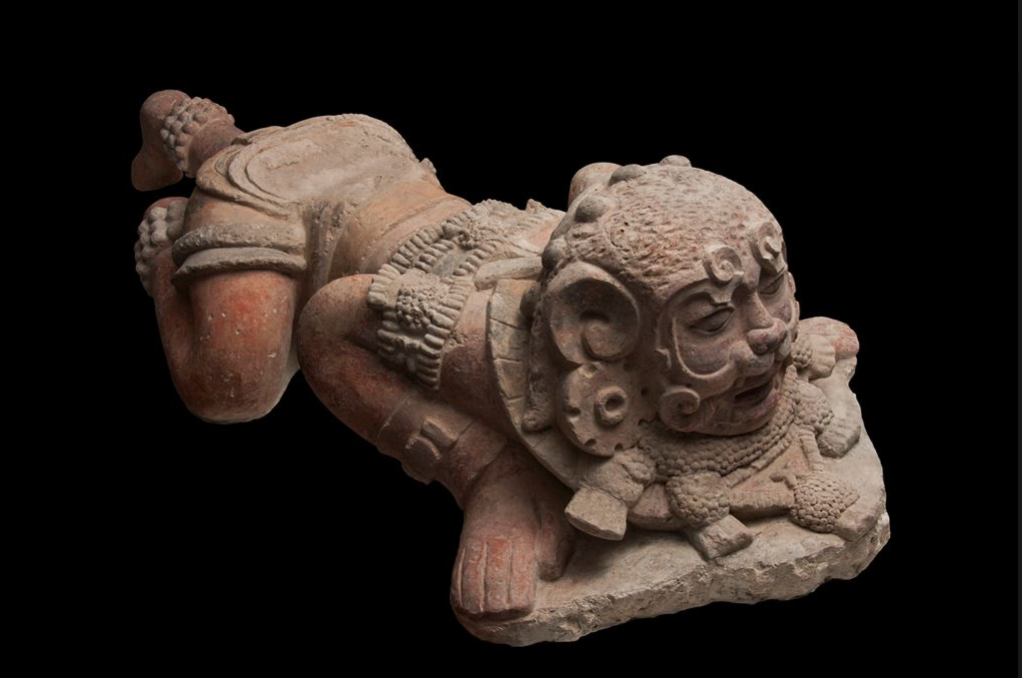
On the morning of Tuesday, May 19, the sculpture called Man with jaguar skin mask and also known as “jaguar man” to be exhibited in the Mayan Route Foundationon Avenida Las Américas. The piece measures almost three meters and weighs more than 2 thousand pounds.
This piece has been part of the organization’s collections and is permanently available to the public. The work had not been on display due to a paperwork process after its last exhibition, in 2023.
Archaeologist Sofía Paredes Maury, executive director of Fundación Ruta Maya, explains that it is an important piece because there are no large stucco figures in the country. Some are from later times and the man with a jaguar skin mask belongs to the early classic, that is, from the years 150 to 200 to 650 AD.
Paredes Maury highlights that this sculpture has been on public view on different occasions inside and outside Guatemala. The piece has been in the foundation since 2013 and arrived with a treated wooden platform and tires capable of carrying the corresponding weight. It is also cut in half, it was delivered this way.
The Mexicans Norma García Huerta and Elisa Ávila, from El Atelier, were in charge of the restoration of the “jaguar man.” The restorers worked for 15 days with a general cleaning, some cracks healed and the base was also modified because the hands were off the platform. García comments that it is the second time they have worked on the piece in recent years.
The professionals followed the arrival of the piece until it was placed in its new place in the Foundation, which took about 90 minutes.
The last news about the Man with Jaguar Skin Mask sculpture was in 2023.. It was part of the more than 245 archaeological pieces that returned to the country that year, after the exhibition in the United States called Maya: The Great Jaguar Rises, presented at the California Science Center.
What are the curious details of the piece?
The sculpture is made of polychrome stucco, that is and represents a male character, possibly a dancer or a warrior, wearing a jaguar skin mask. The mask, with parts of the nose, lips and feline fangs, covers the face of the human character and reveals the features of the mouth, with the thick lips slightly open, showing the teeth.
The character is in a stalking position, like a feline would. Studies on traditional dances in various cultures suggest that most dances are inspired by the movement of animals and plants, so this character could be imitating the movements of the jaguar during the dance.
The character also wears a skirt painted yellow and black, similar to the jaguar skin pattern, a garment limited to the use of the ruler, nobles and members of the military elite.
Their ornamentation includes bracelets—which could represent rolled and knotted paper, cloth, or leather; a plate necklace tied with a bow at the nape of the neck; a bib with fringes, tubular beads or snails; another necklace of spherical beads or pompoms, and figures of tetrapetal flowers in front.
A decorative detail that stands out are the anklets with several strands of spherical beads or snails, which could have sounded like bells when dancing.
This is, perhaps, the only example, to date, of a three-dimensional figure with these characteristics and with its original color preserved.
The masked jaguar figure represented a mythological feline and could be a high-ranking nobleman disguised as a feline deity, or one of the feline figures from the pantheon of deities of the Classic period.
Given its predatory and nocturnal behavior, the jaguar was usually associated with royal power, strength and sacrifice and, as such, appears in its different aspects. A jaguar-deity later known as Yax Bahlam, one of the mythical Hero Twins, was associated with the western night sun, a specific aspect of the Moon, transformation, sacrifice, hunting and war, as well as the prototype of spiritual power and kingship.
Sculpture details Man with jaguar skin mask
- Total length: 276 cm
- Width (hand to hand): 105 cm
- Width (elbow to elbow): 90 cm
- Head height: 66cm
- Hip height: 47 cm
- Length from head to waist: 110 cm
- Length from waist to foot: 166 cm
- Weight: 2,200 pounds
Where does the sculpture come from?
This sculpture was transferred to the La Ruta Maya Foundation in August 2013, almost 20 years after its discovery and registration in the 1990s.
According to the documentation provided to the Foundation, the sculpture was found by chance during the drilling of a water well on a livestock farm, southwest of Lake Petén Itzá, towards La Libertad, Petén.
The piece was registered in the Registry of Cultural Assets (IDAEH, 1996), restored and consolidated before its delivery to the Foundation for safekeeping, conservation, research and exhibition to the public for educational purposes.
Where to see it?
The sculpture is exhibited in the Ruta Maya Foundation museum, Avenida Las Américas 19-60, zone 13.
The hours are Tuesday to Friday, from 9 a.m. to 4 p.m., continuous workday, and on Sundays, from 9 a.m. to 2 p.m.