

The territorial expansion of the Public Ministry (MP), with agencies in 340 municipalities and the implementation of the comprehensive case management model, allowed a drastic reduction in the tax arrears accumulated over the years. However, the National Economic Research Center (CIEN) warns that the main challenge for the MP continues to be the real capacity to investigate and bring cases to justice, since only an average of 3.5% of the cases managed between 2018 and 2025 reached the criminal accusation stage.
David Casasola warned that the expansion of prosecutors’ offices throughout the country and the speeding up of processing files did not necessarily translate into greater access to justice or more effective investigations, which means one of the main challenges for the new management from the prosecutor Gabriel García Luna. The analysis was part of the presentation of the Crime Reporting Index May monthly.
According to data presented by the CIEN, the MP went from having coverage in 183 municipalities in 2020 to reaching presence in all 340 municipalities in the country in April 2021.
However, Casasola pointed out that territorial expansion must be evaluated with caution because “the criminal situation has a very particular geographic concentration,” and opening prosecutor’s offices does not guarantee that the rest of the institutions of the justice system have the same operational capacity.
He explained that processing complaints or carrying out expert analyzes “is not something that can be done immediately” if there is no support from the National Institute of Forensic Sciences (Inacif), vehicles, prosecutorial personnel or minimum installed capacity in each territory.
“It is important to review this,” he indicated, pointing out that maintaining structures in the 340 municipalities represents an operational and budgetary challenge.
More presence, but the majority still does not report
The CIEN also analyzed data from a national survey on the occurrence of crimes, prepared from the project Global Entrepreneurship Monitorof the Francisco Marroquín University.
The results show that, despite the expansion of prosecutors’ offices, the majority of victims still do not report. By 2025, only 44.3% of people affected by a crime filed a complaint, while the 55.7% did not do it.
“There is still a way to go in terms of the population reporting. Here we have data that we, as CIEN, managed to obtain through a survey that measures the occurrence of crimes in the country and we can see that, Although since 2018 there has been a strategy to expand coverage, we have not been able to improve in that more than half of the population still does not report it,” Casasola explained.
He added that “the fact that we have a presence in all municipalities does not necessarily drastically change” the citizen’s willingness to go to the justice system.
The evaluation also showed changes in where complaints are filed. According to the report, in 2016, almost seven out of every ten complaints came through the National Civil Police (PNC), while by 2025 the proportion dropped to about five out of every ten.
In contrast, the MP went from directly capturing around 20% of complaints to 44% according to the data presented.
“This is where we must ultimately evaluate how much this is due, for example, to having prosecutors’ offices in all municipalities or how much this is also due to the fact that there are now complaints that can be presented digitally”said Casasola.
Read also: Renewing the MP is not easy but it is feasible
Less judicial delay, but more closures without accusation
One of the main changes within the MP occurred with the gradual implementation of the comprehensive case management model starting at the end of 2019.
The researcher explained that the strategy divided the workloads between teams in charge of new cases and others dedicated to old or active files, with the aim of expediting procedural outputs and reducing the historical accumulation.
The data reflect an accelerated decrease in tax arrears. In it 2014 there were around 2.4 million unresolved filesbut for him 2025 The figure dropped to about 198 thousand.
The sharpest reduction occurred between 2020 and the 2023when the pending cases increased from more than 2 million to just over 400 thousand.
“That is the result, at a general level, of what this comprehensive case management model is, but those are quantities and “It is important to start reviewing and reflecting on the quality and the type of signals that the system sends with this way of attending to and managing cases.”Casasola warned.
The central point of the CIEN analysis focuses on the composition of the procedural outputs.
According to the evaluation, the majority of the files conclude with decisions that do not imply a criminal accusation or judicialization.
“When the composition of the exits is analyzed, that is, to understand under what figure all these cases came out, we have a high concentration in exits that imply, in essence, that the investigation was not continued, either because the crime prescribed or because there is not enough evidence to advance; then the case is archived, it is put on pause while new evidence emerges”he explained.
The researcher explained that the only cases that really progress towards criminal proceedings are those sent to first instance courts.
“Here what we see year by year is the relative composition of the departures, and we see how, as time has progressed, The composition of cases that reach a stage of judicialization goes from 9.6% to 5% and remains at 3.5%, on average; That is, between 2018 and 2025, which is more or less the period in which this internal case management model begins to work, 3.5% of the cases that are managed have the possibility of being prosecuted and reaching some type of accusation or sentence”.
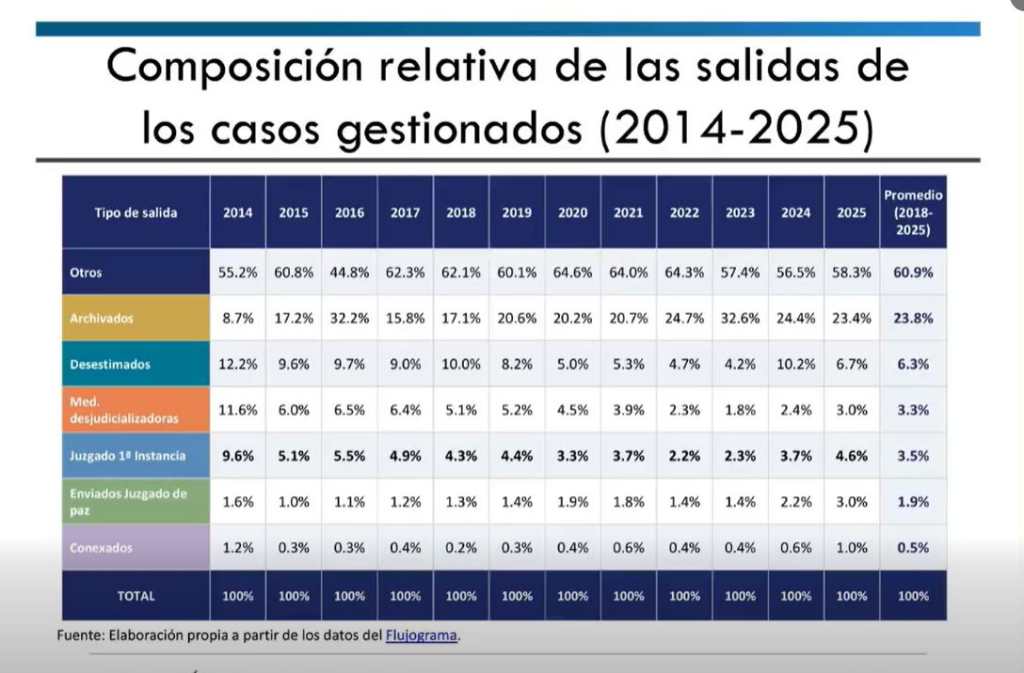
In practical terms, that means that around 96 out of 100 cases do not end in an exit that involves a criminal accusation.
“This is extremely important to review, especially due to the sustainability of a system,” said Casasola, who warned that while seeking to strengthen citizen trust and increase complaints, the predominant signal continues to be that “What is received is rejected, it is not being investigated.”
Homicides: only 7% end in accusations or sentences
The CIEN also specifically reviewed the results in cases of simple homicide and qualified homicidecrimes that, due to their severity, usually require more complex investigations and less room for early closures.
However, historical behavior shows that the most frequent exits continue to be closures in tax headquarters.
“If you see accusations and sentences, in the end we are talking about an average of 7%; That is to say, even when we focus on crimes that, due to their nature, are not so simple that they have solutions that do not imply an accusation or prosecution process, there is still a lot of room for improvement,” he stated.
Casasola concluded that the structural problem persists despite the administrative changes implemented in recent years.
“Before what we had were cases that found no way out, and now what we have are cases that find a way out, but without any accusation.”. So, at the two extremes in which we can see the historical evolution of the institution, deep down what is happening is that there is no greater research capacity that allows individual responsibilities to be deduced for crimes,” he analyzed.
International indicator that does not improve
The analysis also incorporated data from Rule of Law Index of the World Justice Project, in which according to Casasola, Guatemala’s historical rating has remained low between 2015 and 2025, without significant changes despite the internal transformations of the MP.
“It is observed that from 2015 to 2025 there has been no major movement, it has not improved, it has not changed and in the end it is part of the challenges”he pointed out.
He added that both the old model, characterized by high tax arrears, and the current scheme, focused on reducing pending files, reflect practically the same perception of investigative effectiveness.
“There were previous models that had high levels of fiscal delay, now there is a model of lower fiscal delay, but both models showed a practically identical assessment point of effectiveness in criminal investigation,” he pointed out.
CIEN Recommendations
In conclusion, the CIEN proposed reviewing the territorial expansion model and refocusing resources towards strategic regions according to crime incidence and prioritized crimes.
It also recommended recovering a comprehensive vision of the justice system, strengthening inter-institutional coordination, advancing digitalization and interoperability of systems, and evaluating the results of the use of public resources.
“The fact that a system has been implemented to manage cases does not mean that this fiscal human production has increased the investigation capacity and that is important to be able to review,” Casasola concluded.
Read also: Relief in the Public Ministry: The eight years of Consuelo Porras are rated