
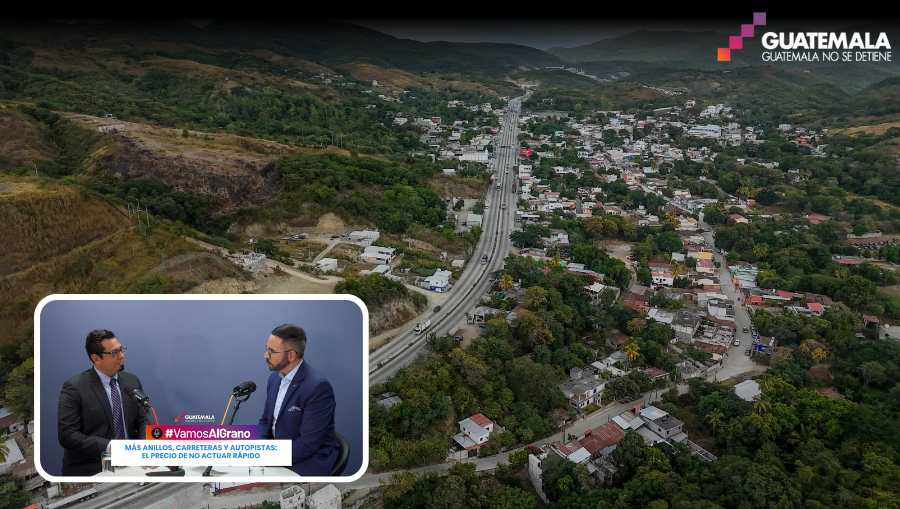
Guatemala City faces mobility problems every day due to the increase in vehicle fleet and deficiencies in road infrastructure. A Guatemalan spends around 1,300 hours in traffic, equivalent to 54 days, according to data from the Inter-American Development Bank (IDB).
In the country, the construction of several mobility projects is proposed, the purpose of which is to improve vehicle fluidity and reduce travel times; However, these have remained in the planning phase for years.
Among them, the metropolitan rings stand out, a proposal that seeks to create new connection routes to avoid a large part of the trips having to necessarily pass through the capital.
Lisardo Bolaños, technical coordinator of Guatemala No Se Detiene, addressed this issue during a conversation with Ricardo García Santander at the video podcast Let’s get to the pointwhere he analyzed the mobility challenges facing the country and the alternatives to promote road infrastructure projects.
According to Bolaños, one of the most relevant changes in recent years is that municipalities have more tools to develop infrastructure projects without depending on traditional processes.
“The municipalities are coming together to build new infrastructure. We have not seen, at the Executive level, for more than 40 years what the communes are proposing today. Definitely, the possibility of articulating actions at the local level is a step forward,” he stated.
He explained that municipal autonomy allows for greater execution and coordination capacity between local governments, especially after regulatory changes that have expanded the options to develop projects through concessions and alliances with the private sector.
Bolaños pointed out that the Constitutional Court’s resolution on municipal concessions and the recent reforms to the Public-Private Partnerships Law opened new possibilities for municipalities to promote infrastructure works without requiring Congressional approval for each project.
Let’s get to the point in five points
- The metropolitan rings seek to redistribute traffic. Bolaños explained that the road network of the metropolitan area was developed for decades with a radial logic; that is, designed to connect different points of the country with Guatemala City. However, this model requires a large number of vehicles to cross the same corridors to travel from one municipality to another. The metropolitan rings seek to create alternative routes that allow surrounding the areas of greatest congestion and connecting different points without having to enter the capital.
- The Koica plan proposes a new mobility structure. Bolaños pointed out that the plan proposes the construction of road rings around the department of Guatemala to complement the existing highway network. As he explained, the idea is similar to the structure of a spider web: in addition to the roads that converge towards the center, circular connections are needed that allow movement between different sectors without necessarily passing through the same congestion points.
- Municipalities could promote projects with greater agility. Bolaños mentioned that municipal governments have operational advantages over the central government to develop infrastructure projects. He pointed out that municipal autonomy allows decisions to be made more quickly and agreements to be established between municipalities to execute works of common interest. In addition, he indicated that recent legislative changes allow concessions and projects to be developed without having to go through Congress.
- Develop infrastructure through public-private partnerships. According to Bolaños, recent reforms to the Public-Private Partnerships Law expanded the possibilities of developing infrastructure in collaboration with the private sector. He explained that these mechanisms have been used in other countries to build roads, viaducts and transportation systems. In his opinion, these tools could facilitate the execution of large-scale projects that require significant investments and long construction periods.
- The problem is not only financial, but also technical. Bolaños stated that one of the main challenges continues to be strengthening the technical capabilities of the State. He noted that Guatemala needs more professionals specialized in urban planning, mobility, design of bridges, roads and strategic infrastructure within public institutions. He also indicated that many projects require continuity in the face of changes in government; Therefore, having technical teams could speed up its execution and avoid delays in the works.
You can listen to the episode on Spotify: