
In April 1988, Guatemala hosted the Concacaf Youth Tournament. What should have been a regional competition became the center of one of the biggest scandals in the history of Mexican soccer: the “Cachirulazo.” Four players with falsified ages were discovered thanks to the formal complaint of the Guatemalan Soccer Federation and the investigation of Mexican journalist Antonio Moreno, of Imevisión and Cheerswho compared the minutes presented with the official yearbook of the Mexican Soccer Federation.
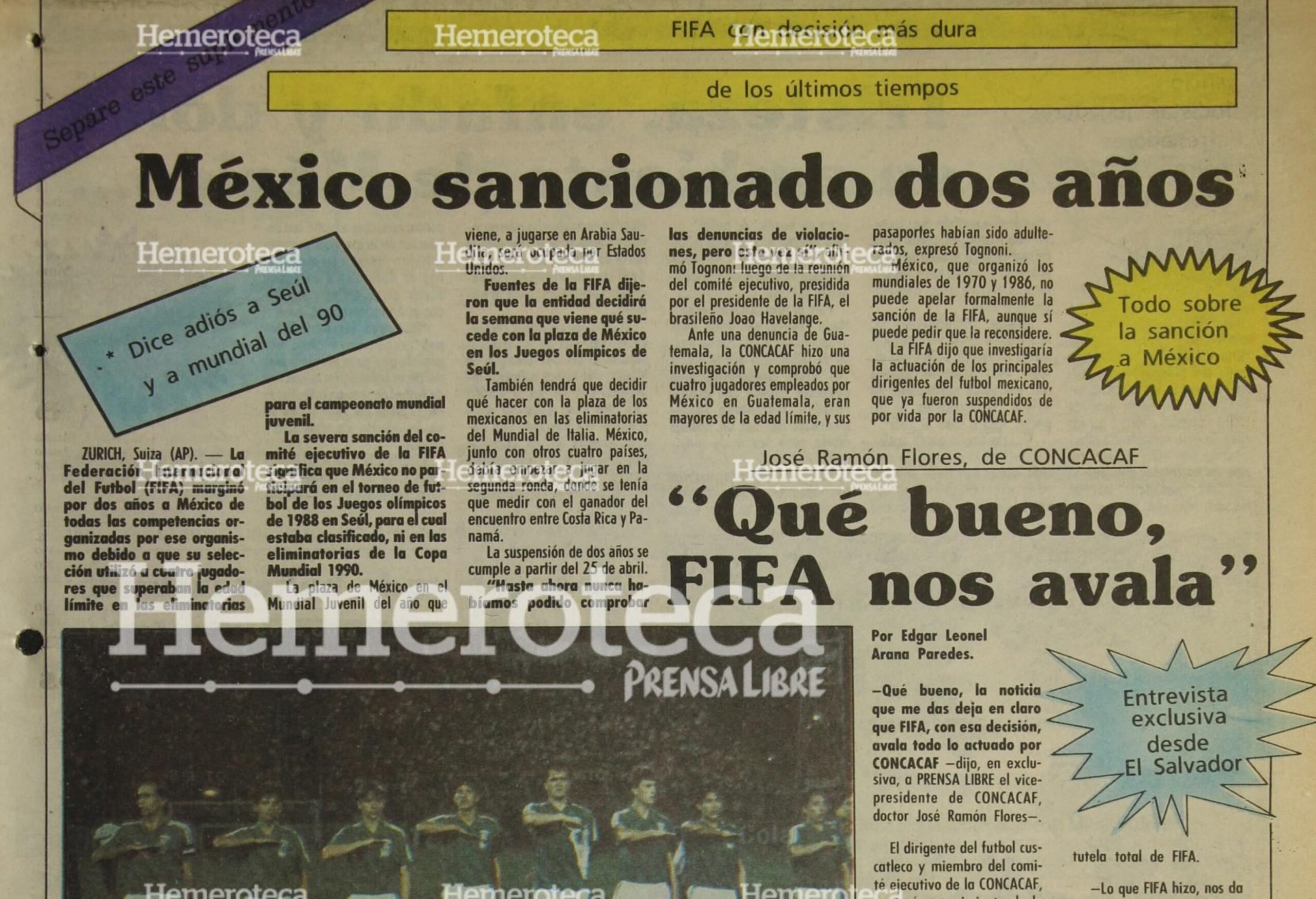
FIFA imposed a historic two-year sanction on the Mexican Federation. As a direct result, Guatemala—second in its group in the Pre-Olympic—inherited the quota for the 1988 Seoul Olympic Games. Today, the film Mexico 86 (Netflix, 2026) returns to those “desk tricks” and forces us to revisit the pages of Free presswhich documented how a small federation managed to get the regulation enforced.
The story began in February 1988, when the final phase of the Concacaf Pre-Olympic Championship was held in Seoul. Mexico and Guatemala shared a group. The Mexican team fielded several protagonists of the 1986 World Cup in one of the key matches: Pablo Larios, Benjamín Galindo, Javier Hernández, Miguel España, Carlos Muñoz and Tomás Boy, among others.
Guatemala presented a combative squad, but finished second in the group. Mexico qualified for the Olympic tournament. Nobody imagined then that, just two months later, an irregularity in another category would bring everything down.
The trigger occurred between April 9 and 24, 1988, when Guatemala hosted the Concacaf U-20 Youth Tournament. The Mexican Under-20 team was coached by Francisco “Pancho” Avilán, who would later publicly confess that he had warned the Mexican Federation about irregularities related to the age of some players, but his observations were ignored.
The team reached the final as runners-up, with a squad that included Sergio Almaguer, Ricardo Cadena and Juan Carlos Chávez, but also the four “cachirules” whose age was falsified: Aurelio Rivera, captain and defenseman; José Luis Mata; Gerardo Jiménez, and José de la Fuente. The subsequent journalistic investigation revealed that the birth certificates had been systematically altered.
The Guatemalan youth team, led by Argentine coach Salvador Pericuyo, formed a squad that included Alexander Garay, Óscar Clemente Marroquín, Ángel Archila, Mynor Bonilla, Miguel Coronado, Saúl Orozco, Joel Rivera, Manuel Callén, David Oliva and Víctor Manuel Salazar.
In addition, Víctor Gómez, Donaldo Torres, Jorge Guzmán, Edgar Meda, Julio Estuardo, Óscar Rosales, Carlos Bonilla, Julio García and Girón participated.
In Group 1, played in Guatemala City, the local team achieved a 1-0 victory over Jamaica, with a goal from Saúl Orozco in the 16th minute. Orozco also scored against Trinidad and Tobago and Guzmán against Costa Rica. However, Guatemala finished fourth in the group, with a victory, and was eliminated in the group stage.
Headquarters, protest and rapid actions
Its participation as host of the tournament and the subsequent formal complaint presented by the Guatemalan Federation on May 5, 1988 were decisive in uncovering the scandal.
Concacaf acted quickly. On May 19, he disqualified Mexico from the youth tournament and suspended managers such as Rafael del Castillo, then president of the Mexican Federation, for life.
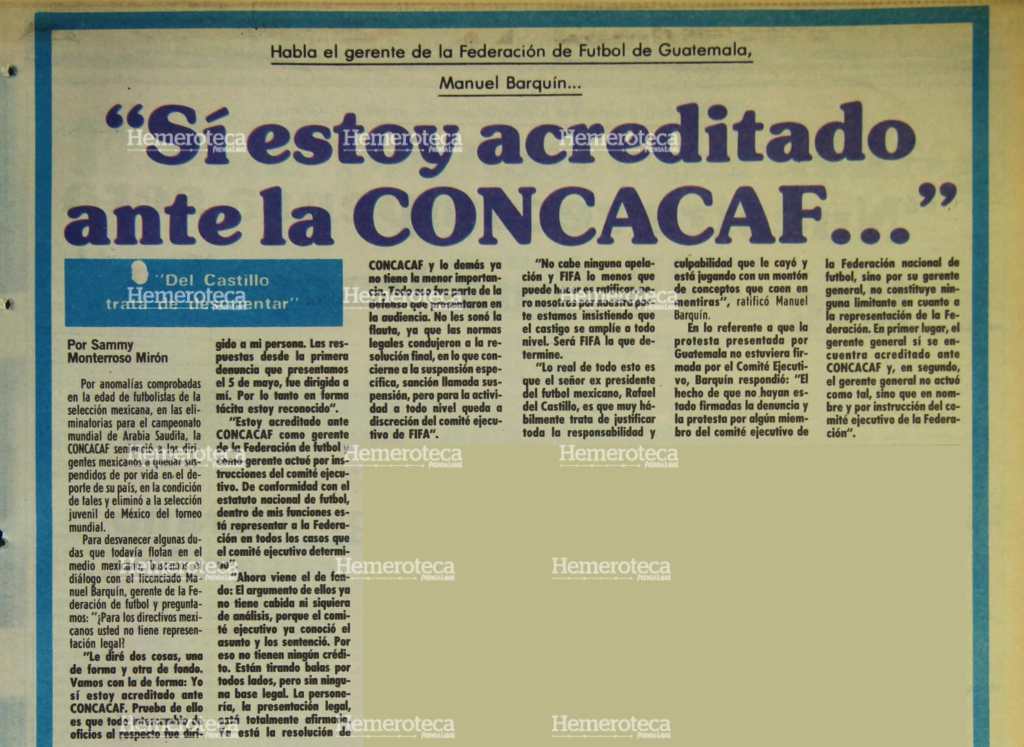
Del Castillo attempted to delegitimize the Guatemalan protest by arguing that Manuel Barquín, manager of Fedefut, “did not have legal representation.” Barquín responded with documents in hand during an exclusive interview published by Sammy Monterroso Mirón in Free press on June 24: “I am accredited to CONCACAF… all exchanges of trades were directed to me.”
The investigation revealed that the Mexican Federation had used adulterated passports.
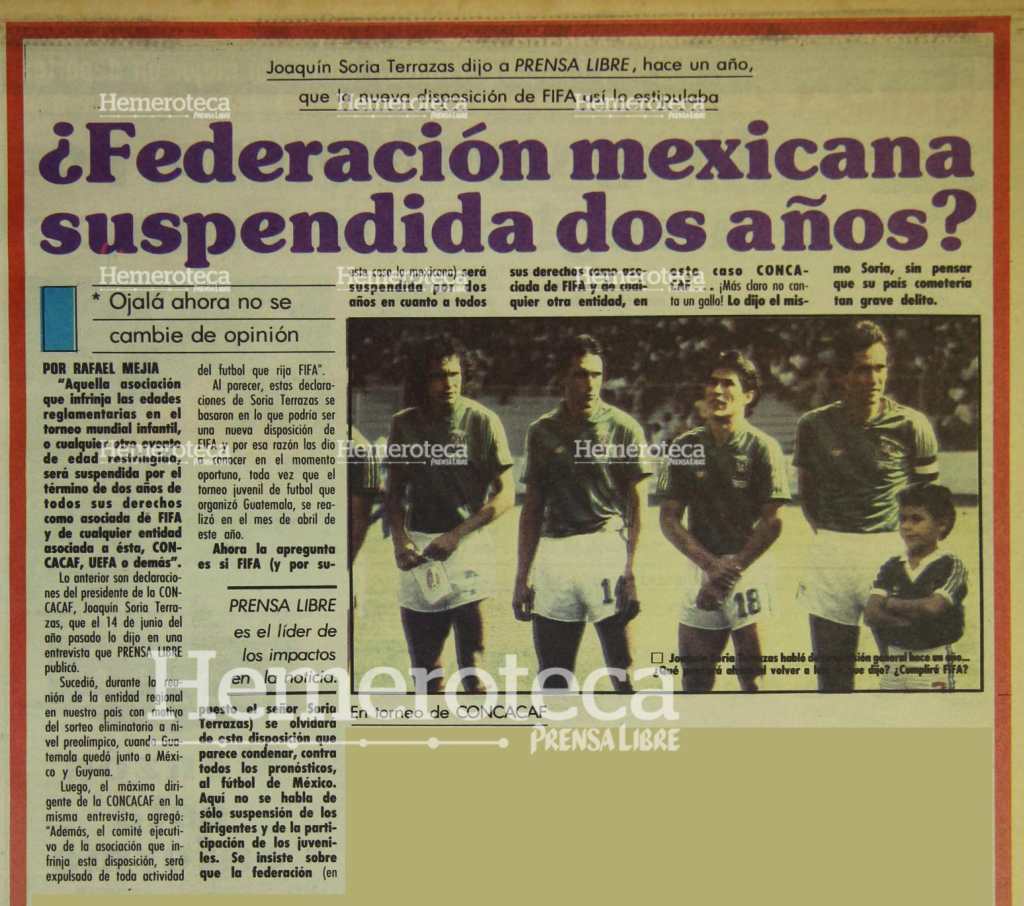
On June 7 and 8, 1988, Edgar Leonel Arana Paredes wrote in Free press: “Only FIFA could suspend Mexico” and recalled statements by the president of Concacaf, Joaquín Soria Terrazas, made a year earlier, according to which any federation that altered ages would be suspended for two years from all competitions.
Regional pressure was evident. On June 23, journalist Rafael Mejía reported that Hugo Sánchez, from Spain, described the case as a “regrettable event” and asked that the punishment be greater. Del Castillo, on the other hand, declared that “they did me a favor by expelling me from CONCACAF.”
On June 30, in Zurich, the FIFA Executive Committee ratified and extended the sanction. Mexico was left out of Seoul 1988, the 1989 Youth World Cup and the qualifiers for Italy 1990.
Free press headlined on July 1: “Mexico sanctioned for two years… Says goodbye to Seoul and the 1990 World Cup.” Edgar Leonel Arana Paredes obtained an exclusive interview with José Ramón Flores, vice president of Concacaf, who declared: “How good, FIFA supports us.”
The sanction came into effect retroactively from April 25. Guatemala, as second in the Pre-Olympic, inherited the quota.
Preparations and friendly matches
Already on June 24, while awaiting FIFA’s final decision, journalist Carlos Morales Chacón reported in Free press that the Federation was managing a friendly against Porto Alegre, from Brazil, for July 20 at the Mateo Flores stadium. He also confirmed a match against El Salvador on August 24, which showed the immediate preparation of the National Team.
For the 1988 Seoul Olympic Games, the Guatemalan team was led by Jorge Roldán. The squad included Ricardo Jérez and Ricardo Piccinini. In addition, Juan Manuel Dávila, Allan Wellman, Jaime Batres, Rocael Mazariegos, Víctor Hugo Monzón and Alejandro Ortiz were part of the team. Carlos Castañeda, Juan Manuel Funes, Julio Alberto Rodas, David Gardiner and Kevin Sandoval were also present.
The roster was completed by Adán Onelio Paniagua, Byron Pérez, Norman Delva, Luis López, Eddy Alburez, Ottoniel Guevara and Julio Gómez.
Guatemala was placed in a group with Italy, Iraq and Zambia. In their debut, on September 17, they lost 5-2 against Italy, with goals from Carlos Castañeda and Adán Onelio Paniagua. They then lost 3-0 to Iraq on September 19 and 4-0 to Zambia on September 21. He did not score points or advance to the quarterfinals.
The investigation not only uncovered the irregularity. It also forced FIFA to act with a severity that was unusual until then.
The sports chronicles of that time
The chronicles of Sammy Monterroso Mirón, Edgar Leonel Arana Paredes and Rafael Mejía published in Free press between June 23 and July 5 show how a Central American federation, without economic or political weight, managed to have the regulations applied.
The “Cachirulazo” was not just a youth scandal. It was the reason why Guatemala played its only Olympic Games in men’s soccer.
Almost four decades later, the film Mexico 86 relives the “troubles” that surrounded the 1986 World Cup and, incidentally, the “Cachirulazo”.
In the film, the character inspired by Rafael del Castillo is called Martín de la Torre, played by Diego Luna, while the journalist José Ramón Fernández also appears on screen, played by his son, Juan Pablo Fernández.
The production, which mixes real events with satire, has awakened renewed interest in Guatemala for the 1988 covers.
What at the time was a sporting decision supported by the regulations today is read as one of the most remembered episodes in the history of Mexican soccer.
The “Cachirulazo” demonstrated that falsified minutes can have real consequences. Guatemala obtained an unexpected quota; Mexico received a sanction whose repercussions are still remembered in its soccer.
Mexico 86 It not only entertains: it also forces us to remember that football, like politics, leaves traces in the press archives.