
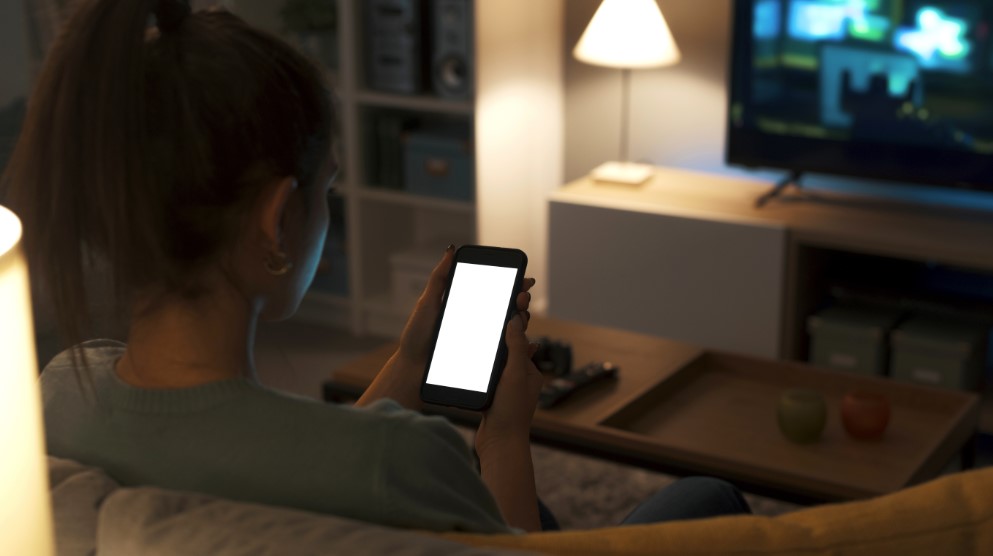
Nowadays, we are all increasingly reliant on our phones, which are a constant source of not only information, but also gratification.
Experts compare it to small, frequent doses of dopamine, since we carry our cell phones with us everywhere. Plus, phones are specifically designed to deliver that dopamine hit quickly.
According to a 2025 YouGov survey, most Americans report spending more than five hours a day in front of screens, and for many, their smartphone is the last thing they look at before going to bed and the first thing they look at when they wake up.
However, the relationship between people and their devices can be contentious: more than half of American adults expressed their desire to reduce phone use. That’s why devices like Brick and apps designed to limit screen time are gaining popularity.
If you, too, want to use your phone less, start by following these three steps.
Turn your phone into a tool
As noted by Kasley Killam, social health expert and author of The art and science of connection, our phones are too much of a distraction.
You can pick up your phone to send a text message and end up scrolling through TikTok, which translates to 30 minutes or more of unwanted device time.
“We spend so much time on technology that we miss the true value of life, which is being present with each other,” Killam said. “Technology can be a very powerful tool to keep us connected, but too often it’s more like fast food than nutritious food, and it’s too easy to consume those empty calories and not get the valuable connection we really crave.”
Killam suggested making the phone less interesting by removing certain apps, so that the device becomes a tool rather than a source of distraction.
Killam found that removing social media and email from her phone helped her reduce screen time. You still have those apps on your computer, but now you have a dedicated space to interact with that isn’t connected to it all the time.
Using your phone for a specific purpose can also help limit the time spent on it and create opportunities to make more meaningful connections.
When you’re bored on the way to work or feel exhausted at the end of the day, it’s easy to turn to your phone for immediate relief. As a healthier alternative, Killam recommended prioritizing personal connections.
“Instead of resorting to podcast or to Instagram, message a friend or call a family member. Replace that instinct with connecting,” Killam said.
“Research shows that those small gestures, even if you call someone and say, ‘I only have five minutes to chat, but I wanted to hear your voice,’ can be meaningful and help you maintain that relationship long-term.” exlica.
Try doing some activities without using your phone
Artist, musician and writer August Lamm tried various techniques to control her phone use. Downloaded applications that block access to social networks after a certain time. He hid the phone all over the house. Deleted applications. But nothing seemed to work in the long term, largely because he made a living as an art influencer on Instagram.
It wasn’t until he was left without access to his social networks for several months in 2022 that Lamm realized the magnitude of his dependence on the smartphone.
“It made me realize how negative that had been for my mental health, but also how dependent I was, how closely tied my career was to social media, and that I didn’t have a career outside of it,” Lamm said. “When my account disappeared, I was left without contacts. That made me realize that I had to create a new network and rebuild my career.”
Lamm began to write. Forced disinterest in her smartphone inspired her to become a self-described anti-technology activist who now uses a flip phone. He has written essays about his experience and urged others to consider upgrading to a feature phone. His first book, You don’t need a smartphone: a practical guide to change your phone and improve your life, will be published in October.
For those interested in reducing their reliance on a smartphone, Lamm suggested taking note of the reasons you use it daily and analyzing how many of those activities can be done without a screen.
“Every time you use your smartphone for something, think: Can I do this later at home from my computer? Or can I do it with an analog alternative? And maybe you’ll never get to the point of going without the phone completely,” he said. “But if, for example, you have a camera and every time you open the phone to take a photo you think, Well, I’ll do it with the camera, you might find that the smartphone becomes obsolete.”
Find fun activities
A common approach people take when trying to reduce technology use involves restriction, without addressing the underlying causes of this behavior, said Nicholas Kardaras, psychologist, technology addiction expert and founder of Omega Recovery.
“A lot of times when people turn to digital escapism, they don’t enjoy their lives. They feel helpless. They obsess over bad news. They feel like, for some reason, they’re not living the life they want,” Kardaras said.
“The key is to work at it. Find hobbies and recreational activities that give you joy, passion and meaning in life,” he recommends.
In many cases, excessive phone use increases anxiety because smartphones They keep our nervous system in a state of constant alert due to constant access to work, social networks and the news, which generates a “deregulation effect,” Kardaras explained. To combat this, she recommended a weekly digital fast to eliminate constant stimulation that can exacerbate anxiety.
If you can, try not to use your device one day a week. On this day, you can choose a pleasurable activity such as going on a hike, sitting on the grass, or spending time with your loved ones.
CONTENT FOR SUBSCRIBERS
“I call it dopamine replacement therapy through something attractive, captivating, in-person and that immerses you in the real world, Kardaras said.
Reducing phone use means reframing our perspective on the problem and ultimately creating lasting solutions, Kardaras said.
“If you want your phone to be small, make your life bigger.”