
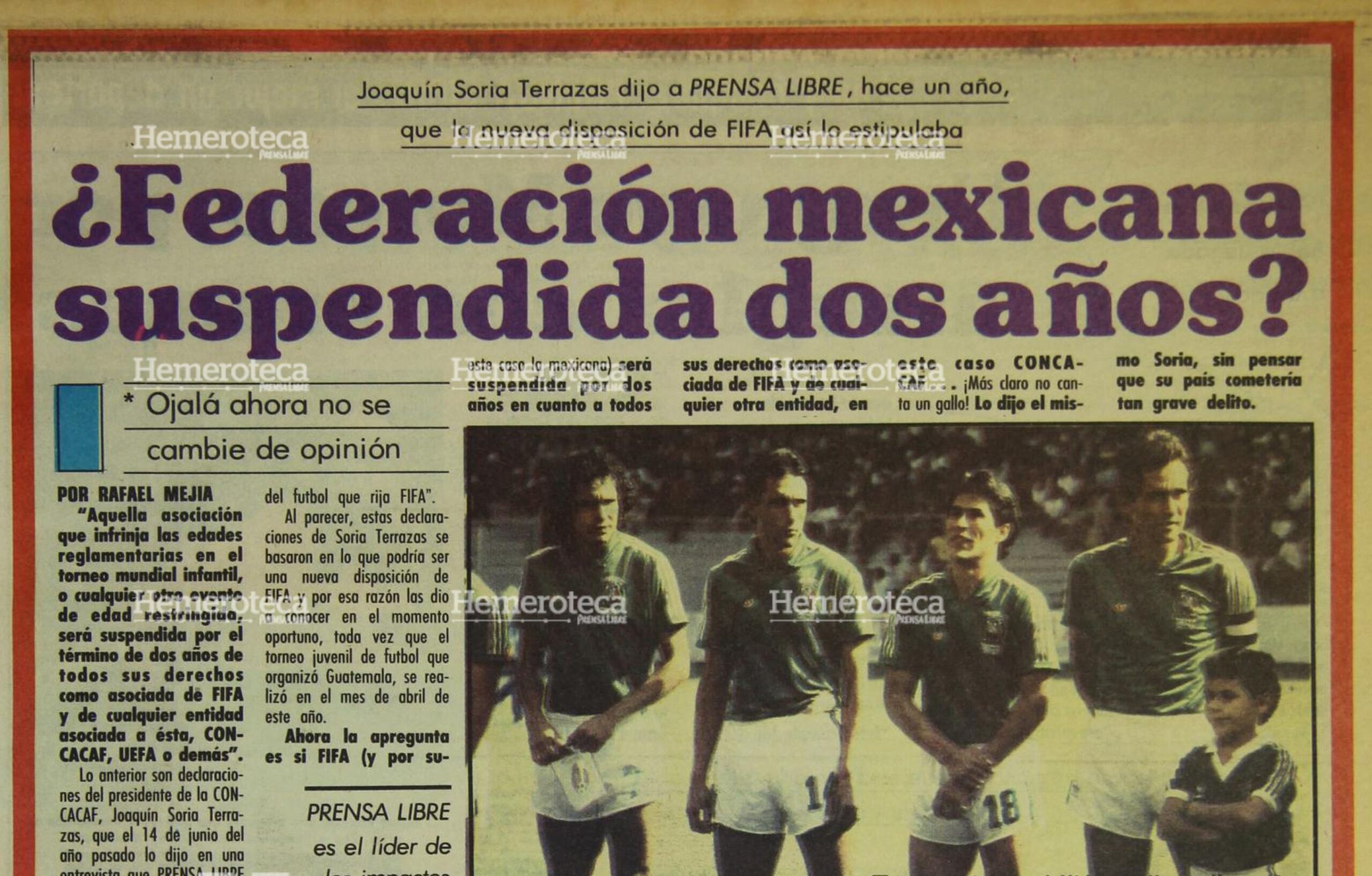
Four decades later, Guatemalan sports writer Gustavo Velásquez relives those days. His story reconstructs how a phone call, a VHS tape and a decision by the Guatemalan National Soccer Federation changed history.
“The day Guatemala left Mexico without a World Cup: the untold story of the ‘cachirules’,” says Velásquez at the beginning of the telephone interview with Prensa Libre.
“In 1988 I broadcast my program Sports Dialogue on a capital station. Suddenly, we received a call from a listener who put us on alert. “He assured us that on Mexican television, specifically José Ramón Fernández, had presented evidence of falsification of documents related to the ages of the players of the Mexico Under-20 team.”
That call reinforced a suspicion that Velásquez already had. “Shortly before, when that Mexican team came to play a friendly match at the Army Stadium, my first impression when I saw them enter was total skepticism. I remember telling one of the managers: ‘The number three can’t be 19 years old, and neither can the goalkeeper,'” he recalls.
The Guatemalan sports writer did not hesitate
“After the call from the listener, I moved to get José Ramón Fernández’s phone number. When I spoke with him, he was extremely cooperative and told me: ‘I’m going to send a colleague of ours, Antonio “Toño” Moreno, with a VHS cassette so he can see what we present on the air. You take it to Concacaf’. At that time, the headquarters of the confederation was where the old Reforma cinema operated, in the Guatemalan capital,” remember.
Then came one of the decisive moments
Velásquez says: “When Toño Moreno arrived in Guatemala, I accompanied him to the Concacaf headquarters to document himself and conduct some interviews. By reviewing the cassette he brought me, I gauged the impact of the investigation. The evidence confirmed the suspicion. Mexico’s number three, surnamed Rivera, was actually 24 years old.”
Velásquez decided to take the information to the national soccer authorities. “Knowing that an evening newspaper or a local sports program could only generate media coverage, I decided to go directly to the house of the president of the National Soccer Federation of Guatemala at that time, Mr. Óscar Humberto Pineda Robles. We saw the video on his television and, after convincing him of the seriousness of the matter, he decided to ‘take the upper hand,’ although at first he hesitated for fear of damaging the cordial relations with Mexico.”
The Federation acted
“Pineda Robles delegated the case to the manager of the Federation, Mr. Manuel Barquín Durán, who years later was a deputy and died today. Manuel traveled to Mexico and, despite receiving threats that forced him to discreetly change hotels, he managed to obtain authentic documentary evidence of the falsification attributed to the player Rivera and other members of the squad.”
The punishment came later
“With the official documents in hand, Concacaf had no choice but to strip Mexico of the U-20 title that it had won fraudulently in the tournament held in Mazatenango (Suchitepéquez). However, I insisted to Óscar Humberto that we not stop there; we had to take the case to FIFA.” “Reluctantly, taking care of diplomatic forms, the Federation presented the formal complaint to FIFA,” recalls Velásquez.
On June 30, 1988, while playing soccer, he received the news that would mark the outcome of the case. “In the middle of the game, a fan called me from the stands and told me: ‘Look, Don Gustavo, you got away with it. They just suspended Mexico for two years from all competition, including the qualifier for the 1990 World Cup in Italy.’ That’s how the historic sanction was carried out.”
The chronicler followed the case closely
“To follow the day-to-day crisis in neighboring soccer, I maintained an airlift with the airline Aviateca, which brought me the Mexican newspapers of the time daily. That had an enormous impact on Mexican soccer and affected prominent figures. Dr. Rafael del Castillo, a Mexican manager who was also a doctor in Law and not in Medicine, was suspended for life.”
The Olympic quota for Guatemala
The scandal had a direct impact on Guatemalan sports. “That scandal, known internationally as the ‘cachirules’ case, had a direct impact on Guatemala,” explains Velásquez.
“At the leadership level, it was possible to break the untouchable status that Mexico had within FIFA, where the influential Guillermo Cañedo, then vice president of FIFA, used to stop any punishment against his country.”
On the sporting level, Guatemala took advantage of the opportunity
“Guatemala had come in second place in the qualifying round for the Seoul 1988 Olympic Games. That qualifying round was eventful. Mexico had won us a key match at the Army Stadium with very controversial refereeing. However, after the disqualification and suspension of Mexico, Guatemala inherited the place and qualified for Seoul 1988 under the technical direction of Jorge ‘El Grillo’ Roldán.”
“That was the third and, to date, last participation of Guatemalan soccer in the Olympic Games.” Velásquez closes with nostalgia when remembering Guatemala’s Olympic participation. He talks about Mexico 1968, Montreal 1976 and Seoul 1988; of the players who shone.
Today, with the movie Mexico 86which revives the scandal, the testimony of Gustavo Adolfo Velásquez takes on new relevance. His story reconstructs how a call, a VHS tape and a formal complaint contributed to uncovering one of the biggest scandals in the history of soccer in the region.