
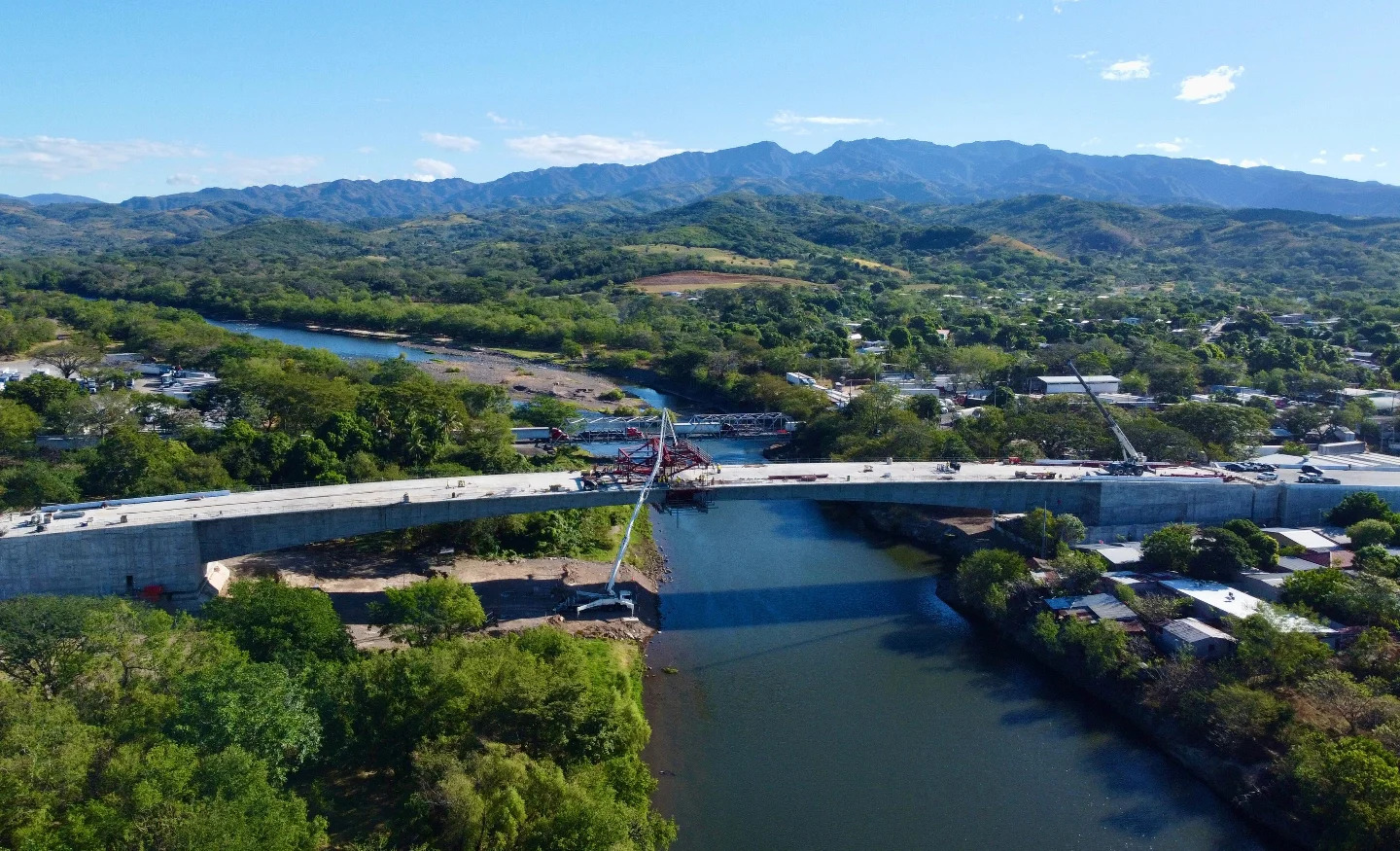
The new binational General José Manuel Arce bridge, built over the Paz River to connect the Pedro de Alvarado border crossing, in Guatemala, with La Hachadura, in El Salvador, remains without entering into operation, despite the fact that the main works were completed by the Salvadoran government at the end of 2025.
The infrastructure is part of the border integration agreements signed between both countries to modernize the main commercial and mobility crossings in the region. However, the opening of the bridge depends on complementary works that still need to be carried out on the Guatemalan side.
According to Delfino Mendoza, an analyst at Guatemala No Se Detiene, the delays that the work experienced during its construction were related to difficulties in releasing rights of way in Guatemala. However, currently the main obstacle is the lack of connection with the national road and customs infrastructure.
“The bridge was completed by the Ministry of Transportation of El Salvador at the end of 2025. It suffered delays due to difficulties in the release of the right of way by Guatemala, but it has not yet been inaugurated due to lack of connection with customs on the Guatemalan side,” he explained.
A strategic work for the border
The project was developed by the Ministry of Public Works of El Salvador as part of an investment program in road infrastructure financed through an international loan of US$144.7 million.
The new structure will replace the current border bridge over the Paz River and seeks to improve connectivity between both countries. According to official information from the Salvadoran government, the bridge has a length of 173 meters and was designed with four traffic lanes, lateral shoulders, sidewalks and drainage systems.
The work also includes the paving of approximately 1.4 kilometers of road access, with the purpose of facilitating the transit of merchandise, cargo transportation, tourists and users who cross the border daily.
The construction also responds to the need to replace an infrastructure that has been in operation for several decades, which has faced damage caused by the flooding of the Paz River during the rainy season.
The pending connection in Guatemala
Although the bridge has already been built, there is still no complete four-lane connection between the new infrastructure and the CA-2 Oriente highway, on the Guatemalan side.
Mendoza explained that initially it was proposed to build a bypass to avoid the passage of heavy transportation through the center of Ciudad Pedro de Alvarado. However, this project requires the acquisition of land, engineering studies and resources for its construction.
“For the interconnection of the new bridge with the CA-2 Oriente route on the Guatemalan side, the possibility of building a bypass to the town of Ciudad Pedro de Alvarado was raised, but for this it is necessary to acquire the rights of way, carry out the engineering studies and build the road section,” he indicated.
While this alternative is being planned, only a roundabout was built that will function as a road distributor and will allow connecting the future bypass when it is executed.
He added that the roundabout is already part of the completed infrastructure in the border area, but additional works are still needed to complete access to the new bridge.
The challenge of completing the four lanes
According to Mendoza, to put the new infrastructure into operation, the only thing left to do is complete approximately one kilometer of connection between the roundabout and the CA-2 highway, which leads to the border crossing.
However, this section includes the expansion of the Jorge de Alvarado Bridge, a structure that currently has two traffic lanes. “For the new bridge to work, all that remains is to make the four-lane connection between the roundabout and the CA-2 highway that connects with the border crossing,” he said.
As a temporary measure, the installation of a Bailey bridge parallel to the existing structure was evaluated to complete the required capacity while a permanent solution was developed.
“For reasons of speed, the possibility of placing a Bailey bridge parallel to the current one and thus completing the four lanes was temporarily proposed, but this has not been done, citing the DGC’s lack of provisional bridges,” the analyst explained.
Other pending works
The modernization of the border infrastructure between Guatemala and El Salvador is not limited to the General José Manuel Arce bridge.
According to Mendoza, both governments agreed to the construction of three new four-lane border bridges. El Salvador undertook the construction of the Anguiatú and General José Manuel Arce bridges, while Guatemala committed to developing the El Jobo bridge, on the Valle Nuevo border.
However, this latest project has not yet advanced to the construction phase. “Only a repair was made to the existing bridge, but the engineering studies for the construction of the new bridge remain to be carried out,” he indicated.
The analyst reiterated that in 2018 the General Directorate of Highways hired studies to develop the project. However, differences between the authorities of both countries over the location of the new bridge prevented the process from being concluded.
As a consequence, the studies were not completed and it will be necessary to liquidate the contract and carry out a new tender to continue with the project.