
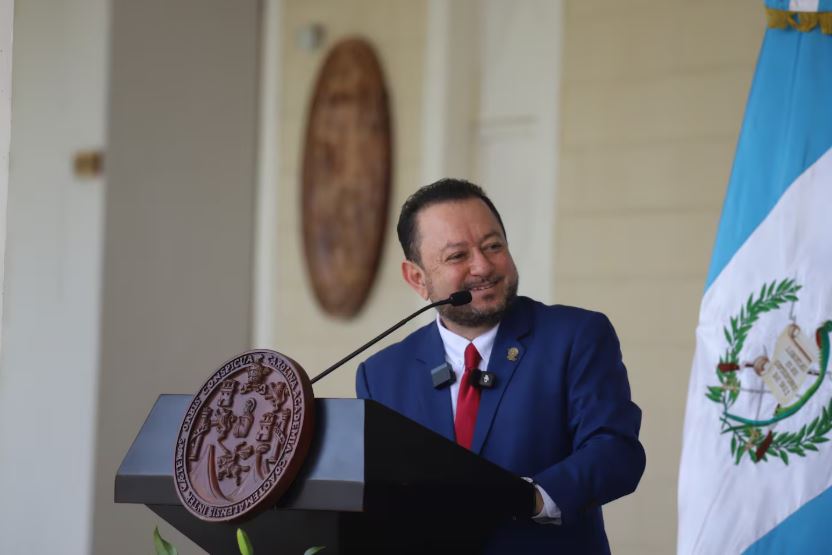
The risk that the candidate for Comptroller General of Accounts will be chaired by Walter Mazariegos, rector of the University of San Carlos de Guatemala (Usac), is high. This is according to organizations that call on the Rectors’ Forum to make an appointment “for the good of the country.”
The 17 academics who lead the universities operating in Guatemala must elect one of them for the position of president in the nomination committee for head of the Comptroller General of Accounts (CGC).
This position in the postulator represents a vote, but it gives the guideline to set the call for sessions, and by tradition, the presiding rector offers the facilities of his university to function as the headquarters of the commission.
Sources close to the universities confirmed, under condition of anonymity, that there is a group of rectors who promote Mazariegos as president of the nomination commission.
The negotiations would guarantee him at least six votes, which already puts him at an advantage, since the election is made with the number of rectors present, for which a minimum quorum of nine academics is required.
This Friday, June 12, Congress will be sending the call to the Rectors’ Forum, in which a date will be indicated to elect the president of the commission.
Sources indicate that a group of rectors related to Mazariegos is seeking to finalize the election in June, taking advantage of the academic recess and previous commitments of the other group of rectors that could influence a poorly attended call.
But on the opposite side, some academics consider it prudent to move the election to July, to guarantee the participation of the largest number of rectors in the election.
Has support
Organizations consulted see it as likely that Mazariegos’ Usac will obtain the presidency of the nomination committee, because the rector has proven to gather support from different actors, including the Rectors’ Forum.
The sources give as an example how in the last nomination commission for the Supreme Electoral Tribunal (TSE) the rectors broke an agreement, and decided to support the rector of Universidad Panamericana.
Hours before that vote, the forum’s agreement was to vote for the rector of the Universidad del Valle de Guatemala (UVG), but the majority chose to vote for the rector who aligned himself with Mazariegos in the nomination.
“There is a high probability that Mazariegos will be elected president, even more so that the election of rector will be illegitimate and illegal. He has political support at the highest level. The Constitutional Court supports him and the Executive prefers to remain silent,” said Edie Cux, an analyst at Acción Ciudadana.
For this nomination commission there will be 27 commissioners, including representatives from the Juan José Arévalo Bermejo University and the American University, the two most recently created.
“The academy is no longer so an academy, several universities have been created, some linked to Walter Mazariegos, we are not talking about academia, but about political interests,” Cux noted.
For his part, Alejandro Solórzano, analyst for the Alliance for Reforms, also sees the appointment as likely, but assures that academics can still consider their vote to leave a good precedent.
“The support that Mazariegos has is relevant. Now seeing the creation of new universities, it is clear that he has the power to make decisions. If it is possible that he is assigned to preside, it would be up to the representatives what legacy they want to leave for the academy,” he said.
For its part, the Projusticia Movement is clearer in its message to the Rectors Forum, recalling how the last election in which they participated left a participation that served as support for Mazariegos.
“In the past, the Rectors’ Forum was a point of trust, but no more. If they elect Mazariegos to preside over the nomination of candidates for comptroller, they would support anti-democratic tricks and influence peddling. Don’t play that game, rectors,” they stated on their social networks.
Respect deadlines
Deputy Elmer Palencia, second vice president of Congress and head of the Valor legislative bloc, said that the second-degree elections in which Congress participated this year have respected the constitutional deadlines, and that the CGC process will not be the exception.
“We from Congress and in my role as vice president, are going to comply with the constitutional deadlines, so that there is no shadow of doubt or weakness in this important process,” he said.
The deputy highlighted that this renewal process is vital, since the CGC helps public resources be well managed, highlighting the work of the current administration.
“Prevention programs have been developed for the proper use of public resources, the training of officials who manage funds. There is a project that must be continued, Supervised Municipality, it is a comprehensive verification with technological mechanisms that finds possible risks in the management of public funds,” he indicated.
For his part, deputy Samuel Pérez, an official who promotes the creation of the Raíces political party, highlighted that this renewal in the CGC comes at an important moment for democracy.
“The CGC process enters a pre-campaign context, which means that the incentives are focused on trying to influence, not so much to strengthen the CGC as an institution, but to control settlements,” he explained.
While deputy José Chic, from the Will Opportunity and Solidarity (VOS) bloc, who also warned of Mazariegos’ intentions on his social networks, considered that the rectors should think carefully about who they will give their vote to preside over the postulator.
“The rectors should weigh these accusations, in addition to evaluating not placing someone who does not have a settlement, someone that the Comptroller’s Office itself denounced for mismanagement of funds. That would only open the accusations and delegitimize a nomination commission with a great function,” he concluded.
The list of six candidates that this new nomination commission will make will go to Congress, where the plenary session of deputies will have to vote for the new head of the CGC for 2026-2030, who must begin his duties on October 13.