
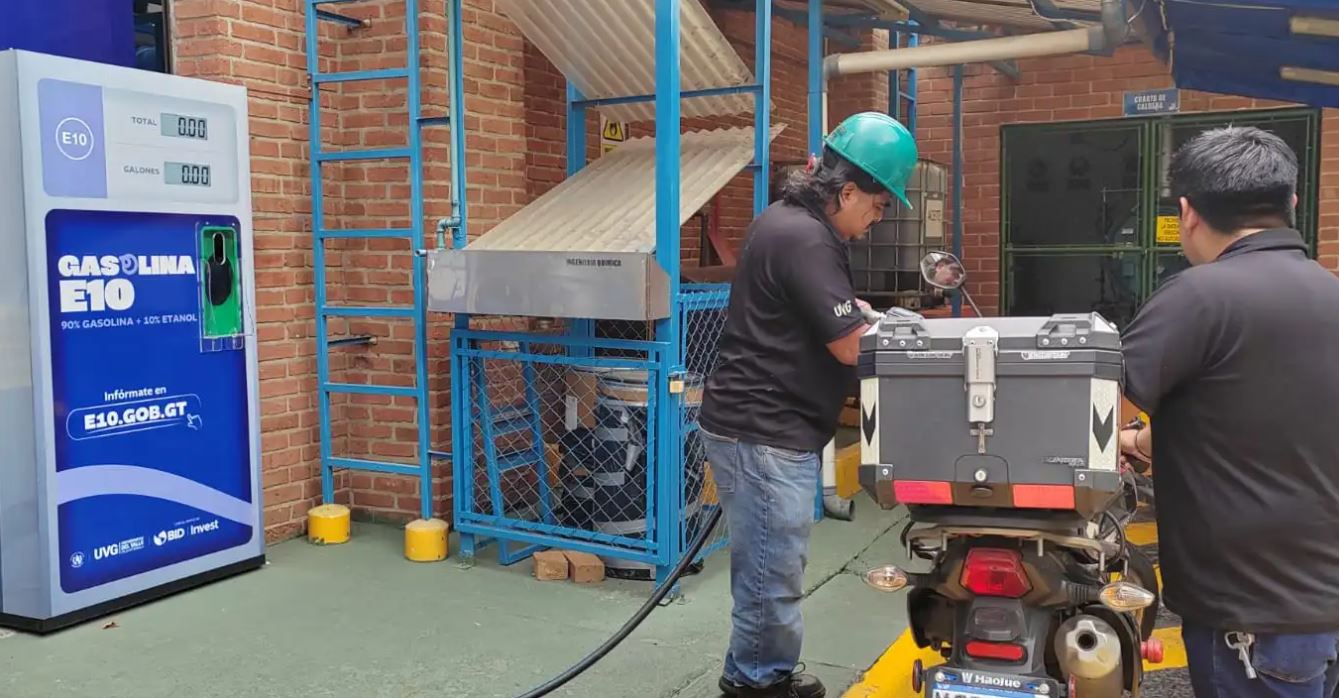
The gallon of gasoline with ethanol mixture will have a 10% discount on the Tax on the Distribution of Petroleum and its Derivatives (IDP) for the end user, because ethanol is not subject to this tax, as confirmed this Thursday, June 18, by the Ministry of Energy and Mines (MEM).
This is because this tax will only be charged on the 90% of gasoline that the gallon will contain, and not on the 10% of ethanol, which is not affected because it is an additive, MEM authorities reported during a meeting in Congress with the president of the Consumer Defense Commission, Ronald Portillo.
Premium gasoline is taxed with Q4.70 per gallon and regular gasoline with Q4.60, according to Decree 38-92 and its amendments, Law on the Distribution Tax of Crude Oil and Fuels Derived from Petroleum.
As a result, 90% of that tax will be applied to the gallon with the mixture. That is, for premium gasoline, Q0.47 per gallon will no longer be charged, which will mean paying Q4.23 in tax for each gallon; For the regular one, Q0.46 will be deducted and Q4.14 will be charged.
The Vice Minister of Energy, Luis Arturo Mérida, attended the summons, accompanied by officials from the Energy and Hydrocarbons directorates.
Direct benefit
Guillermo Therefore, only 90% of the tax is applied, which must be reflected throughout the chain until it reaches the final consumer.
Enrique Meléndez, executive director of the Guatemalan Association of Gasoline Retailers (Ageg), indicated that this is not a reduction, but rather a different calculation of the IDP, because this will only be applied to 90% of gasoline, while the other 10% will not be subject to the tax.
“It will come out like this from the moment it leaves the storage plant and the invoice that is delivered to the service station will already be adjusted,” said the executive.
CONTENT FOR SUBSCRIBERS
He added that the tax is not broken down in the consumer invoice, but is integrated into the price. However, we must wait to determine if the Superintendence of Tax Administration (SAT) establishes any different provision to issue that document.
The MEM authorities indicated at the Congressional meeting that, derived from the lower price of ethanol, its lower volatility with respect to the behavior of fuels and the reduction in the IDP, They foresee reductions in the price per gallon between Q0.50 and Q1.50. However, the Ageg requested that the corresponding studies be carried out to determine these data, because mentioning figures generates a lot of expectation among consumers.
Complaints and protocol
Officials were also questioned at the meeting about who would respond if a vehicle has a problem attributable to the ethanol blend, and how that situation will be identified.
The Vice Minister of Economy, Valeria Prado, explained that they work together with all the actors to establish an appropriate protocol for filing complaints.
He added that said mechanism has not yet been defined and he hopes to have it ready and present it in three weeks. The Consumer Defense Commission demanded that the official have this protocol ready at the end of the month, since the mixture of ethanol in gasoline will be in force as of August 21, and it needs to be socialized.
“Are they working on a protocol to assist users who consider that the mixture may damage the vehicle?” asked Deputy Portillo. The official from the Ministry of Economy (Mineco) indicated that the mixture with ethanol will be something new in the country and that users will probably attribute many of the problems that may arise in vehicles to it. However, he added that it is necessary to establish whether these inconveniences actually derive from the mixture or not, which represents a challenge, which is why work is being done on the development of the protocol.
Meléndez explained that the Ageg requests a specific protocol for the treatment of consumer complaints, and that this delimit the responsibility of service stationswhich is limited to maintaining the stability of the mixture. However, he indicated that gas stations cannot assume responsibilities related to the condition of the vehicles or other aspects unrelated to the stability of the mixture.
The Ageg also proposes that there be an independent technical entity that determines these cases, to prevent the State from becoming judge and party. To this end, it was added, the entity will present a protocol proposal.