
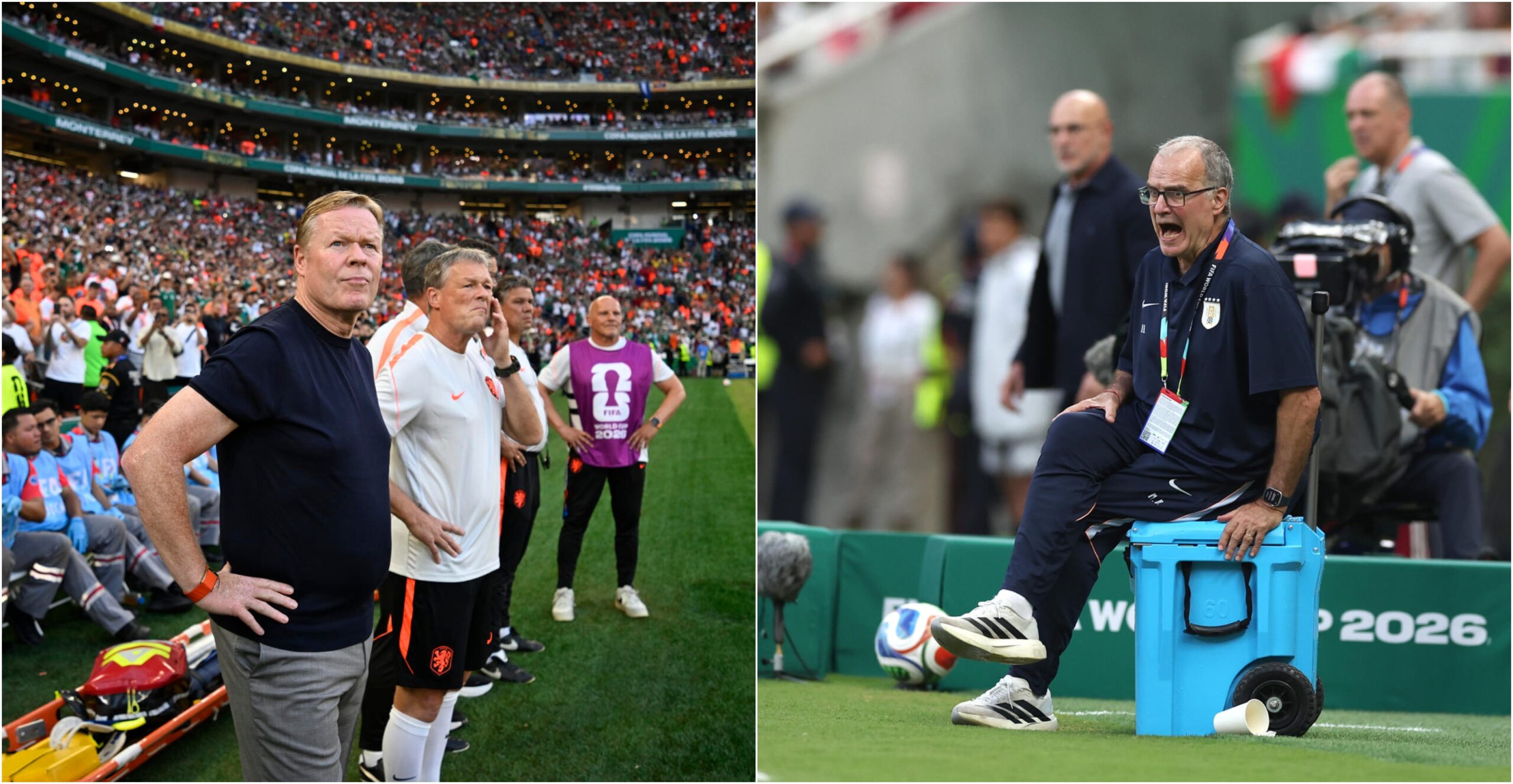
The 2026 World Cup has already begun to take its first consequences on the benches. Marcelo Bielsa stopped being Uruguay’s coach after the elimination of La Celeste in the group stage.
The same decision was made by Ronald Koeman, who announced his departure from the Netherlands after losing to Morocco in the round of 32.
The departures of both coaches reflect a common trend in World Cups: premature eliminations tend to accelerate the end of the processes, especially in teams with tradition, demands and aspirations to compete in the decisive rounds.
Bielsa and a farewell with self-criticism
Bielsa closed his cycle at the head of Uruguay after a campaign marked by frustration. La Celeste was eliminated in the group stage after losing to Spain, in a match that also left goalkeeper Fernando Muslera singled out for an error that ended in a goal.
In his subsequent appearance, the Argentine coach assumed responsibility for the result and acknowledged that he failed to enhance the team’s talent.
“I think we have disappointed the fans. The management I did of the resources I had was not enough,” said Bielsa.
The coach also referred to the case of Muslera, who was substituted at half-time against Spain. As he explained, the goalkeeper had had a fever in the previous days, but was physically fit to play. However, it was the goalkeeper himself who asked to leave due to the emotional impact of his mistakes.
“He told me that he was so hurt by the mistake he had made, surely linked to previous situations, that he preferred to stop playing because the group’s possibilities were intact and he was not in the best condition to face the second half,” Bielsa said.
Koeman closes his second stage with the Netherlands
Ronald Koeman also ended his time as Netherlands coach after the elimination against Morocco in the penalty shootout. The Oranje had reached the knockout stage as one of the strong teams in the tournament, but was left out in the round of 32.
The Dutch coach, who had already led his team between 2018 and 2020, had returned in 2023 to lead a new process. However, the defeat against Morocco accelerated the closing of its second stage.
Unlike the Uruguayan case, Koeman’s departure occurred in a more institutional context, although it was also marked by criticism of the team’s performance and the inability to advance to the quarterfinals.
Other movements on the benches
Bielsa and Koeman are not the only coaches affected by the results of the 2026 World Cup. The group stage and the first qualifying rounds also left other movements or closures of the cycle.
Sabri Lamouchi was dismissed by Tunisia after the 5-1 defeat against Sweden, in one of the first drastic decisions of the tournament. Hong Myung-bo left South Korea after elimination in the group stage, while Steve Clarke ended his time with Scotland after failing to qualify for the next round.
The closure of Miroslav Koubek’s process with the Czech Republic was also reported, after his team’s participation in the World Cup.
The pressure of the result
The departures confirm that the World Cups continue to function as a breaking point for many technical processes. In teams with history and high expectations, an early elimination not only leaves sporting consequences, but also immediate decisions about the future of the projects.
While the tournament continues with its title candidates, several federations are already beginning to plan the next cycle. For Uruguay and the Netherlands, that path will begin with the search for a new coach.