
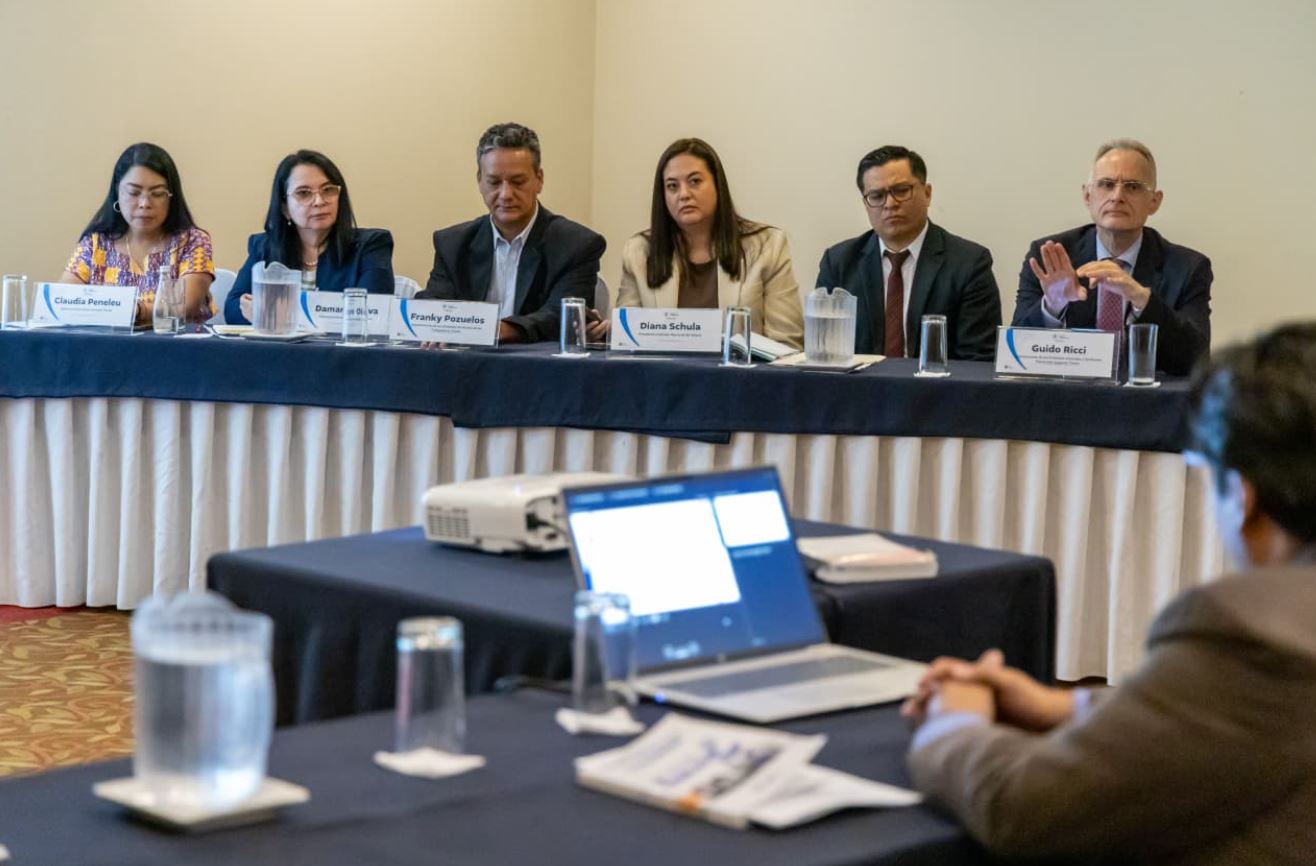
The Vice Minister of Labor, Damarys Oliva, representative of the Government before the CNS, explained that the idea of “employment, productivity and wages policy” was discussed in 2024 and was maintained in 2025; However, this year we seek to take concrete steps in this regard to create a public policy.
The objective is to approve and put into effect the public policy in 2027 and that the minimum wages By 2028 they will be proposed under this provision, with a multi-year fixation, which would change the current modality in which it is discussed and fixed for one year. Although it depends on the dynamics in the commission and the formation of that policy.
If these steps mentioned by the official are carried out, the current government through a final decision of the president of the Republic, The salary for 2028 would be set with this new modality, but it would be executed by the next government.
Oliva said that the issue of multi-year fixing should be decided not only by the Government sector, but by the tripartite bodies in the CNS, with the worker and employer sectors.
He explained that the decisions that will be made from the session on Tuesday the 30th seek to trace the route for the generation of this public policy based on the setting of minimum wages, so they do not yet have defined deadlines, and insisted that the issue should be raised to the Minister of Labor.
What does it mean to be multi-year?
The modality consists of projecting the indicators for several years and establishing a percentage increase on a multi-year basis, which would provide predictability, although the indicators must be reviewed annually to determine if any changed in that period.
In the session this Tuesday, June 30, the members of the CNS learned the Cacif proposal, which had been presented at its Labor Congress last May. In this regard, Oliva said that this would be one of the several elements that must be discussed, since a policy of this nature must be developed by the Ministry of Labor, integrate other components and entails a longer process, based on Segeplan regulations. It has also not been decided for what multi-year period the minimum wage will be established, he explained.
The official indicated that it is planned to define the route this year and continue next year, because it must be contextualized in the Planning Secretariat’s guide for the development of public policies and in the aspects that must be addressed, since it must be comprehensive. For example, employment, productivity, competitiveness and the salary part, since this is only one component among several.
CONTENT FOR SUBSCRIBERS
“It is planned to start with this definitively, because time has passed and we have not landed on it as such, and I would understand that it could take until 2027, hoping and trusting that by that year we will already have a public policy, and everything will depend on the actors who also intervene,” said the vice minister.
Asked about the deadlines to have the policy ready by the end of 2027, she said that they hope it will be sooner, but it will depend on the internal dynamics of the CNS as an advisory body to the Mintrab. To do this, a seminar will be held during July with different analysis and research centers.
The proposal
Guido Ricci, representative of the employer sector before the CNS and coordinator of the Cacif Labor Unit, indicated that the entity’s proposal is broad, which refers to guidelines for an employment policy, and that one of the elements is the multi-year fixation of the minimum wage, which they have requested for several years, since this will allow companies to have certainty and project in the medium and long term.
For this reason, it is considered valuable that the Executive Body, from 2024, also addresses the issue in the CNS.
The manager explained that the review would have to be done every year as long as the Labor Code does not change, which establishes this annual process in the CNS, that is, having an annual salary review process and reaching conclusions each year, but salaries would be projected based on those commitments or provisions that are established in the medium and long term. “The multi-year proposal would allow for projections over time and setting bases so that each year it would only be reviewed if the variables changed,” he commented.
He indicated that they still do not have a specific proposal on how many years this modality would cover.
Ricci explained that there are experiences in other countries: conditions are established; for example, that the increase would be recommended based on technical formulas of 3% annually and, in the coming years, if circumstances do not change, it would remain the same. But if they change based on some specific factor, that element would also vary.
Regarding what indicators They must be analyzed to define the projections, he commented that they have not yet been defined, he said that the needs of the worker must be addressed, but also consider the possibilities of the companies, within a context that does not affect job creation.
Separately, the vice minister pointed out that, although the projection of the minimum wage is made for several years, global events that impact the country must be considered, such as the increase in oil that is currently being experienced, so these factors must be analyzed technically.
Oliva said that the decisions are important because they involve the three sectors and must provide sustainability to the policy over time, so the projections would have to be reviewed if these changes occur.
Meanwhile, Franky Pozuelos, representative of the worker sector before the CNS, explained that there are several aspects that must be visualized within this tripartite effort. He mentioned that there are many factors that impact the processes and, therefore, decision-making, so they seek to know the employer sector’s proposal on guidelines and evaluate how much they can adapt, without losing sight of the conditions of workers and households, as well as informality and the increase in prices due to international conditions.
They will analyze constituencies
The economic constituencies (EC) currently in force, such as CE1, made up of the department of Guatemala, and CE2, made up of the other 21 departmentsbegan to apply for the minimum wage in 2023.
Asked about this, the vice minister considers that an evaluation of whether the constituencies are maintained or modified should be considered within this comprehensive analysis that will be carried out in the CNS and the Ministry, because these are part of the decisions that must be made at the time.
“Within that same employment, productivity and salary policy, the analysis would have to be done to see what the result has really been in the functioning of the economic constituencies,” he said. He added that there are currently two, but that, when reviewing the background of the CNS, salaries were previously set for almost all economic activities, such as shoe manufacturing, baking and others. “Today we have these two major divisions and it will be after the analysis that is done around this policy” that decisions can be made.
They reserve information
When the commission was consulted about what macroeconomic scenarios they are observing and what discussions have been carried out, the president of the CNS, Diana Schula, indicated that currently the sessions of said commission are under confidentiality of information, in accordance with agreement 1319 that contains the Regulations of the National Salary Commission and Joint Salary Commissions.
It was only indicated that various technical aspects proposed by the sectors are being analyzed, that there will be an ordinary monthly session and, if necessary, extraordinary meetings. In addition, a seminar with analysis centers will be held in July, and later the discussion on the minimum wage will begin.
Oliva explained that the decision is based on article 50 of the aforementioned agreement, and that the reservation has already been withdrawn based on the information discussed in 2025 and previous years, but not this year because the issue of the minimum wage is under discussion.
Expectations
About expectations for 2027, taking into account the macroeconomic scenarios, inflationary uncertainty and the Cacif proposal, Ricci said regarding his sector’s proposal that they cannot advance an opinion because there is no defined position and there are elements that must be reserved for discussion at the tripartite table. However, he recalled that in 2024 the President of the Republic, Bernardo Arévalo, left open the possibility of discussing an employment policy.
Oliva commented that since 2025 the Government sector, together with the worker and employer sectors, have seen the need to generate a public policy on employment, productivity and salaries, and that this year it was decided to learn about the proposed Cacif guidelines as a starting point.
Pozuelos pointed out that it is important to consider that global economic phenomena impact the economy of Guatemala, taking into account that it is an importing country of several products, which has an impact on households. Therefore, he expressed concern about the recovery of family income.