
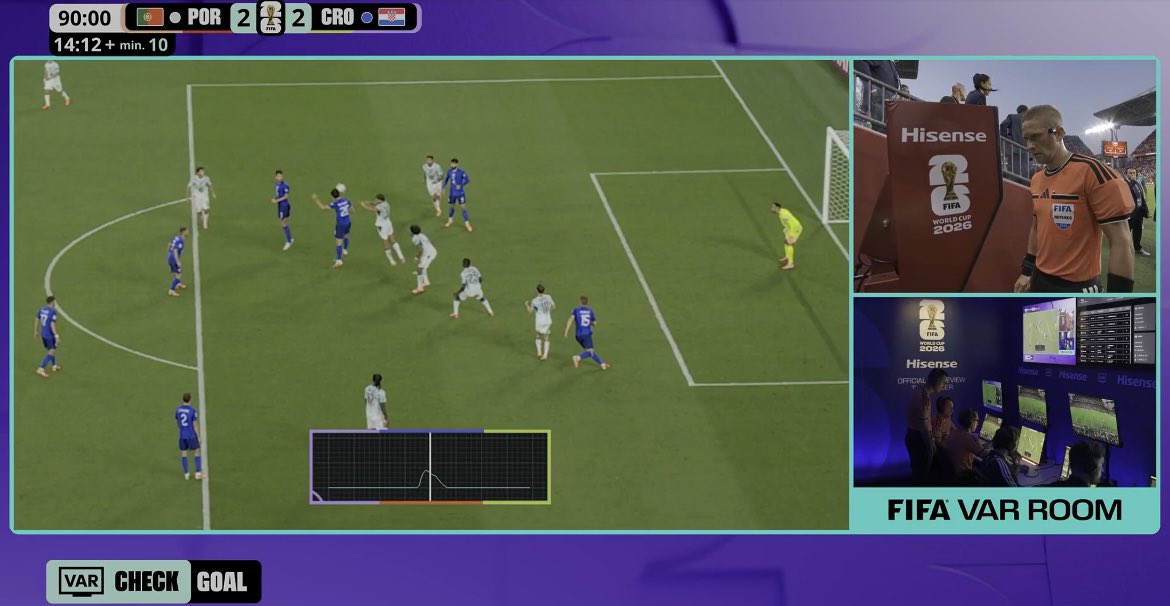
The controversial elimination of Croatia against Portugal (2-1) in the round of 32 of the 2026 World Cup was not resolved solely with the VAR images.
The decision that annulled Josko Gvardiol’s goal in the 102nd minute also involved the official Adidas Trionda ball.
It is the official ball of the 2026 World Cup, which is equipped with a sensor capable of detecting contacts imperceptible to the human eye.
Yes, imperceptible to the human eye.
FIFA responded to the criticism and explained that the technology incorporated into the ball was decisive in confirming the offside that nullified the Croatian tie.
These were the five keys that supported the arbitration decision.
1. A hidden sensor inside the ball
The Adidas Trionda incorporates a inertial measurement unit (IMU) installed in the center of the ball.
The device remains suspended by tensioners to maintain its stability throughout the match and works with an induction charging battery, without the need for electrical connections.
2. Records 500 data every second
The sensor sends 500 data packets per second directly to the VAR room.
This frequency allows us to precisely establish the exact moment in which a player comes into contact with the ball, eliminating any room for interpretation regarding the moment of the action.
3. He detected the friction that no one saw
Technology confirmed that the Croatian striker Igor Matanović He managed to touch the ball before it reached Mario Pašalić.
The contact was practically invisible to the cameras and the referee, but enough to modify the analysis of the play.
4. The touch changed the offside
Once contact was confirmed, the referees took that moment as a reference to review Pašalić’s position.
The system determined that the midfielder was ahead before assisting Gvardiol, whose goal would have meant 2-2 and extra time against Portugal.
During the review, a slight brush against the Portuguese defender Renato Veiga was also detected.
However, FIFA explained that it was an involuntary action and that, according to Law 11, this contact does not restart the play or eliminate a previous offside position.
5. The “heartbeat” confirmed the decision
The broadcast showed the graphic known as “heartbeat”a visual representation that marks the exact moment of impact detected by the sensor.
The tool, used for the first time at Euro 2024, allowed referees to synchronize contact with the offside review.
The technical explanation failed to extinguish the controversy.
In Croatia, media and fans questioned the decision and even resorted to sarcasm.
The portal Gol.dnevnik.hr He ironically said that “if Matanović had been bald, Croatia would have tied”, considering that the contact was barely perceptible.
Despite the criticism, FIFA maintained that the data obtained by the smart ball confirmed the existence of the touch and supported the VAR decision. Thus, a technology capable of recording hundreds of data per second ended up being the protagonist of one of the most controversial plays of the 2026 World Cup.
With information from EFE