
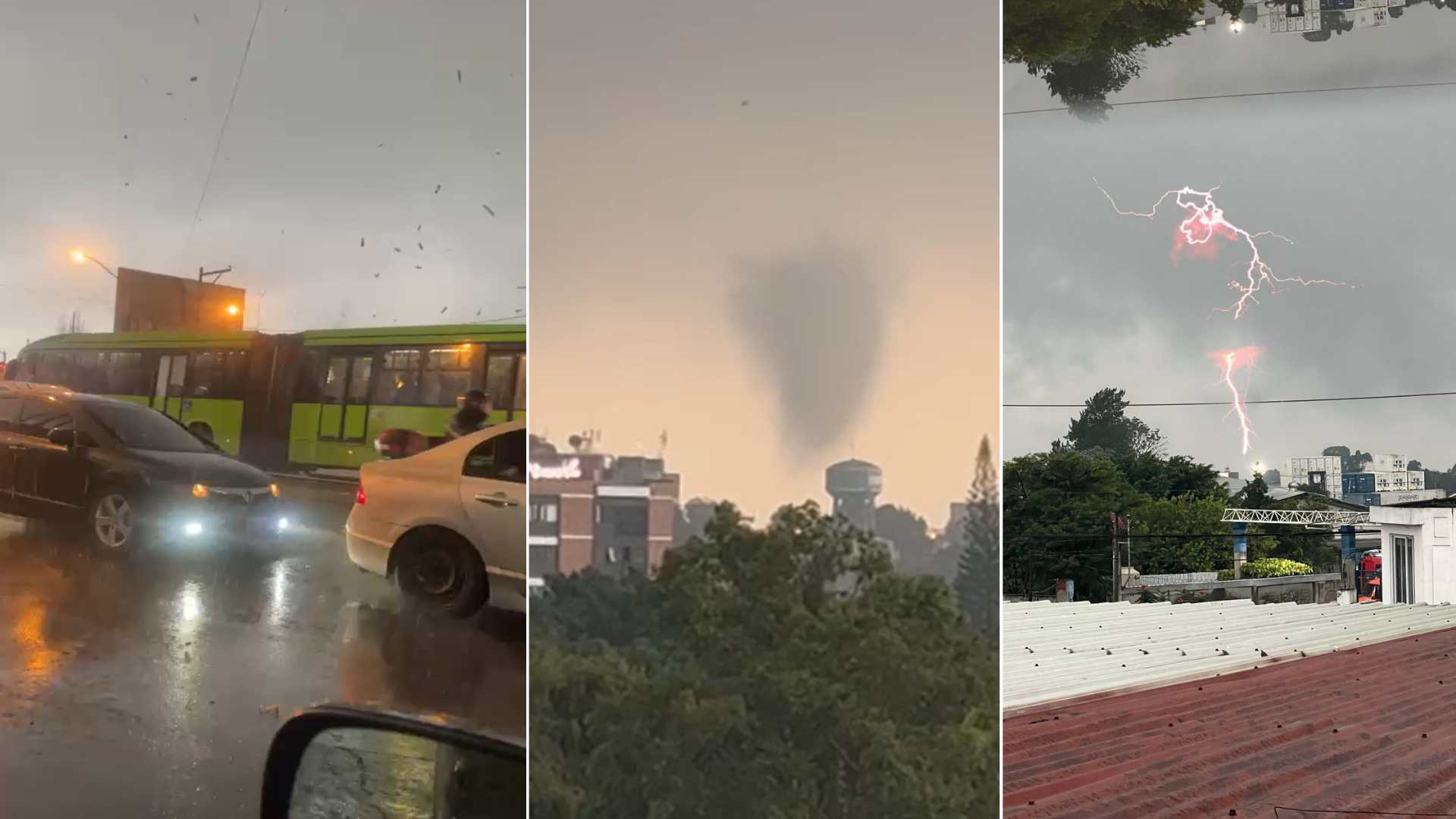
This Thursday, October 9, 2025, shortly before 5:45 p.m.the Insivumeh issued a special bulletin in which it warned that very intense rains were affecting Guatemala City during the afternoon.
In the midst of the severe local storm, hail was recorded in certain points and, most strikingly: the formation of a whirlpool of considerable dimensionscaptured on video and viralized on social networks.
The phenomenon generated alarm among neighbors and users. Although not common in Guatemala, its appearance confirms how dynamic the environment can become during heavy convective rainfall.
Experts explain why it happens, and why it is unusual for a tornado to form in the territory.
Storm details
According to the Insivumeh, the storm was linked to cumulonimbus cloudscapable of generating heavy rains and electrical phenomena due to internal currents.
The bulletin indicated that these effects occurred due to the heat of the day, the arrival of humidity and a very unstable atmosphere.
In addition, it was specified that the phenomenon that was observed was a whirlpool, and that although they are not common, they are usually seen in local storms.
INFORMATIVE METEOROLOGICAL BULLETIN #008-2025
Severe local storm
October 9, 2025#SomosINSIVUMEH #PassionForScience #CIV pic.twitter.com/s5A7Nu8mPY— INSIVUMEH (@insivumehgt) October 10, 2025
Although another similar effect is not expected to form tonight, the institution warned that they are not ruled out floods, river floods either slides.
Images circulated on social networks in which the whirlpool seems to break away from the cloudy skycapturing the attention of hundreds of users.
What does this swirl mean?
This type of eddy—when it connects with the cloud and hits the ground—is a violently rotating column of air that extends from a storm to the ground, according to the official website of the United States National Weather Service.
For it to form, these conditions usually occur:
- Winds that change speed or direction with height (wind break).
- Powerful updrafts within the storm (updrafts) and rotating air near the ground that rises.
But Not all whirlpools seen in storms are tornadoes. confirmed. In similar cases in Guatemala, the Insivumeh has ruled out its character as such.
The formation of tornadoes in Guatemala is ruled out, according to Insivumeh, because wind, pressure and thermal contrast conditions do not usually reach the intensity necessary to generate them, different from what usually promotes them in other countries.
What the experts explain
According to Paris Riveraresearcher of the University of the Valley of Guatemalain it Center for Environmental Studies and Biodiversity (CEAB)the atmospheric conditions on Thursday were especially conducive to the formation of the phenomenon.
“In general terms, it is not so frequent that they form, but the atmospheric conditions were conducive to the formation of the whirlpool. It was the result of a confluence of factors that created a favorable environment”Rivera explained.
The researcher details the factors that coincided:
- High humidity and heat: Typical conditions of the rainy season in Guatemala, added to the entry of humidity from both coastlines, generated an unstable atmosphere. Daytime ground warming exacerbated this situation, creating warm air that rose rapidly.
- Low pressure zone: A low atmospheric pressure system that affects Central America and has caused constant rains in the region in recent days created an environment conducive to the development of local storms.
- Atmospheric instability: The combination of warm, moist air rising with cooler, drier air at upper levels generated strong updrafts within the storms, precursors to rotation.
Rivera adds that this type of phenomenon “It’s not common, but it can happen.” under the right conditions.
Is a tornado common in Guatemala? Brief historical tour
Tornadoes are rare in tropical areas such as Guatemala, where extreme wind conditions do not occur as often as in mid-latitudes.
In February 2022, a tornado affected MoralesIzabal, causing damage to homes. The Insivumeh then explained that heat, humidity and instability were determining factors.
In July 2020, another tornado impacted Patzún, Chimaltenango, affecting roofs and leaving dozens of people injured.
Even so, most of these phenomena have been brief, localized and of lower intensity compared to classic tornadoes in the United States or temperate regions.
Read also: How possible is it that lightning strikes buildings in Guatemala City: expert responds