
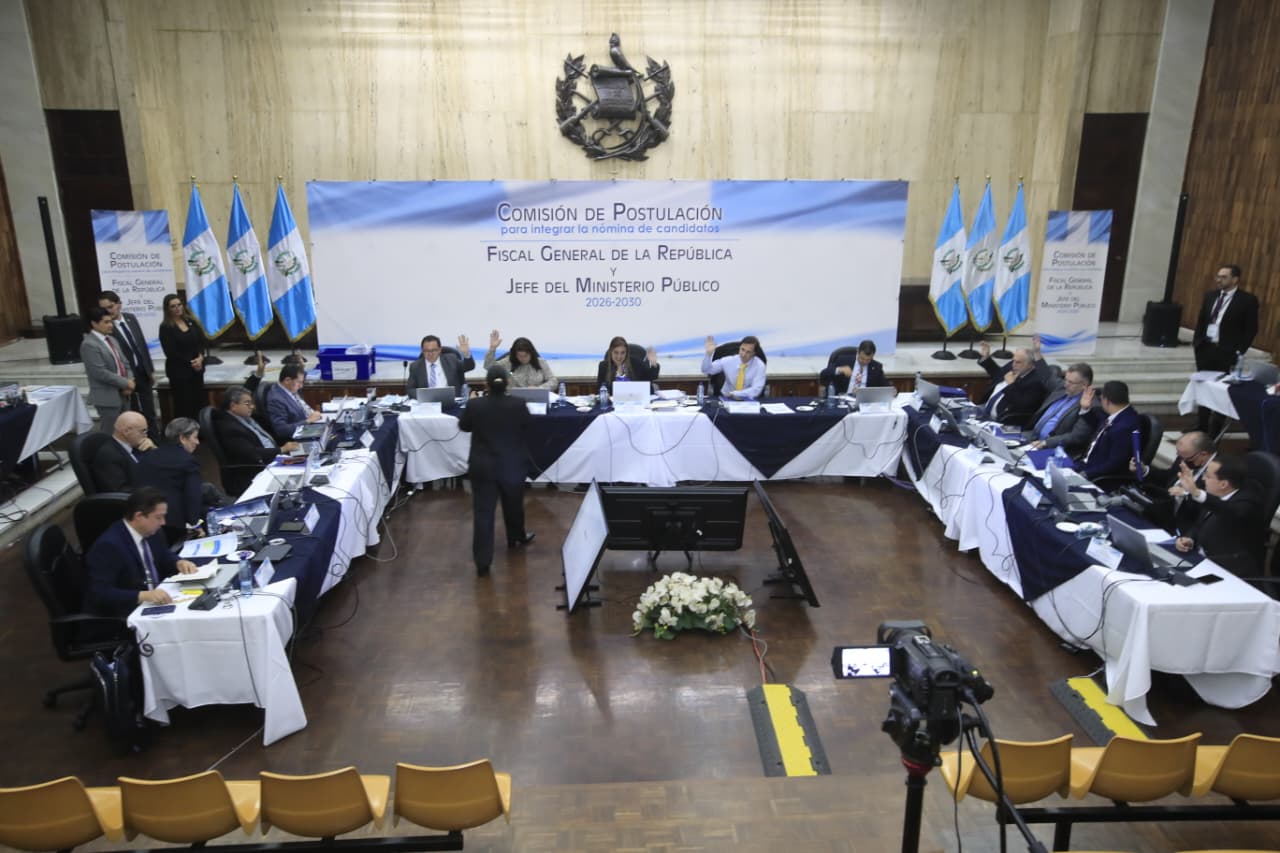
The evaluations to integrate the list of candidates for attorney general and head of the Public Ministry (MP) began on Monday, April 13 with the review of files by the Nomination Commission.
On the first day they were analyzed 17 applicantswhich marked the beginning of the last stages for the appointment of the next head of the MP
From that group, only three candidates managed to surpass the cut-off line of 75 pointsthe minimum threshold that allows one to be profiled as eligible within the process.
The rest of the candidates fell below that score, amid internal discussions that also marked the start of the evaluations.
For this Tuesday, April 14, the Commission plans resume voting from 3:00 p.m.with the evaluation of more files.
Applicants who pass the cut-off line (75 points)
- 86.21 – Gabriel Estuardo García Luna
It has 18 years and two months of professional practice. He has a doctorate in Law from the University of San Carlos of Guatemala and a degree in Legal Sciences from the Rafael Landívar University. Currently it is presiding magistrate of the Judicial Disciplinary Board since 2023. Previously he was a magistrate in the Court of Appeals of Cobán, Alta Verapaz, according to his resume.During the challenge period, the organization Guatemala Visiblecompiled that received a strike presented by Armando Rodríguez Son, who questions that he did not exercise second instance jurisdiction, having been a member of the Judicial Disciplinary Board for seven years.
- 79.69 – Néctor Guilebaldo de León Ramírez
Has 30 years of experience. He has a master’s degree in Criminal Law and Legal Pluralism from the University of San Carlos of Guatemala and has a completed curriculum in Constitutional Law from the Mariano Gálvez University. Since 2012 he has served as presiding judge of the Fourth Chamber of the Court of Appeals. He has also been a judge in the Appeals and Femicide chambers.During the process received a strike presented by Ricardo Méndez Ruiz, who questioned his suitability due to the dismissal of deputy Orlando Blanco in 2019, in a case of unreported electoral financing, pointing out an alleged lack of independence.
- 76.85 – Henry Elias Wilson
Addition 16 years and six months of professional practice. He has a doctorate in Criminal Law and Criminal Procedure from the Da Vinci University of Guatemala and has a postgraduate degree in Criminal Law from the University of San Carlos in Guatemala. He was member magistrate I of the First Appeals Chamber for crimes of Femicide between 2014 and 2021. He also worked as a trainer at the Justice Education Society and at the Public Ministry as a technical coordination professional.During the process received three strikes linked to the case “Parallel Commissions 2020”. The accusations point to an alleged obstruction of justice, by mentioning that he would have been one of the judges for whom the withdrawal of pre-trial was requested —which ultimately did not prosper—. According to the complaints, he would have maintained communication with the political operator Gustavo Alejos and participated in unofficial meetings, which, according to the investigations, sought to influence the formation of the lists of candidates for the Courts of Appeals and the Supreme Court of Justice.
Applicants who do not pass the cut-off line
- 70.28 – Zoila Tatiana Morales Validzón
- 69.21 – Carlos Alberto García Alvarado
- 67.71 – Gladys Veronica Ponce Mexicans
- 62.35 – Mynor Hernandez
- 54.07 – Brenner Israel López
- 53.53 – Walter Brenner Vásquez Gómez
- 53.5 – Shayne Ochaeta Argueta
- 51.14 – Marco Antonio Cortés Sis
- 50.78 – Edgar Miguel Morales Santos
- 45.6 – Walfred Orlando Rodríguez Tórtola
- 43.6 – Juan Luis Polanco Santizo
- 33.64 – Sully Claudet Merlos Moya
- 27.84 – Paolo Rubén Similox Valiente
- 25.92 – Maynor Eduardo González Méndez
Disagreements due to judges’ evaluation
The start of the qualifications, on April 13, was marked by differences within the Commission. One of the main discussions arose from the proposal of the president of the Supreme Court of Justice (CSJ), Claudia Paredeswho also chairs the Nomination Commission.
The initiative proposed not award points for professional practice to those who have been judgesunder the argument that the judiciary is incompatible with the practice of law and notary practice.
However, the proposal did not prosper and evidenced divisions among the commissioners—mostly deans—who cited criteria from the Constitutional Court, including resolutions from 2014 and 2022, to support different interpretations of how to count professional experience.
There were also disagreements in academic areas and in the definition of the beginning and end of the professional career, which directly impacts the assignment of points (two for each year of practice).
Despite this scenario, the three candidates who exceeded 75 points They agreed that everyone made up the final payroll of six candidates in the previous process election of attorney general.