
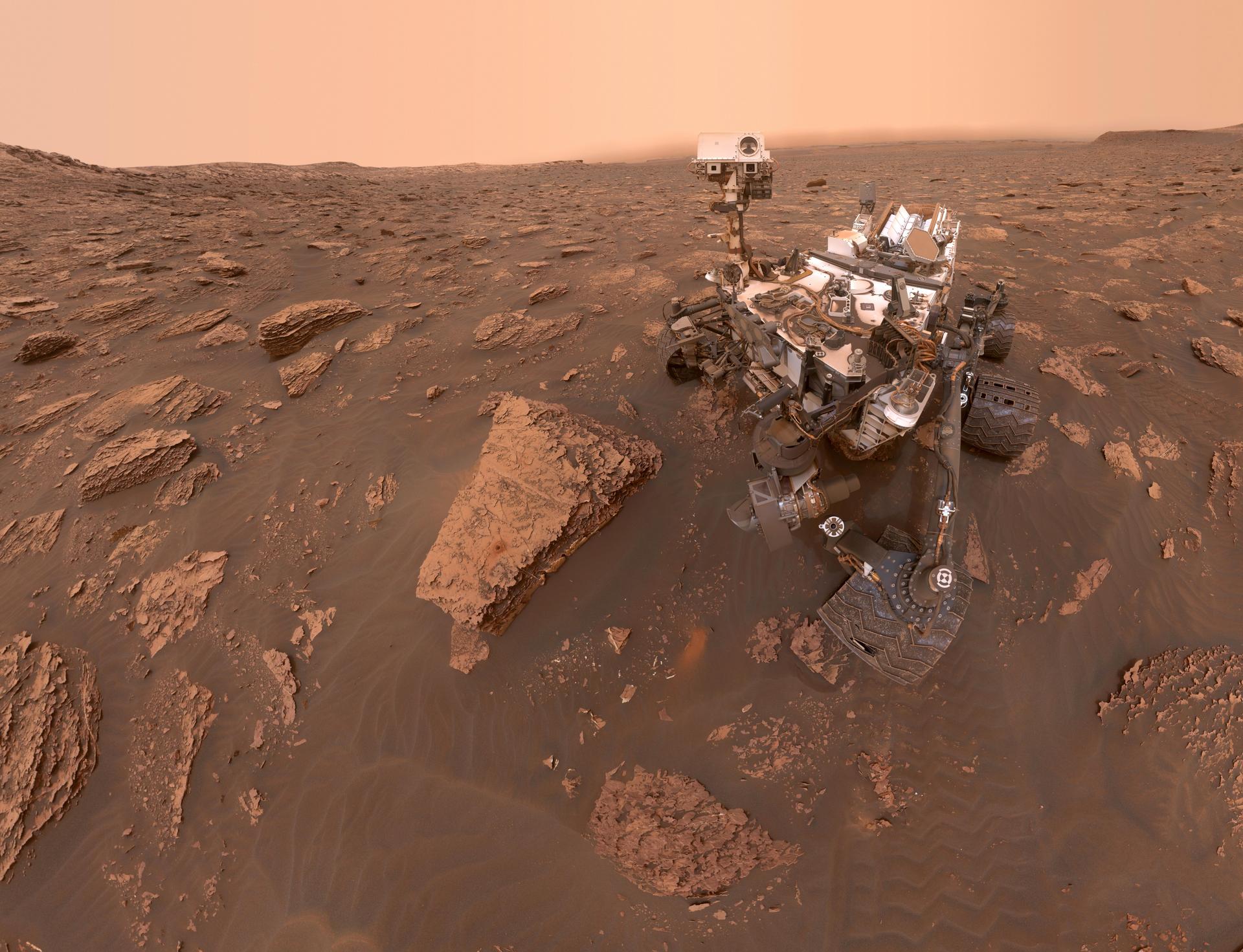
“We think we are looking at organic matter that has been preserved on Mars for 3.5 billion years,” said Amy Williams, a professor of geology at the University of Florida and a scientist on the Mars missions. rovers Curiosity and Perseverance on Mars.
Williams is the lead author of an article in Nature Communicationswhere this discovery is collected this Tuesday, April 21.
Launched in November 2011, the Curiosity rover landed in Mars’ Gale Crater on August 6, 2012 to determine whether the Red Planet ever had the right environmental conditions to support microbial life.
Led by NASA’s Jet Propulsion Laboratory, the rover carried out the experiment in 2020 in the Glen Torridon region of the crater, an area rich in clay minerals that indicate the area contained water in the past.
These clays can retain and preserve organic compounds better than other minerals, making them a priority target for discovering chemical molecules compatible with life.
Identified substances
Among the more than 20 chemicals identified by the experiment, Curiosity detected a nitrogen-containing molecule, with a structure similar to DNA precursors, a substance never before detected on Mars.
The rover also identified benzothiophene, a large, double-ringed, sulfurous chemical that often reaches planets via meteorites.
“The chemical fallout from meteorite debris on Mars is the same as that experienced on Earth and likely provided the building blocks for life as we know it on our planet,” Williams said in a statement.
The experiment cannot distinguish between organic compounds from possible past life on Mars and those formed through geological processes or brought by meteorites. To do this, it would be necessary to bring rock samples to Earth and study them in the laboratory.
Next steps
These results come at a time when future missions, including the Rosalind Franklin mission to Mars and the Dragonfly expedition to Saturn’s moon Titan, plan to carry a test to search for organic compounds on board.
“We already know that there are complex organic compounds preserved in the shallow subsurface of Mars, and that is very promising for the preservation of chemical molecules that could be indicative of life,” Williams concluded.
The experiment was carried out by the instrument suite known as SAM, for test analysis on Mars. Using a chemical, the experiment broke down larger organic molecules so they could be analyzed by instruments on board the vehicle.