
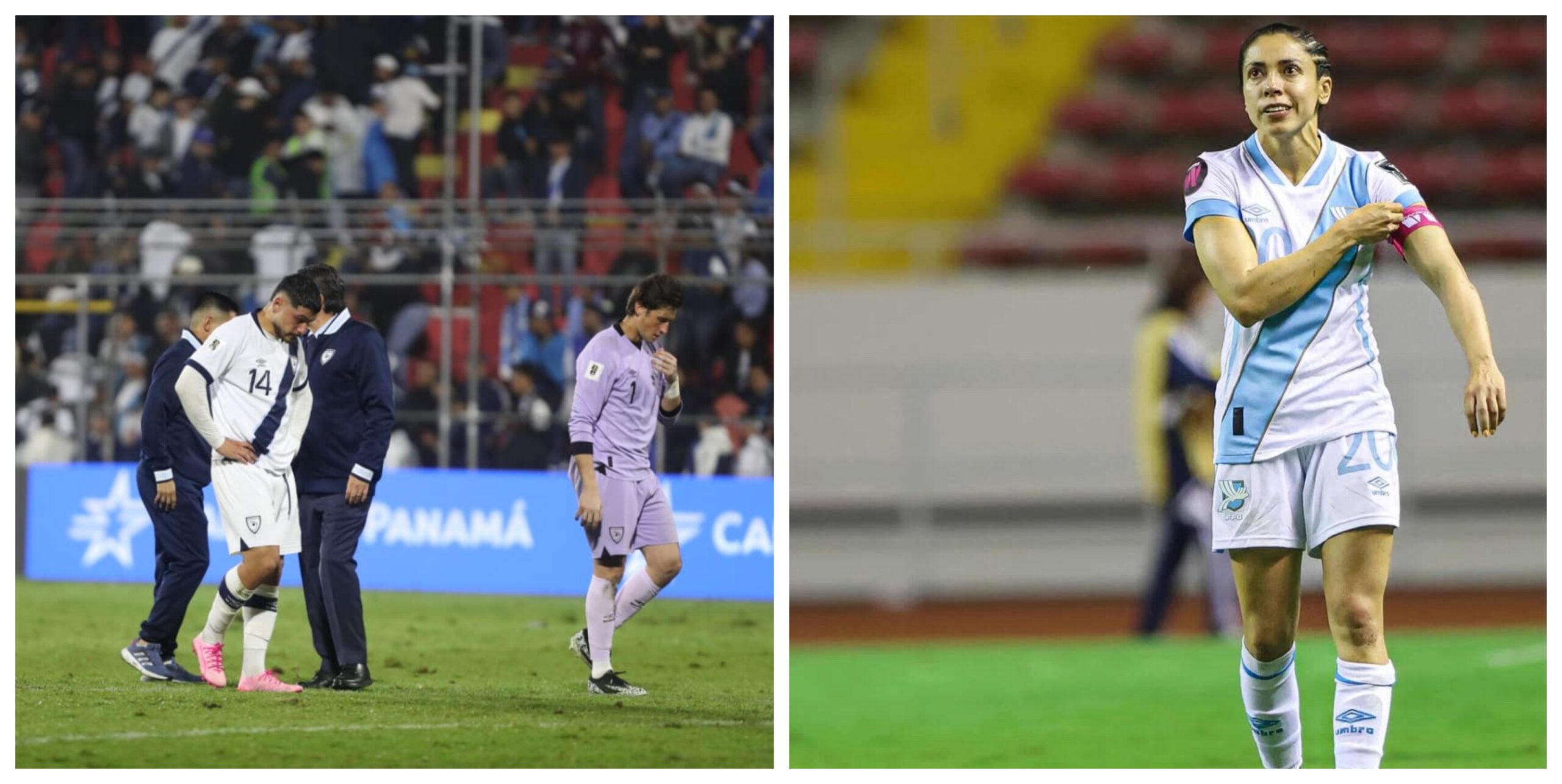
Guatemalan soccer is going through one of the most disappointing moments in its recent history. In a period of less than five months, the country saw the dream of qualifying for a World Cup in three different categories disappear, consecutively, a situation that shows the fragility of the national sports project and leaves a feeling of widespread frustration among fans and protagonists.
The elimination of the Senior National Team meant a hard blow and a great failure, as it was a real opportunity to compete for the first time in an absolute World Cup. The team failed to consolidate its strength at home or translate the support of the fans into decisive results, which repeats a pattern that has hindered previous processes.
Added to that disappointment was the failure of the U-17 category, which missed a valuable opportunity to qualify for a youth World Cup. The elimination exposed deep deficiencies in talent training, long-term planning and lack of continuity in processes, key aspects for the sustainable development of national football.
The closing of this chain of eliminations was the fall of the Women’s National Team, which also frustrated their chance to qualify for their first World Cup. Altogether, the three eliminations confirm that Guatemala not only missed three World Cup berths, but also a historic opportunity to lay firm foundations for the future of national soccer.
First blow: the Senior National Team and another failed eliminatory
The beginning of this chain of disappointments occurred in November 2025, when the Guatemalan Senior National Team was eliminated in the final phase of the Concacaf qualifying round for the 2026 World Cup. It was a historic opportunity: for the first time, the World Cup will have 48 teams and, in addition, regional powers such as Mexico, the United States and Canada were already classified by being hosts.
However, even that favorable scenario was not enough. The team led by Luis Fernando Tena finished in third position in Group A, behind Panama and Suriname, and only surpassed El Salvador. That location left him without the possibility of even accessing the intercontinental playoffs, thus consummating failure number 17 in the search for absolute World Cup qualification.
The elimination was especially painful because the football environment believed that this was the right generation to break the historical ceiling. But, once again, Guatemala stayed on the shore and committed another failure.
Second failure: U-17, wasted home field and repeated elimination
The second setback came in February, during the U-17 World Cup, played in Guatemalan territory for the second consecutive year. The youth team, led by Willy Coito Olivera, was also left out of the category’s World Cup, which will be held in Qatar with the expanded format of 48 teams.
History was a painful repetition. Guatemala was eliminated by Haiti, the same rival that had left it out the previous year. In a group in which only the first place obtained the World Cup ticket, the Blue and White finished in second position, insufficient to fulfill the dream of playing their first U-17 World Cup.
The defeat once again showed the fragility of the training processes and the inability to capitalize on being home, an advantage that ended up being sterile.
The last blow: the elimination of the Women’s National Team
The third and most recent blow occurred with the Guatemalan Women’s National Team, led by Mexican strategist Karla Maya. In the Concacaf W qualifying round, the national team fell 0-3 against Costa Rica, a result that buried any possibility of advancing to the World Cup and seeking the long-awaited ticket to the World Cup.
Only first place in the group granted qualification and, with that defeat, Guatemala was left with no options to fight for a ticket to the Women’s World Cup, which will be held in Brazil, as well as the 2028 Los Angeles Olympic Games. Another illusion that was extinguished before its time.
A repeating pattern
Five months, three selections, three eliminations. The balance is devastating. Far from being isolated events or simple sporting accidents, these eliminations confirm a deep structural problem that Guatemalan soccer has had for decades.
The growing dependence on foreign-trained footballers shows the country’s inability to produce competitive talent on a sustained basis. Although these players can provide individual quality in the short term, they do not replace the need for a solid local training base.
The responsibility is collective. The Federation, the clubs and the associations – especially those of the National League – maintain a historical debt with the minor divisions. Investment remains limited, planning is inconsistent and the training of specialized coaches is insufficient. Without modern methods, clear structures and demanding internal competition, local talent ends up stagnating.
Results that reflect the crisis
The numbers are overwhelming. In its entire history, Guatemala has only qualified for two World Cups, both in the U-20 category: Colombia 2011 and Argentina 2023. More than signs of sustained progress, these participations show the sporadic success and the absence of a long-term training project.
The dream of going to a World Cup is still alive among the fans, but sporting reality insists on hitting it again and again. Time passes, opportunities disappear and national soccer continues waiting for a transformation that, to date, has not arrived.