
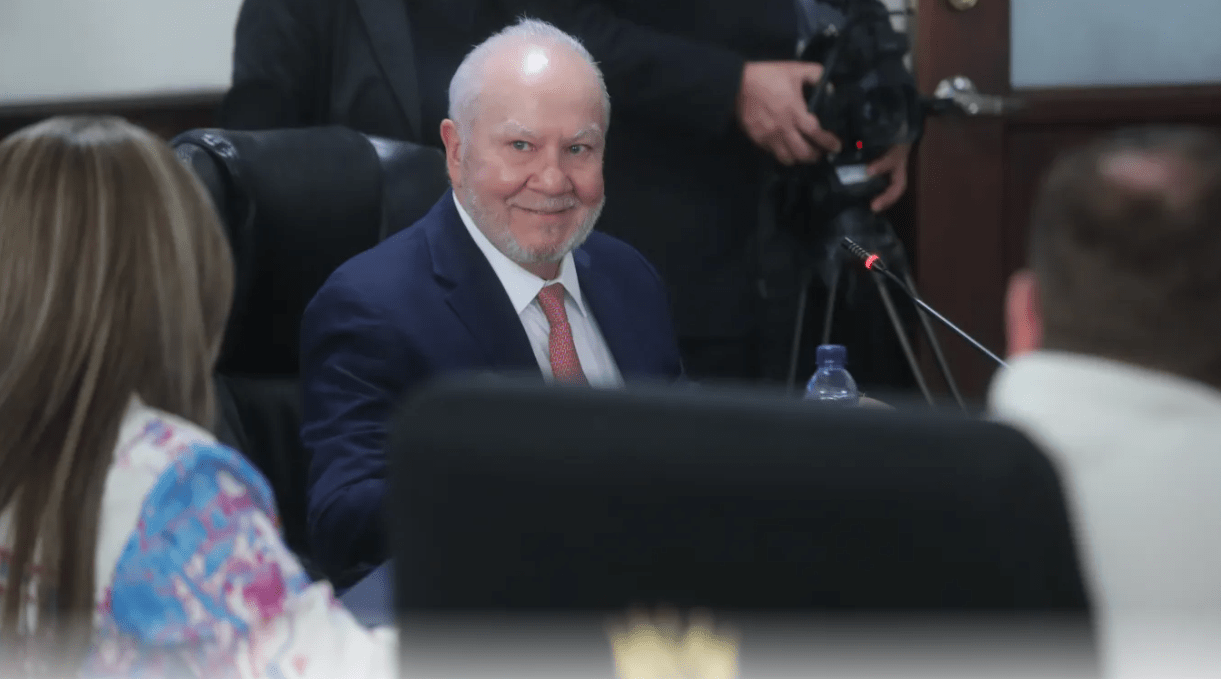
He titular magistrate of the Constitutional Court (CC), Roberto Molina Barreto, in interview this Friday, April 24 in Free Press Radioexpanded details of the resolution that annuls the payroll for candidates for attorney general and explained under what arguments they resolved. In addition, he was consulted about his point of view after President Bernardo Arévalo’s reaction to what was resolved.
On Thursday, April 23, The CC decided to repeat the evaluation of applicants and redo the list under new criteria, after granting provisional protection.
In its resolution, the CC considered that it is a well-known fact that in the sessions of the Nomination Commission the verification of the requirements demanded by Article 251 of the Constitution was not met, specifically because the time served as a judge could not be computed within the exercise of the legal profession.
In that sense, Molina Barreto indicated that if the Court resolved until Thursday it was by omission, since the outgoing presidency and the current one had not convened, as they had requested for several days.
He added that the request that it be convened in time was to create fewer problems in the process being experienced for the appointment of the new attorney general of the Public Ministry (MP).
He recalled that the amparo entered the CC a long time ago, which is why three magistrates had already expressed the urgency of resolving it, remembering that it was not a new criterion, but that the Court had already mentioned it since 2022.
He stated that from the first day they assumed the new magistracy they also made the request, but it was not convened until April 23.
“This forces us, therefore, to completely go back to the process to a previous stage,” he indicated.
According to the magistrate, if it had been resolved in time, it would have been when the Nomination Commission was still evaluating how to qualify the prosecutor candidates.
He stated that The resolution is not directed at any particular person, but seeks to fulfill the function of the Court, which is to protect the constitutional order. He added that there are also others responsible for this setback, such as some members of the Nomination Commission.
Molina Barreto recalled that it is public knowledge that the issue of whether or not the experience of practicing the liberal profession could be accumulated with the practice of the judiciary was widely discussed. According to him, some interpreted it correctly, remembering what the Court has already established, while others maintained an opposite position, which led to this consequence in the process.
He added that the CC analyzed that the Nomination Commission did not comply with making that due qualification, and that is why it set a deadline for the president to return the payroll and, within 48 hours, the Commission to review the applicants’ files again.
He explained that what was resolved does not imply reviewing each candidate’s file at all, but only those cases in which there was an improper qualification; that is, who were judges and who had that time accumulated to score points.
He said that he does not know what the result of this review will be and who it could affect, since he does not have access to all the files.
He explained that This is not a situation in which the Court is classifying peoplebut compliance with the Constitution, and that compliance cannot be void. He added that a precedent cannot be left that would vitiate future processes.
He recalled that the Court was urged to hear the protection in an appropriate time, given the threat that the requirements would be poorly qualified or identified, because if it had been resolved when the Commission was preparing the grading table, this would not have happened.
He stated that The Court has no intention of affecting any payroll professionalbut it cannot fail to resolve or declare the case without matter.
Molina Barreto said that the Court or the magistrates do not react to social networks or opinions of legal activists. He pointed out that, if they were jurists, it could be debated; However, he considers that there is activism that seeks to discredit the CC or its members due to disagreement with the resolutions.
For the magistrate, there is an evolution of the criterion, not a contradiction; It is totally complementary not only to the ruling of April 23, but also to that of 2022, when a similar situation arose.
He indicated that the Constitution establishes the requirements and that, if article 216 is analyzed, it clearly indicates that one must have a full period as a Chamber magistrate or more than 10 years of professional practice. He considered that it would be illogical for the constituent to establish two conditions for the same requirement.
“A judge is not a lawyer”
The magistrate clarified that “a judge is not a lawyer”, but rather an arbitrator who resolves conflicts between parties or between the State and a person.
He said that, if after the review and the final vote it is determined that they are the same six candidates, that is the function of the Commission; and if it changes, it also responds to its purpose.
He recalled that the process had an original defect that cannot be maintained in the constitutional processes for the position of attorney general or for other positions established in the Constitution.
He stressed that it is not advisable to allow vices that violate the constitutional order.
He warned that any protection, if not fulfilled, has consequences, according to the protection law, which is of constitutional rank, and can lead to criminal and civil liabilities.
The magistrate was consulted about Bernardo Arévalo’s reaction. Molina Barreto indicated that he respects the figure of the President of the Republic and his freedom of expression, and that he will not judge his statements.
He added that he perceived in Arévalo’s statement “a bit of resentment for this protection,” and considered that “he should be grateful, because could make his appointment in an unflawed process.”
He recalled that something similar happened during the inauguration of Arévalo and his team to the government, when – according to Molina Barreto – the protections were valued because they allowed his arrival to the Presidency.
What was the president’s reaction?
“The regime of abuse and fear is about to end. I will soon appoint a new attorney general for the Public Ministry,” the president published on social networks.
“The protection that reversed the list of candidates submitted shows that some are reluctant to lose. But the truth is that we are on the verge of a change of time, a change of authorities. I encourage the commissioners to continue with their crucial task for the future of Guatemala, do not let them give in,” he added.
“The new list must be made up of upright, ethical and independent professionals, and leave out those who have served with impunity, the operators of dark interests and those who have betrayed the people’s mandate of justice,” he stated.
The Presidency was consulted to find out its position following what was indicated by Judge Molina Barreto. We are still waiting for a response.
Stay up to date with the Now newsletter. Key information at the moment it happens. Subscribe here.