
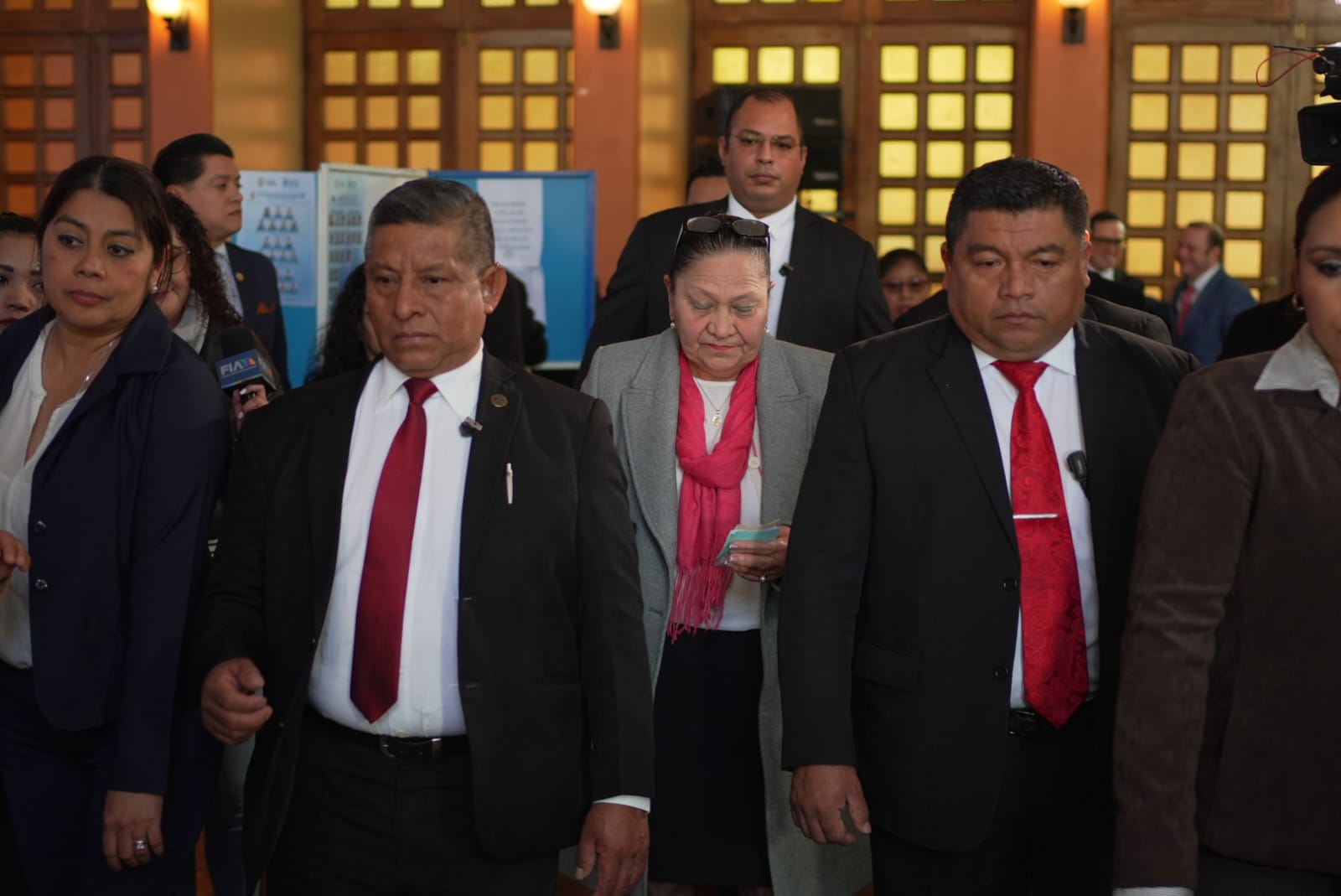
The appointment of the new attorney general and head of the Public Ministry (MP) by President Bernardo Arévalo is at hand, since on May 17 the successor of Consuelo Porras, who held the position for eight years, must take office.
With the appointment of a new attorney general, some deputies and analysts believe that it may be an appropriate time for Congress to once again address the issue of modifications to the Public Ministry Law, with the aim of returning to the president the power to dismiss the attorney general.
It is worth remembering that in 2016 Congress approved the reforms to the MP law, in which article 14 of the regulations was modified so that the only reason for which the president can dismiss the attorney general is for the commission of an “intentional crime” during his administration, as long as there is a duly executed conviction.
This situation was the reason why President Arévalo could not dismiss Porras, with whom he had differences since before he took office, due to investigations into alleged fraud in the 2023 elections and other cases that were opened by the investigating entity, in which attempts have been made to involve the ruler and his associates, as well as officials and pro-government deputies.
Right time
According to deputy Samuel Pérez, from the official bloc, With the appointment of the new attorney general, it would be the right time to resume the discussion to reform the organic law of the Public Ministry.
“I believe that this also has to open space to have a discussion about the Organic Law of the Public Ministry, specifically in the part of appointment and removal of the attorney general, which right now is protected at one end and we must ensure that it is in compliance with the Constitution, because the president is the one who appoints and that he is the one who can also remove,” stated the congressman.
According to Perez, The reform would be conducive to “prevent” the attorney general from “committing abuses and exceeding his duties as Consuelo Porras did.”
Deputy José Chic, from the Will, Opportunity and Solidarity (VOS) blocconsiders that the issue of modifications to the Organic Law of the Public Ministry must be addressed seriously. It also highlights that, previously, an attempt has been made to modify article 14 of this law in the context of Attorney General Porras, but there was opposition from the congressmen who did not support the modification of the aforementioned rule at the time.
“At the time there was an attempt to reform article 14 based on what was happening with Consuelo Porras. There we saw that many people opposed that. In this context we will have to discuss whether that is worth it or not, if necessary, given that we are facing the appointment of a new attorney general, but we are also close to the change of government,” he assures.
Chic believes that the power that the president may have to remove the attorney general should have a broad discussion; besides, indicates that a reform to the MP law must be comprehensive and not temporary, since, as he states, an “immediate crisis” cannot be taken advantage of to make partial changes to the law.
As to whether the official bloc is currently promoting the reform of the MP law, Deputy Pérez stated that the legislators of the official bloc “will not address the issue at this time.”
“I don’t think that we are going to move that particularly, but that it should be a broad consensus, not only of the deputies, but of Guatemalan society in general, to choose a democratic model as happens in other countries. For example, that Congress nominates and that the president is the one who decides, but continuing to politicize spaces such as universities or the Bar Association is inappropriate for political appointments such as the attorney general,” he assured.
Reform is necessary
In the opinion of several analysts and experts consulted, it is necessary to reform the Public Ministry law in order to return to the president the power to remove the attorney general, as well as to expand the grounds for his dismissal, always taking into account the aspects established by the Constitution regarding the functions and powers of both the president and the attorney general.
Carmen Aída Ibarra, director of the Pro Justice Movement, indicates that it is necessary to expand the causes for dismissal of the attorney general, so that the president recovers the constitutional power to remove him, but also warns that clear limits must be had to avoid abuses in said power.
“There has to be very delicate work on the part of Congress, cautious and delicate so that whoever is the president recovers that constitutional attribution, as long as there are limits. That you cannot dismiss someone just because you don’t like them or because they don’t share political positions,” he stated.
According to Ibarra, The current regulations “tie the hands of the president,” as well as any authority, to remove a prosecutor who is “negligent, inefficient or perverse.”
“That only cause that remained as a cause for dismissal is not good for it to remain because logically, when you see a situation of imprisonment because you are serving a prison sentence, logically you had to leave office; it is not necessary for that to be in law,” said Ibarra, who also points out that the management of Porras and his leadership in the MP “became an instrument of political persecution and elimination of adversaries.”
For his part, Francisco Quezada, analyst at the National Economic Research Center (Cien), considers that the reform of the MP law must have a balance.
In this sense, criticizes the extreme of the “absolute immobility” of the attorney general, as well as the extreme established in the proposal sent to Congress by President Bernardo Arévalo, in which it is intended to convert the attorney general into a “subordinate” of the Executive.
“Unfortunately, the president, in an initiative that he presented, was to seek the opposite effect of what the Constitution says because, if the attorney general was untouchable, he now turned him into a subordinate of the president. So, from one extreme he went to another and that is why that initiative never passed. It is always very prudent that there be a balanced proposal because, at the end of the day, now for the president, since he is going to choose his prosecutor, it will be in his best interest for his prosecutor to be immovable, because his prosecutor is also going to be a prosecutor. with a new president,” says Quezada, who also believes that the current reform, promoted by CICIG in favor of Thelma Aldana, was completely “absurd.”
Regarding a reform of the MP law, Quezada highlighted that this must be focused on three constitutional axes. The first, the power of appointment and dismissal by the president without making him subordinate; the second, the functional autonomy enjoyed by the Public Ministry; and the third, take into account that the attorney general enjoys the same prerogatives and immunities as the judges of the Supreme Court of Justice.
For his part, Óscar Morales, independent analyst, He believed that a reform of the MP law should not be casuistic or cyclical, but rather consensual, transparent and technical.
“The Public Ministry has to be accountable to Guatemalan society. It cannot be an institution without accountability, that’s for starters. The article that has to be reformed in the law of the Public Ministry has to be studied in depth and not with political interests. If that is done, I think it is appropriate, convenient and necessary to reform the law to have an ideal and professional mechanism for how to remove the attorney general,” he assured.
Regarding whether this is the right time to carry out a reform to the law of the investigating entity, Morales considers that “it is not the most favorable”, due to the electoral overtones that could occur in Congress, since this is a pre-election year as a consequence of the elections that will be held in 2027.
“It may have an electoral interest, but it may also have a political interest. As the election of the president is coming, the president who comes may be changing the prosecutor if he does not like it. It is a double-edged tool. I believe that the interest of the deputies may be biased at this moment. It is important that we begin to discuss it and that we look for the ad hoc moment to define whether this or another Congress is going to reform it because, if the reform is good, it does not matter which Congress does it, but if the reform is biased or has a particular interest in the future president doing whatever he wants with the MP, then we would be wrong,” the expert concluded.