
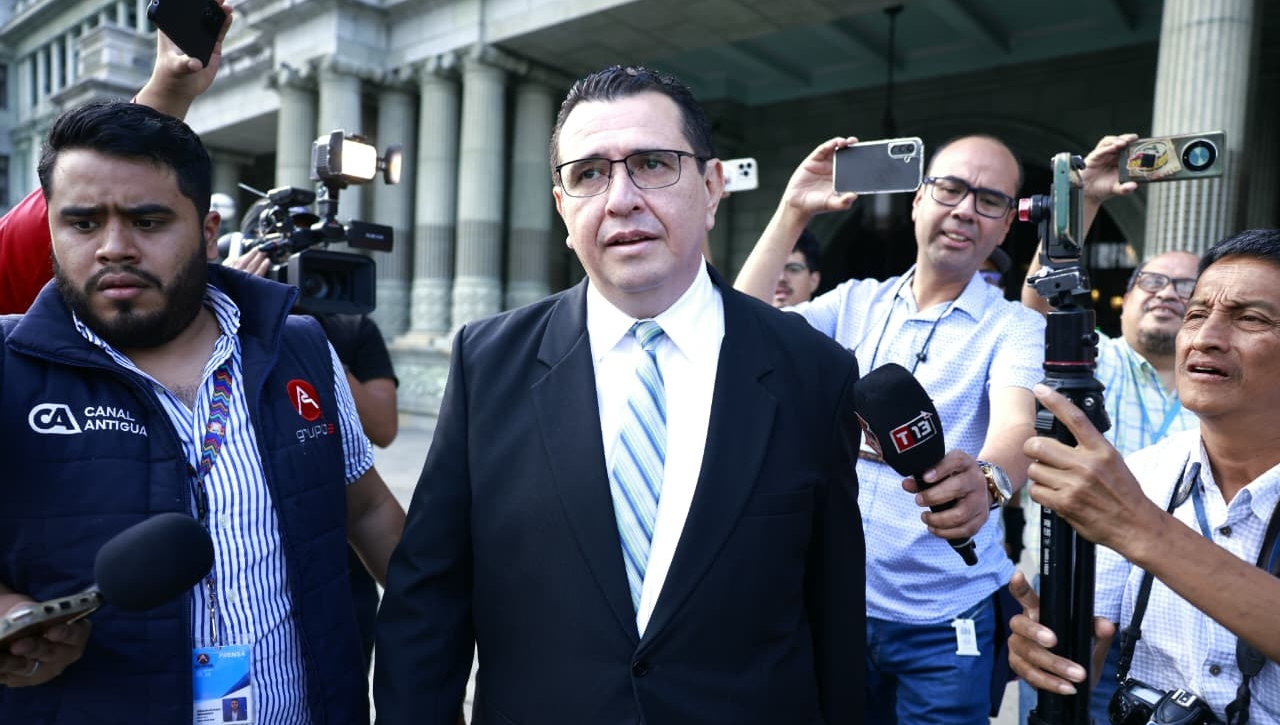
The appointment of Gabriel Estuardo García Luna as the new attorney general and head of the Public Ministry (MP) for the period 2026-2030 has raised expectations among different sectors of society, who have spoken out about the process carried out by President Bernardo Arévalo, which, they claim, is important for the “maintenance of the institutions” in the country.
Analysts consulted who followed up on the election process of the new attorney general Since the formation of the corresponding nomination commission, they agree that Gabriel García Luna was the professional who separated the most from the line of the other five candidates included in the list sent to the ruler by the qualifying body, which is why they assure that it was not difficult for the president to make the designation. In addition, they commented that greater independence and stability is seen in the Public Ministry, with the appointment of the professional.
Expected designation
According to Carmen Aída Ibarra, director of the Projusticia Movement, The name of Gabriel García Luna was already mentioned since 2024when it was thought that President Bernardo Arévalo would dismiss Consuelo Porras. He also recalled that The new attorney general was part of the list of candidates that made up the Nomination Commission in 2022and from which President Arévalo had to choose Porras’s eventual replacement.
“García Luna was mentioned since 2024 when everyone thought that the president was going to dismiss Consuelo Porras. Everyone expected that from that list – from 2022 – where García Luna, Henry Elías Wilson, Néctor Guilebaldo de León, Darleene Monge and Jorge Luis Donado were, the president was going to choose García Luna to complete Porras’ term,” says Ibarra.
Likewise, the political scientist Renzo Rosal also indicates that The appointment of García Luna by the president was to be expected. Furthermore, he highlighted the moment in which the president made and announced his decision, after being notified by the postulator about the non-existence of challenges to the list of six candidates, something that, According to what he indicates, he helped “stop sabotage maneuvers” by groups or sectors interested in preventing the appointment of the attorney general from being made.
“It was quite clear that of the six candidates, Mr. García Luna was the profile that separated himself from the other five and that he was the one that one could think, a priori, as the one with the best chance of being elected. The timing was relatively adequate. Having made the designation last Monday helped make sabotage actions and the presentation of appeals to the Constitutional Court impossible,” he assures.
However, although Arévalo appointed García Luna as the new attorney general, The Public Ministry must be an independent entity, which carries out the criminal investigation objectively and without being at the service of the Government in power. nor of particular interests that may benefit certain groups or sectors, says Christa Walters, president of the National Civic Movementwho also highlighted the importance of the independence that the Public Ministry must have in relation to the Executive Agency, as well as the risks that the politicization of justice in the country could imply.
“The president appoints them, but that does not mean that he is at the service of the current president who elected him. I think that citizens hope that this decision is not politicized, even more, that is, to be attorney general one should not have a mentality of responding to the president or being related to him just because he elected him. The expectation is that it is an impartial administration, independent of any political actor; that is number one,” says Walters.
Cessation of differences
About the confrontation and the existing differences between the Executive and the MP during the administration of Consuelo Porras, Rosal considers that it has been a situation that “does not do the country any good”, so it would be expected that with the García Luna administration there will be greater stability for the Executive, which will allow it to have more freedom of action in other aspects concerning the Government.
“Let’s move on from the scenario of a confrontation, of a hostility as strong as there was between this government and the current prosecutor – Porras -. That is not good for the country. I believe that the appointment will allow greater space for oxygenation and stability for the Executive to be able to undertake various tasks in the final stretch of its government and accelerate the pace,” he assures.
For his part, Walters indicates that these “differences” have been detrimental, mainly, from the research entity, so a change in this dynamic would be expected.
“We citizens had to see what seemed like a novel between the president and the attorney general, some saying one thing, others demanding other things, and I believe that this has been to the detriment of the institution—of the MP—. I think that citizens hope that the decision is not further politicized,” he adds.
Accompaniment of a good team
An aspect that will be of utmost importance, according to the experts consulted, is the formation of the new attorney general’s work team, which they consider key to carrying out their work well. According to Ibarra, it’s mu and important that the new prosecutor can announce who will be part of this team and they will have a key role in positions such as the General Secretariat, the Criminal Policy Secretariat and important prosecutors’ offices such as the Special Prosecutor’s Office against Impunity (Feci), among other positions.
“It is very important that the new prosecutor can announce in the shortest possible time who will be occupying important positions such as the general secretary, the secretary of Criminal Policy and the head of prosecutors’ offices such as the Feci, this as part of the transparency in his management,” says Ibarra.
In this sense, Rosal also considers it necessary for the new attorney general to have a good team that allows you to take the institution on the right path.
“Mr. García Luna must prepare in the best possible way to face a task that is going to be very complex. On the one hand, manage citizen expectations and, on the other, face the recomposition of the Public Ministry. Let us remember that the Public Ministry is a very personal institution, but Mr. García Luna will have to be accompanied by a good team that will allow him, precisely, as a whole, to straighten out the institution,” concludes Rosal.
Reform to the MP law
Before the president made the announcement about the appointment of Gabriel García Luna as attorney general, In Congress, deputies from various opposition blocs sought consensus to approve the reforms to the Law of the Public Ministry, with the aim of returning to the president the power to dismiss the attorney general, this in exchange for possible votes to approve the law against Money Laundering.
On this matter, Rosal warns that these lobbies arise from those legislative blocks that believe they have a chance of winning the presidency in the 2027 elections. and that they would be willing to dismiss the attorney general appointed by Arévalo.
“The issue of exchanging votes in favor of the anti-money laundering law, exchanging them for reforms to the organic law of the Public Ministry, to return the ability to the president in power to replace the attorney general, this is done with a view to the electoral process next year. It is clear that a group of parties that consider that they may suddenly have some opportunities to win the presidency in 2027 would like to announce from now on that they would seek to dismiss the attorney general,” he assures.
Walters believes that deputies should conduct a detailed analysis of this matter. and not only respond to current or current situations to obtain some benefit.
“You have to be careful that it does not respond to what you are experiencing, because that can have repercussions in the future and not necessarily good ones. Laws should not be changed or reformed to respond to a moment or a situation because then they can turn out the other way,” he said.
Ibarra believes a reform of the MP law is necessary aimed at expanding the causes so that the president can dismiss the attorney general, but this should not be “casuistry” or respond to the current situation on the part of the deputies.
“That is part of the despicable practices carried out by deputies in Congress. Although a reform of the Public Ministry law is necessary to expand the causes for dismissing the attorney general, this must be done correctly and not in a casuistic manner,” concludes Ibarra.