
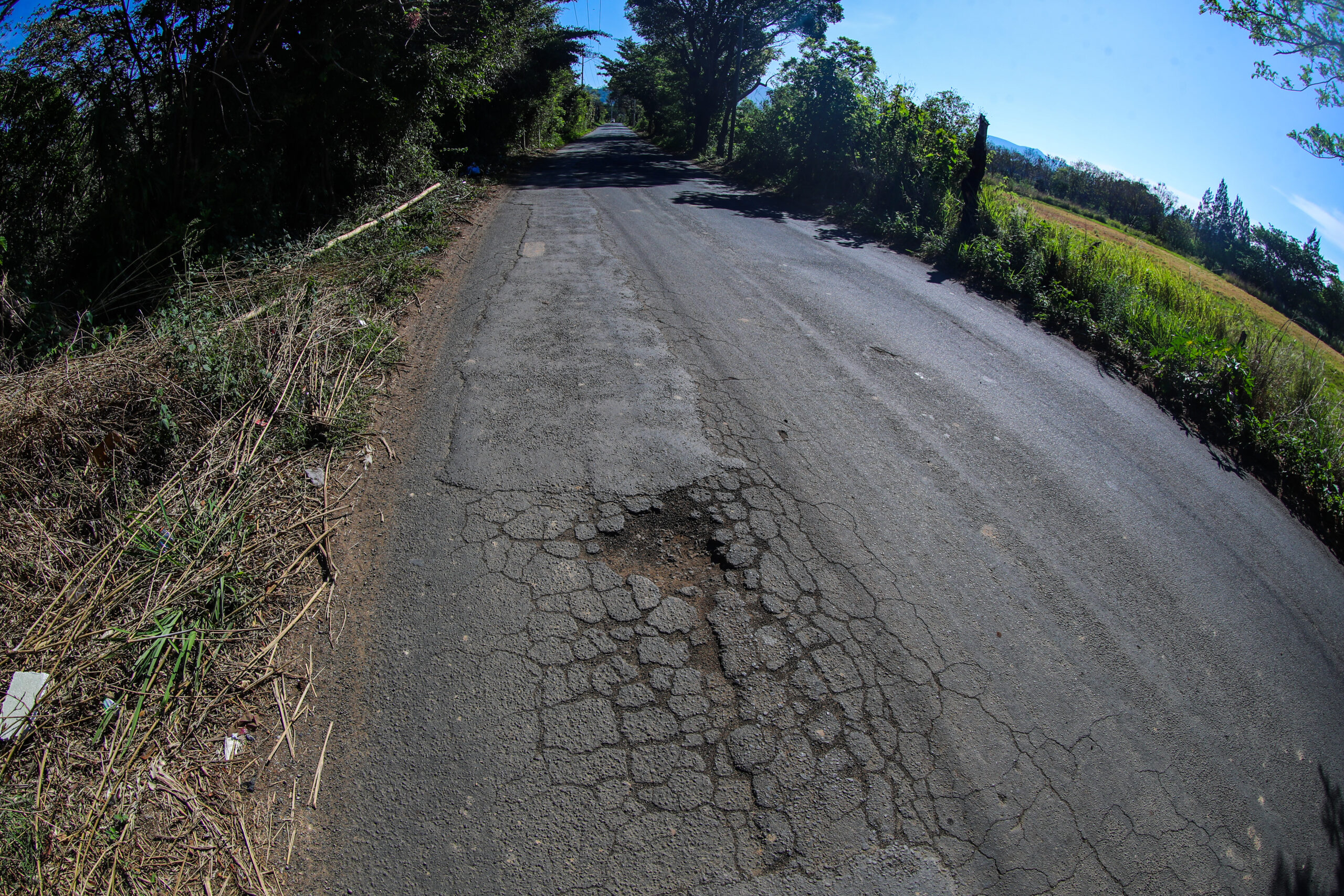
The first half of May has already passed and the Ministry of Communications, Infrastructure and Housing (CIV) The implementation of several projects to improve roads in the country has not yet started, as well as new road infrastructure works, this just over a year and a half before the end of Bernardo Arévalo’s government.
For this year, the Advisory Council of the Ministry of Communications approved the Action and Maintenance Plan for the different routes in the country, which includes patching, cleaning, dirt road maintenance, bridge maintenance and signaling projects on different routes.
However, most of these projects have not yet begun to be implemented, because the conclusion of some works awarded between October and November of the previous year is still pending, as confirmed by the acting director of the Road Conservation Execution Unit (Covial), Estuardo Gómez, during a recent summons in Congress, which could further complicate mobility on the country’s roads.
The Action and Maintenance Plan, approved for this year and carried out by Covial, contemplates 41 patching projects for Q162 million; 62 road cleaning projects for Q84 million; 36 dirt road projects for Q162 million; nine bridge maintenance projects for Q36 million, and five signaling projects for Q75 million, the latter are already in preparation for contracting.
Low execution
For this year, the Road Conservation Execution Unit (Covial) has the largest budget among the units in charge of executing projects of the Ministry of Communications.
Initially, the 2026 budget for Covial was Q2,210 million, but due to readjustments and internal budget movements in the portfolio it had an increase of Q913 million.
In total, for this year said unit has a budget of Q3,123 million, according to information from the Administrative and Financial Vice Ministry of the portfolio.
However, although the unit has sufficient budget to execute projects, To date it has only executed Q290 million, equivalent to 12% of the assigned resources.
Although the works contained in the Action and Maintenance Plan are still pending award, Covial already has Q1,318 million committed for the execution of ten projects contracted under the Priority Road Infrastructure Law, aimed at the maintenance and rehabilitation of national and Central American routes. According to estimates, this sum is equivalent to just over 36% of Covial’s budget for this year.
Low coverage
According to Delfino Mendoza, infrastructure expert at the Foundation for the Development of Guatemala (Fundesa), It is worth recognizing the effort being made by the Communications Ministry in the use of article 95 of the Priority Road Infrastructure Law to contract emergency projects aimed at improving the road network in the country. It also indicates that said law should have been used since 2025, when it came into force.
However, he clarifies that The percentage of kilometers that will be served through these ten projects contracted under this modality is very low, taking into account the current needs of the road network.
“The contracts total 245 kilometers of roads. If we take away the rural roads, the road network that should be attended to is on the order of 15 thousand kilometers. 245 is a fairly low percentage. That is definitely not going to solve the problem,” he assures.
Mendoza also emphasizes the lack of timely planning by the authorities of the Ministry of Communications to execute improvement projects on the road network before the start of the rainy season in the country.
“The contracts come into effect very out of date, when winter is already at its peak. Construction or maintenance in winter time is more complicated and does not progress with the same speed as in summer time. We are almost reaching half a year until 2026. It would take just over a year and a half for the government to carry out works,” he assures.
At the expert’s discretion, The project contracting cycle is repeated every year with a considerable gap between the dry and rainy season in the country.which prevents significant progress in the renovation, cleaning and maintenance of the road network.
He also considers that, with just over a year and a half remaining in office, the current government will not be able to do significant work to rescue the road network.
“To that we add that we are almost at the gates of winter. However, I wish that progress could be made at least in something, at least in the main road network, which would be the Central American routes and the departmental routes to all the departmental capitals, that could be served. But I would believe that in the best of cases they will be, hopefully, serving 30 percent of the total road network,” he concludes.
Projects contracted under the Priority Road Infrastructure Law
Carmen Abril director of the Directorate of Priority Road Projects, (DIPP), recently indicated during the forum “The Urgency of Implementing the DIPP” that to date 22 projects have been awarded for more than Q1,300 million under the protection of the Priority Road Infrastructure Law. On that occasion he criticized that although the direction is moving slowly, the law is used as a mechanism “of acquisition by exception and not of technical and specialized institutions.”
Delfino Mendoza also indicated that, according to the information provided by the CIV to Fundesa, within the contracted projects under the modality of the Priority Road Infrastructure Law for the attention of national and Central American routes There are some destined for the maintenance of the following roads:
- RN-02 Fraijanes–Santa Elena Barillas, Fraijanes, CA-01 Oriente
- CA-02 Oriente El Jobo–Taxisco, Taxisco and Chiquimulilla, CA-02 Oriente
- CA-10 Aldea El Ingeniero–Quezaltepeque, Chiquimula and Quezaltepeque
- CA-10 Río Hondo–Gualán, Río Hondo and Gualán, CA-09 North
- RN-17 La Cumbre–Lost Child, Morazán, CA-14
- CA-01 West San Carlos Sija–Palogá, San Carlos Sija, CA-01 West
- CA-02 West Escuintla–Siquinalá
- CA-02 West Retalhuleu–Coatepeque, El Asintal and Coatepeque
- CA-01 San Bartolomé Jocotenango – Vigen, Huehuetenango,
The project for the rehabilitation of the bridge over the Dulce River, in Izabal, was also awarded under this modality.
Regarding the maintenance project for the CA-02 Oriente route in Chiquimulilla, Mendoza indicated that, according to information from the Ministry of Communications, this was not awarded because the offers received “did not meet the requirements” demanded in the bidding rules, so a new process was started.
Regarding the contracts awarded by this modality The Ministry of Communications (CIV) indicated that ten have been awarded for the maintenance of national and Central American routes, while the challenge contracts are for the supervision of these maintenance projects.