
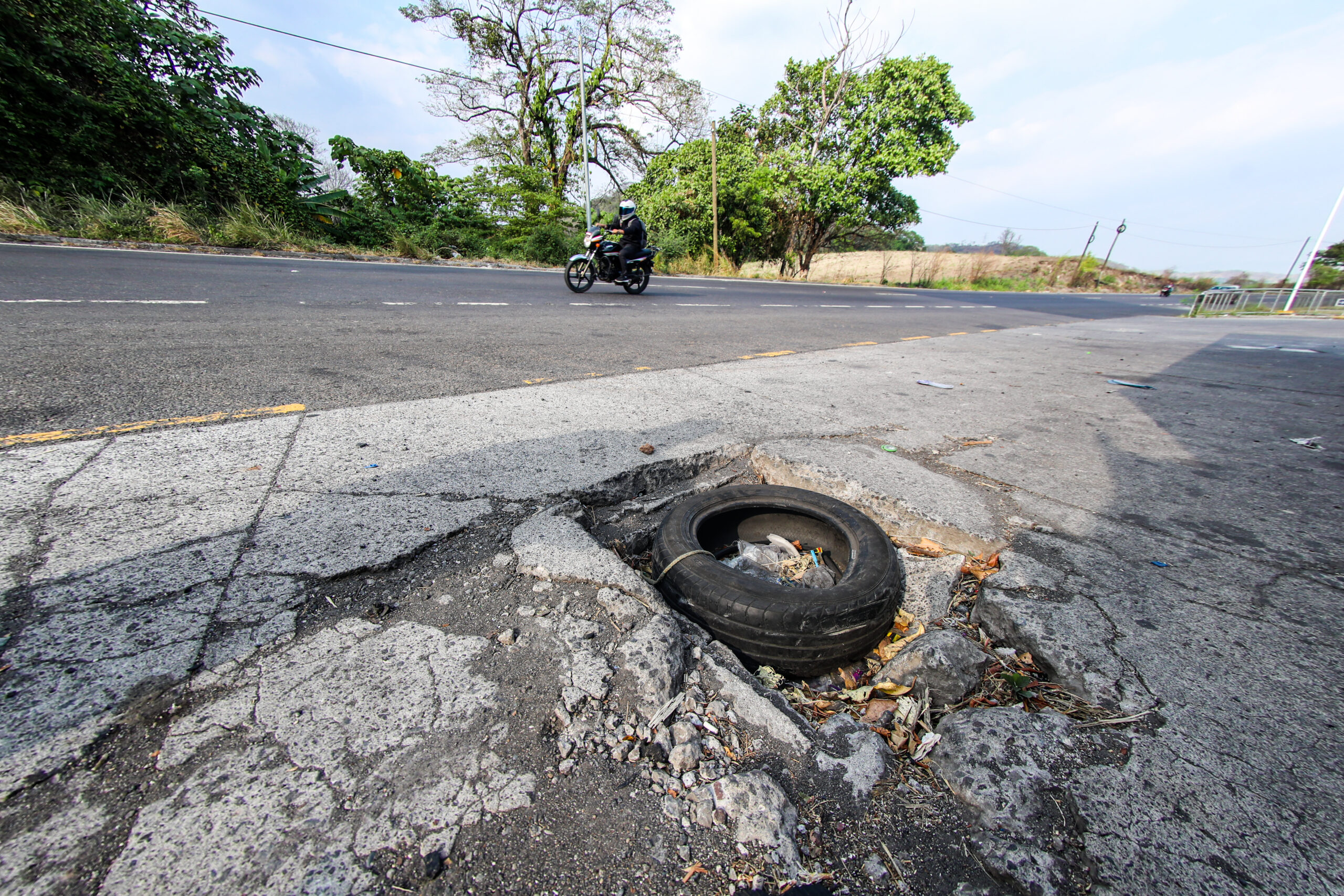
The CA-2 Oeste highway was evaluated using the methodology of the International Road Assessment Program (iRAP), an international tool that analyzes road safety conditions and classifies roads between one and five stars, according to the level of protection they offer to users. The study identified deficiencies in infrastructure, signage and protection for pedestrians and cyclists along 200 kilometers of the corridor.
The study was prepared by the Automobile Club of Guatemala. During the presentation of results, Salvador Morales, representative of the project, explained that the objective of the program is not limited to evaluating the highway, but to establish a reference on how road investments should be planned in the country. “The roads not only have to be constructively well made. It is useless to have the best asphalt or the best concrete if in the end people are going to die. The road has to fulfill its purpose, which is to move people from one point to another safely,” he said.
Morales pointed out that one of the purposes of the study is to show models used in other countries to prioritize investments based on road safety. As an example, he mentioned the case of Brazil, which seeks to evaluate its road network to guide improvement plans before 2030. “What we want to deliver today is what is the improvement plan based on these risk factors to reduce accident rates,” he indicated.
According to the evaluation, 50% of the road does not have separation of traffic directions, while 97% lacks sidewalks and 100% does not have cycling infrastructure. Furthermore, 90% of intersections do not have specialized road treatment. Among the predominant lateral obstacles, trees, poles, slopes, rocks and other rigid objects were identified.
The analysis was carried out through video recordings and coding of the road every 20 meters, with the use of iRAP’s VIDA platform to detect risks and possible interventions. Only 30% of the road has three stars for vehicle occupants, while it represents 15% for motorcycle users. For pedestrians, only 0.16% of the road is safe, while for cyclists the study showed 0%.
The results were delivered to representatives of the Traffic Department of the National Civil Police (PNC), with the objective of having information to carry out interventions that safeguard the lives of the users of the evaluated section. Representatives of the General Directorate of Road Protection and Safety (Provial) also participated.
Detected risks
The report indicates that one of the main problems corresponds to the risk of head-on collisions, due to the lack of central barriers and the invasion of lanes in the opposite direction in different segments of the corridor.
According to Morales, the lack of separation of traffic directions increases the severity of frontal accidents. “When we all want to occupy the same point in different directions, the severity worsens. Head-on collisions are the predominant factor in deaths on this highway,” he stated.
Signage deficiencies were also identified, related to limited visibility, poor location of signs, deterioration, and ineffectiveness at night. According to the study, these conditions reduce drivers’ ability to anticipate and react.
Morales added that the road was designed mainly for vehicles, although it is currently used by pedestrians, motorcyclists and cyclists in several urban sections. “97% of the road is not made for pedestrians and yet it is a highly used road,” he said.
He also noted that throughout the evaluation no specific infrastructure for cyclists was found, despite the fact that they continue to use the road as a means of transportation.
Another of the factors pointed out was the disorderly use of the road corridor, with a non-segregated mix of pedestrians, cyclists and vehicles, as well as invasion of the right of way and high lateral friction by adjacent activities.
Furthermore, the study concluded that the majority of shoulders are narrow, non-existent or invaded, while 82% of intersections lack formal design and 98% do not have channeling.
The five priority sections
The evaluation identified five segments considered priority for intervention, taking into account factors such as annual average daily traffic (ADPT), speed and risk level.
- The Mazatenango-Cuyotenango section was classified as having “very high” risk. It registers a TPDA of 29,443 vehicles and an average speed of 50 kilometers per hour. The report recommends interventions at intersections and signage, considering that it is one of the segments with the greatest road complexity.
- Siquinalá-Santa Lucía was also classified as “very high” risk. This segment reports a TPDA of 25,796 vehicles and speeds of up to 70 kilometers per hour. Proposed actions include the installation of containment barriers and delineation work to reduce conflicts and improve flow separation.
- In the Cocales-Río Bravo section, which registers a TPDA of 25,797 vehicles and speeds of up to 90 kilometers per hour, the study proposes signaling and speed control measures. The evaluation indicates that in this segment there is a combination of curves and accesses that increases the risk level.
- Escuintla-Siquinalá was identified as having high risk, a TPDA of 23,079 vehicles and speeds of up to 100 kilometers per hour. The report recommends delineation and removal of lateral obstacles to reduce the severity of possible road departures.
- Aldea Sibana-Coatepeque registers a TPDA of 23,257 vehicles and speeds of up to 70 kilometers per hour. For this section, signaling and lighting interventions are proposed, mainly in areas with the presence of vulnerable users and mixed circulation.
Proposed interventions
The report suggests that more than 60% of road safety benefits could be achieved through low-cost interventions, such as signage and delineation.
Among the proposed measures are vertical and horizontal signage, containment barriers, metal defenses, delineators, alert bands and channeling, under the concept of “forgiving infrastructure” of the system. Safe System.
The evaluation estimates that the complete program would require an approximate investment of Q1.3 billion and could prevent around 20 thousand deaths and serious injuries (FSI). It also projects economic benefits of Q8,230 million, with a benefit-cost ratio of 6.31.
According to the study, for every quetzal invested in road safety improvements, approximately Q6.3 could be generated in economic benefits associated with accident reduction, medical care and productivity.
Morales indicated that the system allows identifying the points where the interventions would have the greatest impact, according to the level of risk and severity of the incidents. “If we only have Q5 thousand, this makes it easier for us to know where to invest those Q5 thousand. We already know what to do, where to do it and how much it costs,” he said.
From study to action
Morales pointed out the need for the results of the evaluation to be translated into public policies and permanent investment plans for the country’s road network. “The study, the richness it has, is that it provides tangible solutions in the short, medium and long term to be included now in the investment plans that the State may have,” he stated.
As explained, the proposal seeks that future evaluations of roads in Guatemala adopt international methodologies based on technical-scientific evidence and not only construction criteria.
“Our proposal is that the entire infrastructure, starting with the priority and then the rest of the infrastructure, enters under a model not only of constructive evaluation, but also of operation in the area of road safety,” he indicated.
Morales also considered that citizen involvement will be key so that the results do not remain only in technical documents. “Social pressure is a fundamental factor. Being able to get involved and demand that the authorities comply with what they were elected for,” he expressed.
In addition, he pointed out that the recent Priority Road Infrastructure Law represents an opportunity to institutionalize this type of evaluations. “It would no longer be solely a policy of the authority in power, but rather a standardized practice of how to build infrastructure,” he added.
For his part, Delfino Mendoza, member of the infrastructure table of Guatemala No Se Detiene, indicated that the presentation of the study coincides with the implementation of the Priority Road Infrastructure Directorate (DIPP), contemplated in the new legislation.
Mendoza explained that the law establishes that one of the first tasks of the DIPP will be to evaluate the road network under its responsibility, made up mainly of Central American highways and routes in the metropolitan area. “The same law says that after evaluating the road network, a work plan must be presented to address that network,” he commented.
Likewise, he considered that the results of the study could be used as input for future contracts and infrastructure projects. “We can now begin to take the first steps in the General Directorate of Highways so that the terms of reference of the engineering studies include the obligation to present an evaluation with this methodology,” he stated.