
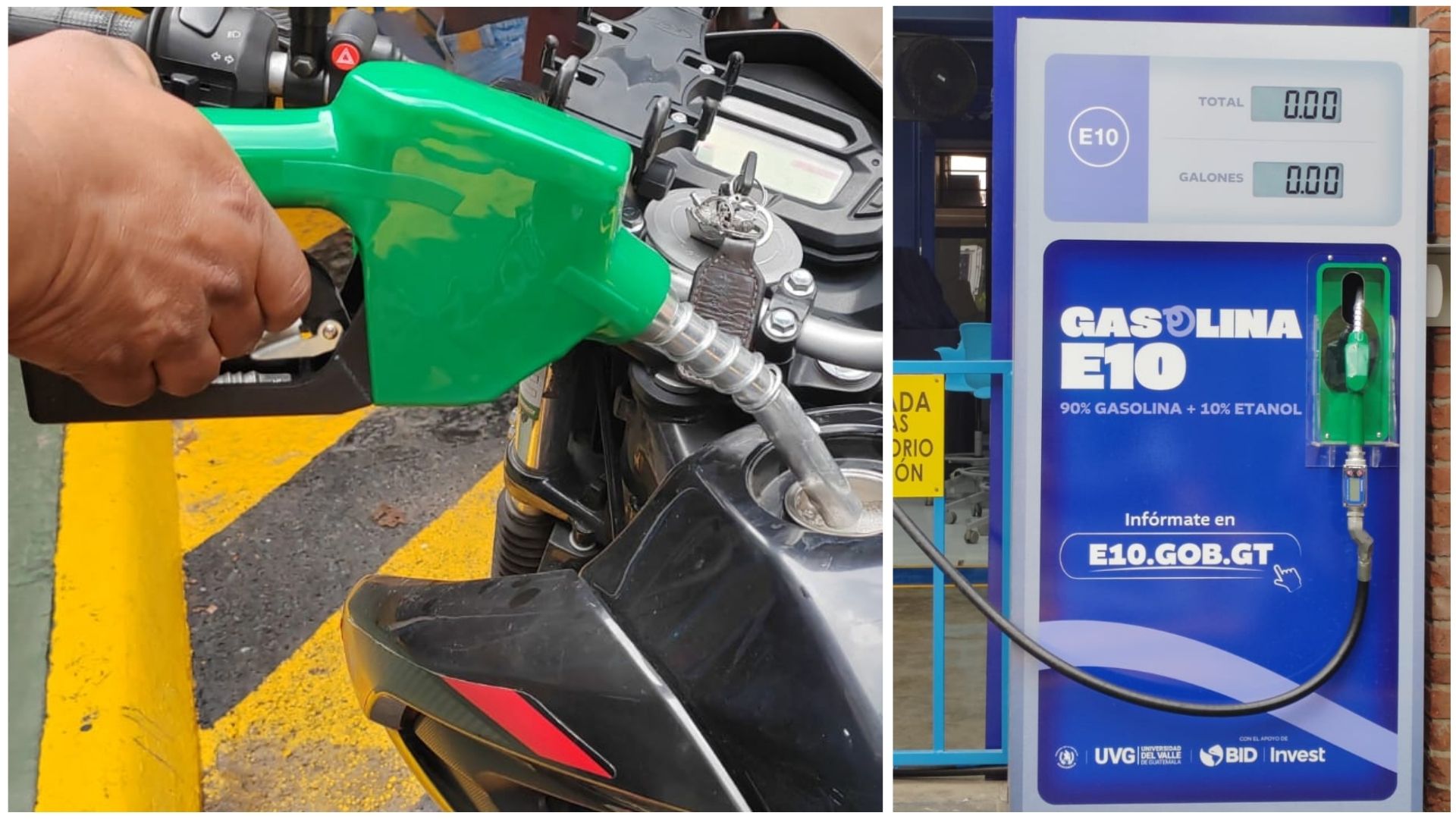
Less than a month after the entry into force of the E10 gasoline In Guatemala, authorities assure that the new mixture could represent savings for consumers, although they emphasize that the measure was driven mainly by its environmental and public health benefits.
During the presentation of the results of a pilot test carried out by the Ministry of Energy and Mines (MEM) and the Center for Industrial Processes of the University of the Valley of Guatemala (UVG), the vice minister of Mining and Hydrocarbons, Erwin Barriosexplained that there are several factors that point to a possible reduction in the fuel price once the mixture begins to be marketed on a mandatory basis as of June 30, 2026.
Why E10 gasoline could be cheaper?
The E10 It is a fuel composed of 90% gasoline and 10% ethanol, a biofuel produced from raw materials of plant origin.
According to Barrios, one of the elements that could favor a decrease in price is that ethanol has historically had a lower cost than conventional gasoline, less use of gasoline as a base and fewer taxes.
- He ethanol historically it has been cheaper than gasoline.
- By increasing the octane rating of the mixture, it allows the use of a lower cost base gasoline.
- Ethanol does not pay the tax on petroleum derivatives because it is a biofuel.
“We had a discussion with the importers about how much it was going down, because we agreed that it was going down, so we stopped discussing it because that is obviously a market issue.”
Erwin Barrios, Vice Minister of Mining and Hydrocarbons of the MEM
Based on the analyzes carried out by the authorities and representatives of the sector, the reduction could be between Q0.50 and Q1.50 per gallonalthough the final amount will depend on the behavior of the market.
The price will depend on free competition
The vice minister clarified that the Government cannot guarantee a specific reduction because Guatemala operates under a free market scheme.
In that sense, he indicated that the final price will be the result of negotiations between ethanol producers, fuel importers and distributors.
“The Ministry does not control prices. The buying and selling dynamics between the different actors in the chain will determine the final value that the consumer will pay,” he said.
Therefore, although the technical and tax conditions point to a reduction in costs, the exact impact can only be measured when the E10 mixture begins to be sold at service stations in the country.
RELATED READINGS


The main objective is not economic
Despite the expectation of a possible decrease in gasoline priceBarrios insisted that the implementation of E10 responds mainly to environmental and public health objectives.
As he explained, Guatemala seeks to diversify its energy matrix, reduce dependence on fuels petroleum derivatives and reduce polluting emissions generated by the vehicle fleet.
Likewise, he highlighted that ethanol replaces additives such as MTBE (mixture of isobutylene and methanol), a substance used to raise the octane number of gasoline and that has been restricted or prohibited in several countries due to its possible effects on the environment and health.
Studies report fewer polluting emissions
During the activity, the director of the UVG Industrial Processes Center, Gamaliel Zambranopresented the results of an investigation carried out with 10 motorcycles representative of the national vehicle fleet.
RELATED READINGS

The trials showed a reduction of between 13% and 21% in carbon dioxide equivalent emissions (CO₂) per kilometer traveled when using the mixture with ethanol.
The researcher explained that the reduction in emissions would contribute to reducing the accumulation of pollutants in the atmosphere and the presence of compounds that can affect groundwater sources.
The Universidad del Valle de Guatemala accumulates more than a decade of experience in biofuel research, evaluating their performance, efficiency and environmental impact in different types of vehicles,” highlighted Gamaliel Zambrano.
“It is not a new topic for us. We have been researching biofuels in Guatemala for more than ten years and generating technical evidence on their impact on engines, emissions and vehicle performance. The implementation of the E10 mixture is supported by years of studies carried out in the country”
Gamaliel Zambrano, director of the UVG Industrial Processes Center.
Health benefits would be seen in the long term
Zambrano indicated that the greatest benefits of the measure could be reflected in the health of the population, although its effects will not be immediate.
He explained that the reduction of polluting emissions could contribute, over the years, to reducing the incidence of respiratory diseases and other conditions associated with poor air quality.
According to the researcher, by reducing people’s constant exposure to pollutants from vehicles, a gradual improvement in public health indicators is expected.
measure that took more than 30 years to be applied
The implementation of the E10 gasoline It is not a recent measure. Its origin dates back to Fuel Alcohol Lawapproved in 1985 with the objective of promoting the use of renewable fuels in the country.
Decades later, the project took shape with the issuance of the Government Agreement 159-2023which established the conditions to incorporate 10% ethanol to gasoline sold in Guatemala.
Although its entry into force was planned initially for January 2025, it was postponed to allow service stations to adapt their infrastructure. Now, after completing this process, the E10 mixture will begin to be sold compulsorily starting June 30, 2026.