
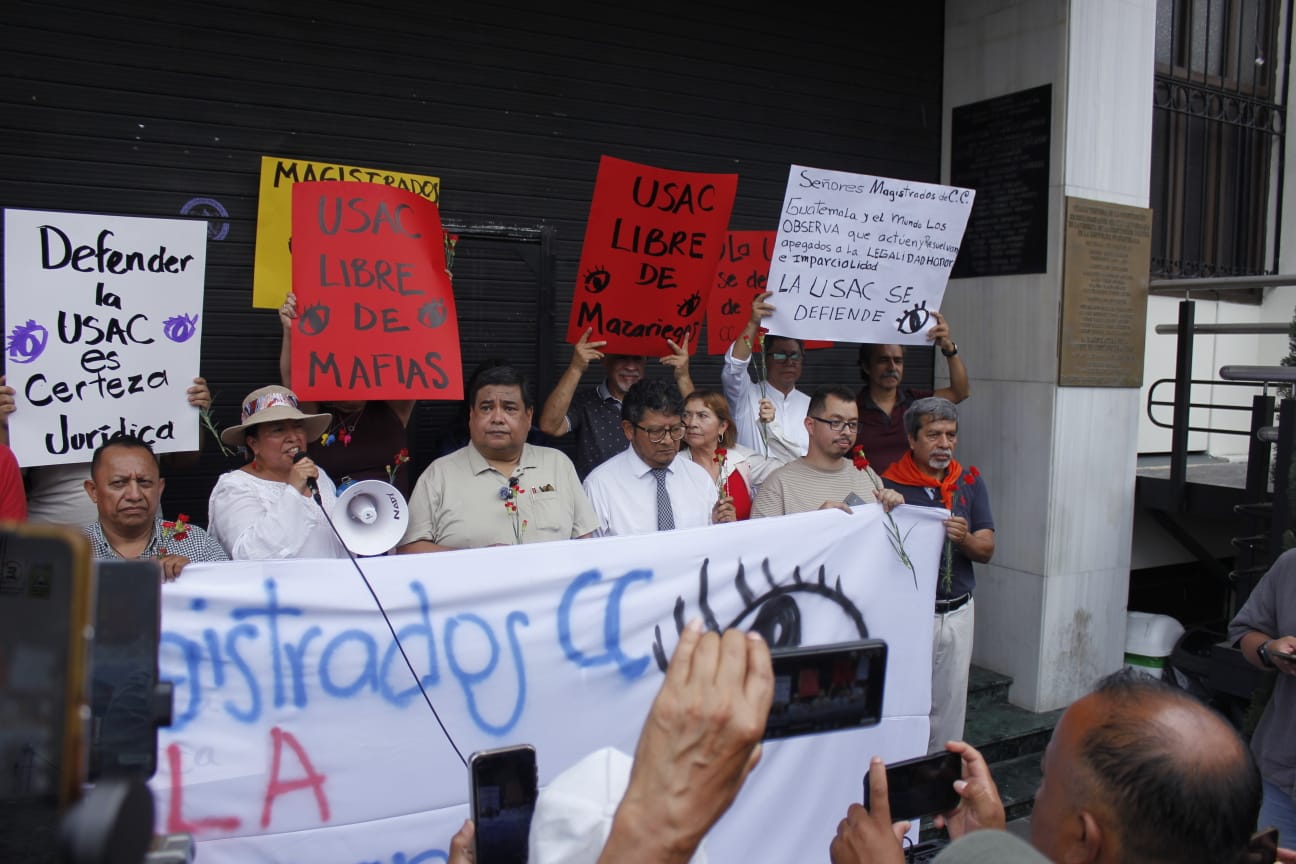
After new adverse resolutions were reported in legal actions related to the election of rector of the University of San Carlos of Guatemala (Usac), This Tuesday, June 3, lawyers from Dignity and Resistance (Usac-Dire)consulted, questioned the role of the Constitutional Court (CC), and the criteria used to resolve some of the files.
Recent resolutions include six protections who were in the Sixth Administrative Litigation Chamberand that were suspended by the magistrates, according to the notifications sent to the parties.
Furthermore, in recent days also other legal actions were notified and rejectedwhile files related to the rector’s election are advancing in the Constitutional Court.
Given this panorama, the lawyer Aníbal Garcíaa member of Usac-Dire, stated that the decisions made known in recent weeks reflect an unfavorable trend for the actions promoted by the group.
As explained, they have also been aware of resolutions related to protections promoted to annul the election of Walter Mazariegos held on April 8.
“It seems to us that the Constitutional Court is going too far, and the arguments by which these protections are rejected and suspended are totally unacceptable”he stated.
García maintained that the criteria used to resolve these files lack legal basis, and considered that the decisions respond more to political interests than to a strictly legal analysis.
“We believe that the resolution has a political charge and is not necessarily a legal resolution”he added.
Asked about the panorama faced by the actions promoted by Usac-Dire, after a series of unfavorable resolutions, García recognized that the decisions adopted by the courts and by the CC represent a complex scenario for the group’s approaches.
“Unfortunately, in the face of the Court’s resolutions, whether we like it or not, we cannot propose anything […] “It seems that the Constitutional Court itself is on its knees in front of those sectors linked to corruption.”Garcia stated.
Despite the adverse resolutions, the lawyer indicated that the group he represents has other pending actions related to the university electoral process, among them he mentioned protections promoted against decisions of the Higher University Council (CSU), linked to the integration of electoral bodies.
“A wrong precedent”
For its part, Edwin Orozcoalso a lawyer for the Usac-Dire group, maintains that the irregularities in the election of rector “they have been so clear” that “not even the worst justice system could validate those arbitrary acts that were revealed.”
Orozco warned that an eventual validation of the questioned actions would have broader implications for the Guatemalan justice system. “The rule of law in Guatemala would be totally violated,” he stated.
The lawyer also questioned the way in which some of the files are being known in the different judicial instances. According to their interpretation, there are procedural stages that should be respected before certain decisions regarding amparos are made.
“It is not… at the appropriate procedural moment to suspend protections” definitively, he maintained.
In Orozco’s opinion, modifying the way in which these types of constitutional actions are traditionally processed would set a wrong precedent and affect the legal certainty that the highest constitutional court must guarantee.