
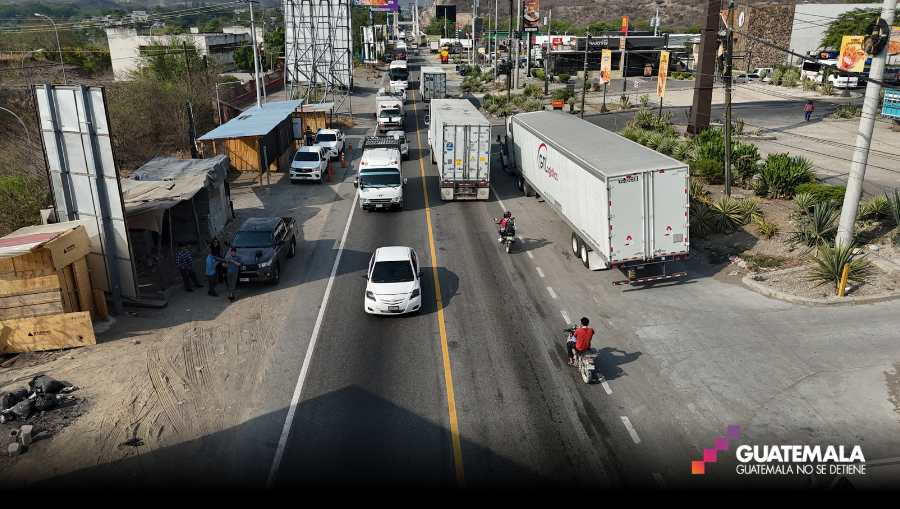
The expansion of the El Rancho-Teculután section, on the CA-9 North route, advances in its bidding and contracting phase. The project includes the rehabilitation of the existing highway and the construction of two additional lanes to expand a stretch of approximately 35 kilometers between the departments of El Progreso and Zacapa from two to four lanes.
The work will be financed through a loan of US$175 million approved by Congress on October 22, 2024, through Decree 24-2024. However, despite the fact that the resources were authorized almost two years ago, construction has not yet begun due to the administrative, technical and contracting processes required for projects financed by international organizations.
The CA-9 North connects the metropolitan area with the Guatemalan Atlantic and constitutes one of the main routes for the transportation of goods. Containers, raw materials, agricultural products, manufactured goods and merchandise destined for both the domestic and export markets are moved along this corridor.
Delfino Mendoza, Fundesa analyst, explained that this section concentrates a significant proportion of the heavy transportation that circulates in the country. “A high percentage of import and export cargo moves through Santo Tomás de Castilla and Puerto Barrios,” he noted.
Although the financing was approved by Congress in October 2024, the execution of the project still depends on various administrative and technical procedures.
Delfino Mendoza explained that the Ministry of Communications is currently making progress in hiring the supervision and the company that will carry out the work. “Offers for supervision have already been received and the qualification process has been carried out. We are waiting for the bank’s approval to continue with the signing of the contract,” he indicated.
At the same time, the bidding process continues to select the construction company. “Prequalification has already been carried out for the work and the receipt of offers is scheduled for June 15. Then will come the evaluation and contracting process,” he explained.
Required paperwork
According to Mendoza, projects financed by multilateral organizations require additional review and control processes. “The bank has a prequalification and supervision methodology that seeks to guarantee compliance with the requirements established for this type of projects,” he said.
If the expected deadlines are met, construction could begin during the second half of the year. “I would hope that the contract can be ready around August and that the work can start between September and October,” he indicated.
Mendoza explained that another project related to the Agua Caliente bridge is also currently advancing, a point that for years functioned as a bottleneck within the corridor. “When that bridge is finished we would have four continuous lanes to El Rancho,” he said.
In addition, there is already another loan approved to continue the expansion from Teculután to Mayuelas. “That is still in the initial stages, but the idea is to continue advancing in the corridor,” he explained.
However, there are still no engineering studies completed for the subsequent sections to Puerto Barrios. “Taiwan offered resources to finance these studies and work is being done to formalize that cooperation,” he added.
What could delay the project
Although the tender is underway, there are still factors that could affect the schedule. Delfino Mendoza identified technical, financial, legal and administrative aspects that usually arise in large-scale infrastructure projects. “There may be design changes derived from situations encountered during the execution of the work,” he indicated.
He also mentioned possible conflicts related to the right of way or legal proceedings linked to the project. “There are legal factors associated with the release of the right of way or possible lawsuits that may arise during execution,” he explained.
For Mendoza, another relevant aspect will be guaranteeing the availability of resources to maintain a constant flow of payments.
“You have to demand from the contracting companies, but you also have to comply with them. If financing is available, there must be a constant flow of payments to avoid delays,” he said.
He also highlighted the importance of supervision. “The supervision of the contracted company, the General Directorate of Highways (DGC) and the bank can help ensure that the project does not have delays,” he stated.
Crucial route
Héctor Fajardo, director of the Chamber of Central American Transporters (Catransca), indicated that the highway is used by a large part of the units that connect the Atlantic ports with the distribution and consumption centers located in the rest of the country. “It drives Guatemala’s trade, both exports and imports as well as local consumption, because we have no other means. There is a total predominance of road transport,” he stated.
According to Fajardo, measurements carried out by the Ministry of Communications have identified sectors where up to 30,000 vehicles circulate a day, especially in the vicinity of El Rancho. “It is one of the most important highways in Guatemala, with a very high traffic flow. All the trade that leaves for the Atlantic ports moves along that route,” he explained.
He added that the current infrastructure already shows signs of saturation. “Currently, two lanes are insufficient, considering the traffic flow required to travel along this road,” he indicated.
The strategic importance of the corridor also transcends national borders. At points near Río Hondo, transportation from El Salvador is incorporated that uses Guatemalan ports for commercial operations. “El Salvador does not have ports in the Atlantic and part of those fleets also move through this corridor,” commented Fajardo.
Years in planning
The expansion of the El Rancho-Teculután section is part of a road modernization strategy developed in stages in recent years. Delfino Mendoza explained that projects were first executed in other strategic corridors, such as the route to Puerto Quetzal, the expansion to Quetzaltenango and work on the highway to the border with Mexico.
While these projects advanced, the corridor to the Atlantic remained pending. “She was falling behind,” he said.
For several years there were talks to finance the expansion with support from Taiwan. According to Mendoza, it was even proposed to extend the work to Puerto Barrios through a combination of donations and loans on favorable conditions.
“Taiwan had offered resources to build the section from El Rancho to Mayuelas and even to Puerto Barrios. The cost began to be quantified and there was talk of around US$640 million, with part in donation and part in loan,” he mentioned.
However, the pandemic modified public investment priorities. “Those resources changed destination and the Government decided to use them for health issues. The highway was suspended and the project was no longer continued,” he explained.
Subsequently, a new source of financing was managed through the Inter-American Development Bank (IDB) and Spanish cooperation. “A loan was managed for US$175 million, of which US$100 million is provided by Spanish cooperation and US$75 million by the IDB,” said Mendoza.
“This loan has been in force since last year and with this the process of contracting the section begins, but it no longer reaches Mayuelas. There are more than 35 kilometers that would be financed with the loan,” he mentioned.
The cost of delays
According to Mendoza, a trip that could previously be completed in approximately six hours can now take 12 hours or more for some carriers. “All of this implies increases in operating costs and travel time. In the end, it translates into an increase in freight costs,” he said.
Fajardo agreed that the speed reduction directly affects logistical efficiency. “Today we have average speeds of between 14 and 17 kilometers per hour on this route. Some years ago it was traveled in five or six hours and now it can take between 12 and 14 hours to reach the port or return to the capital,” he stated.
Likewise, he indicated that these conditions force many units to circulate at night to comply with loading and unloading schedules. “Transport sometimes has to move at night. It is a time when visibility is lower and there are more risks to road safety,” he commented.
He also noted that prolonged congestion can put additional pressure on drivers. “The fact of traveling at such low speeds and having to arrive at the port before a certain time generates fatigue and pressure on the pilots. These are factors that also affect traffic events,” he stated.
According to Mendoza, the impact is not limited to the transportation sector. “Logistics costs represent between 20% and 30% of the final cost to the consumer. To the extent that these costs increase, they end up impacting the prices of the products,” he explained.
The impact on agricultural exports
The relevance of the road is also reflected in the transportation of agricultural products. Carla Caballeros, executive director of Camagro, explained that a significant part of the country’s agricultural exports uses the Atlantic ports. “56% of the cargo that leaves through Santo Tomás de Castilla and more than 60% of the cargo that leaves through Puerto Barrios corresponds to products from the agricultural sector,” he indicated.
Among the main products transported by this route are bananas, pineapples, fruits and vegetables destined mainly for the US market.
According to Caballeros, delays in transit generate additional fuel, transportation and operation costs. “When there are interruptions or congestion, transfer hours increase and that generates additional costs for the entire logistics chain,” he explained.
In addition, he highlighted that in the case of perishable products it is necessary to preserve the cold chain to avoid losses. “Agricultural products are perishable and that is why it is important that transportation times are maintained within appropriate parameters,” he noted.
The business representative added that the growth of trade has also increased pressure on existing infrastructure. “Atlantic ports have reported double-digit increases in cargo handling in recent years and that growth is also reflected in the road network,” he said.
Find more Guatemala Doesn’t Stop on our video channels Free press and Guatevision, alliance content focused on solutions journalism.