
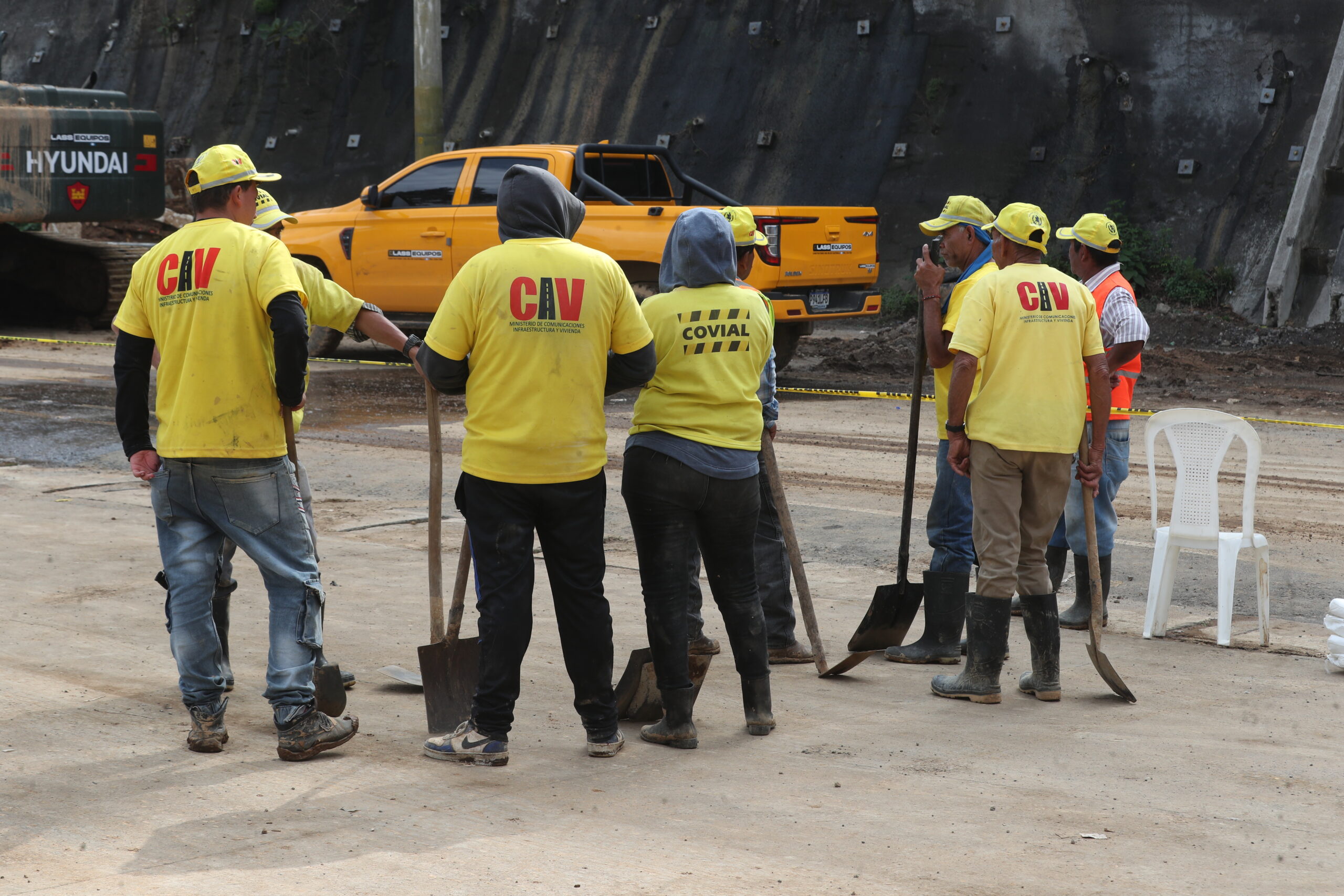
The Executive Agency has reactivated several road projects that are part of the infrastructure plan by the Ministry of Communications, Infrastructure and Housing (CIV).
On June 3, President Bernardo Arévalo visited Huehuetenango, where he participated in the inspection of several of these works, which, as he indicated, “are important to improve connectivity, bring services closer and generate better development conditions for the population.”
That day, work was inaugurated on the section that connects the Calel village, San Carlos Sija, Quetzaltenango, with the Pologuá village in Momostenango, Totonicapán, a project authorized in 2020, according to the National Public Investment System (SNIP).
Both President Arévalo and the authorities of the Communications Ministry stated on that occasion that These works are being promoted in Huehuetenango, since it is “a key department for the country”due to its border location with Mexico, as well as the “territorial diversity” it has and which is conducive to carrying out commercial, agricultural and productive activities.
Executive sources confirmed that During this year the Government will give priority to the recovery of the country’s roadsso in the coming months the president will promote several road projects in other departments.
Projects from past administrations
In Huehuetenango the Ministry of Communications executes seven road projects. The works were approved by previous government administrations.
According to the SNIPthe project identified as RN-09 North, 25.58 kilometers, Santa Cruz Barillas-Río Espíritu —which is part of the plan recently announced by the president— has code 190120 for the construction of the Santa Cruz Barillas-Río Espíritu section and its execution was approved in November 2016.
Another project that has been reactivated by the Government is the one identified as RN-09 North for the replacement of that highway in the RD-Hue-2-Piedras Captsin bifurcation section, Huehuetenango, which was approved for execution in August 2017 and has the SNIP code 209047.
The Executive also announced project work to improve the highway, RD-Hue-04 bifurcation section, from San Miguel Acatán to San Sebastián Coatán, identified with number 245285 in the SNIP and approved in August 2019.
The other projects that are part of the portfolio activated by the Executive and that have been identified in the SNIP are:
- Improvement of the RD-Hue-03 highway, section from the Santa Eulalia village to San Sebastián Coatán, code 245284, approved in 2019.
- Improvement of the road of the Todos Santos Cuchumatán-aldea San Martín section, Concepción Huista, code 209133, approved in 2018.
- Improvement of the RN-7W highway, Cuilco-Tectitán section, code 209139, approved in 2018.
- Construction of highway route RD-Hue-11, bifurcation section CA-01-Santa Bárbara, code 317620. This is the most recent, since it was approved for execution in June 2023.
The Minister of Communications, Norma Zea, stated during the visit to Huehuetenango that these and the other works contained in the Road Infrastructure Plan for the department of Huehuetenango 2026 have been entrusted by President Bernardo Arévalo, since the roads of the department, “historically”, have been forgotten.
“We are aware that there is a lot of work to be done to build our road infrastructure. The president has entrusted us with this work and, above all, connect the populations that have historically been abandoned with the main roads, knowing that Guatemala continues to be a highly agricultural country,” said the Minister of Communications, Norma Zea, who together with the president visited and inspected the work being carried out at the beginning of June.
In addition to the reactivation of these projects, which are in charge of the General Directorate of Roads, there are six more projects in the study phase. 14 maintenance projects contained in Covial’s Ordinary Maintenance Plan corresponding to 2025 are also being executed and another 14 projects scheduled in the Maintenance Plan for 2026 will be executed. The latter were contracted under provisions of the Priority Infrastructure Law. All of these projects are aimed at developing during this year in Huehuetenango.
Drag projects and few results
In the opinion of Cristhians Castillo, analyst at the Institute for Analysis and Research of National Problems of the University of San Carlos of Guatemala (Ipnusac), The current administration has given priority to the payment of contracting companies for hauling projectseven some that come from previous governments, which reveals the allocation of resources towards inherited commitments instead of focusing on current projects.
“There has been a lot of criticism of how payment for old works has been handled, how priority has been given to complying with payments to companies that come with projects, including those that were delivered during the government of the National Unity of Hope.”
The expert indicates that, in addition to this situation, The climate factor in the national territory is critical and requires immediate actions throughout the country to prevent further damage to the road network. He also considers that the current administration has not shown the ability to deliver results in this area in the short term.
“It is urgent to address the complex situation of deterioration that exists in the road portfolio or in the country’s strategic infrastructure, taking into account that we are already entering the rainy season of the year. The current administration does not have the capacity or has not found the route to have actions that give results in the very short term,” he assures.
The position of the Secretariat of Social Communication of the Presidency was requested to find out the reasons why the Government has given priority to the reactivation of towing projects for their execution in Huehuetenango, but at the closing of this note no response had been given.